

How to Publish a Research Paper
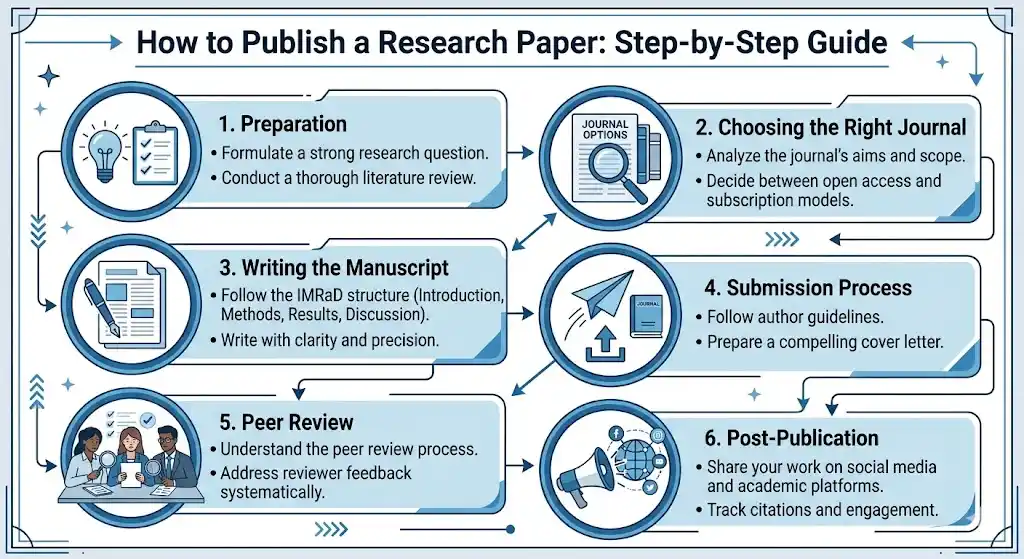
Table of Contents
- How to Publish a Research Paper: A Step-by-Step Guide
- Why Publishing Your Research Matters
- Step 1: Choose the Right Journal Before You Write
- How to Evaluate a Target Journal
- Open Access vs. Subscription Publishing
- Step 2: Write a High-Quality Manuscript
- The IMRAD Structure
- Crafting a Compelling Title and Abstract
- Step 3: Master the Submission Process
- Write an Effective Cover Letter
- Final Checks Before Submission
- Step 4: Navigate the Peer Review Process
- How to Handle Revisions
- Step 5: Overcome Common Publishing Challenges
- Dealing with Rejection
- Avoiding Plagiarism and Self-Plagiarism
- Step 6: Post-Publication and Maximizing Impact
- Need Help Getting Published?
How to Publish a Research Paper: A Step-by-Step Guide
You’ve just spent months, perhaps even years, conducting extensive research. You’ve gathered your data, reviewed your results, and made a groundbreaking discovery. Now, you’re faced with your greatest challenge: sharing your discovery with the world.
Discovering how to publish a research paper can be overwhelming, especially if you’re new to academic writing. There is a process, a journey, between creating a blank document and having your paper published in a respected, peer-reviewed journal.
But if you’re aware of how academic publishing works, you’ll not only eliminate any mystery, you’ll also greatly increase your chances of getting published. Here, you’ll find exactly what you need to do to get your research published. We’ll take you through every step, from choosing the right journal to surviving peer review, and even increasing your paper’s impact.
Why Publishing Your Research Matters
Before we get into the steps, we must understand the importance of going through the tedious process. Publishing your research is more than just adding another line to your resume.
- It can advance the field: Your research could be what others build on to create a breakthrough.
- It can build your credibility: Publishing in a peer-reviewed journal can get you seen as an expert.
- It can lead to opportunities: A good publication record can get you grants, promotions, and jobs.
Let us get into the steps of getting your manuscript published.
Step 1: Choose the Right Journal Before You Write
It is a common mistake for researchers to write their paper first and then search for an appropriate journal. You should select your target journal before you start writing. This is because you can design your paper in a way that meets the requirements of that journal.
How to Evaluate a Target Journal
When compiling your list of potential journals, it is important to consider the following factors with regards to each journal:
- Aims and Scope: Does your research question align with the journal’s aim and scope? Be sure to read the journal’s “About Us” section.
- Target Audience: Who reads this journal? Be sure your topic will interest their specific audience.
- Impact Factor: This is the average number of citations an article in the journal is expected to have. Although a higher impact factor is desirable, it is also important to consider whether the journal is a good fit for your work.
- Publishing Model: Do you want to publish in an open-access journal or a subscription journal?
Open Access vs. Subscription Publishing
It is important to understand your publishing model as part of this process. Here is a brief summary:
| Feature | Open Access | Subscription |
|---|---|---|
| Cost to Author | Often requires an Article Processing Charge (APC) | Usually free for the author |
| Access for Readers | Free to read and download for anyone | Requires a paid subscription or institutional access |
| Visibility | Generally higher reach and citation rates | Limited to subscribers |
| Copyright | Author usually retains copyright | Author transfers copyright to the publisher |
Tip: Many institutions offer grants to cover the fees associated with Open Access publishing. Don’t dismiss this option without asking first!:
Step 2: Write a High-Quality Manuscript
Next, you need to choose your journal, after which you need to read the “Guidelines for Authors.” The guidelines will determine the word count, referencing style, and formatting style for your paper. The worst thing you can do is ignore the guidelines, as this is the quickest way to ensure your paper is rejected.
The IMRAD Structure
Scientific and academic papers are written using the IMRAD structure. The structure helps you arrange your thoughts logically.
- Introduction: Define the domain of the problem. What is the particular research query? Explain the significance of the topic, as well as your hypothesis.
- Methods: Ensure you offer enough details so that your experiment can be replicated by someone else. Be sure to list your materials, subjects, and analytical frameworks.
- Results: Only use facts in your paper. Explain your experimental outcomes using plain text, tables, and diagrams. Avoid interpretation in the results section.
- And Discussion: In this section, you are expected to discuss your findings. How does your paper contribute to the particular subject? Be sure to point out the weaknesses in your paper as well as your suggestions for future studies
Creating an Engaging Title and Abstract
The title and abstract of your paper are the most important sections. They are the first thing that the reader will read and help the reader decide if the rest of the paper is worth reading.
A title should be brief and descriptive. It should include the major keywords associated with your research. The abstract of your paper should be a standalone piece of your entire paper. It should include your research question, methodology, major findings, and conclusions in fewer than 250 words.
Step 3: Master the Submission Process
However, it is more involved than just a simple button click. You must prepare a complete submission package.
Write an Effective Cover Letter
Your cover letter is an opportunity for you to introduce your manuscript to the journal editor. Do not repeat what is already in your abstract. This is an opportunity for you to explain exactly why your research is a perfect fit for their journal.
Emphasize the originality of your research and how it contributes to the current academic discourse. Keep it professional, concise, and one-page only.
Final Checks Before Submission
Before you submit, let’s go through a quick list:
- Did you format your citations correctly?
- Are all co-authors listed with their correct affiliations?
- Have you secured ethical approvals (IRB) if your study involved human or animal subjects?
- Did you declare any potential conflicts of interest?
Step 4: Navigate the Peer Review Process
Next, after you submit your paper, the editor will perform an initial screening. Once your paper passes the initial screening, the peer review process begins. In this step, experts in your field assess your paper’s methodology, originality, and significance.
It may take several weeks or several months before you receive one of the following four possible outcomes from the journal:
- Accept without changes: This is extremely rare, so you should be very happy.
- Accept with minor revisions: In this case, you are expected to make minor changes in your paper, such as changes in the format.
- Revise and resubmit (Major revisions): The reviewers like your paper, but they want you to make significant changes, such as performing new experiments.
- Reject: The journal does not want your paper.
How to Handle Revisions
If you are told that you need to revise your paper, don’t be disheartened. It is just a part of the process on how to publish a research paper.
Carefully peruse the comments of the reviewers. When you resubmit your paper, you are expected to include a document called “response to reviewers.” You need to tackle all the comments point by point. If you agree with the suggested changes, you need to indicate the changes you made in your paper. If you don’t agree with the suggested changes, you need to give a reason for your decision.
Step 5: Overcome Common Publishing Challenges
The path to publication is seldom smooth. You must prepare yourself for a few common challenges
Dealing with Rejection
All accomplished researchers have experienced rejection. If an editor rejects your paper, try to read the rejection objectively. Allow yourself time to feel disappointed for a day. Then resume your research.
Try to use the criticisms of the reviewers to improve your paper. After revising your paper, submit it to the next journal on your list. Do not allow rejection to discourage you from sharing your research.
Avoidance of Plagiarism and Self-Plagiarism
Originality is a non-negotiable aspect in academic publishing. Always be sure to give proper credit to sources.
New writers often commit “self-plagiarism” by accident, by copying large sections from previous published works. Journals use software such as Turnitin and iThenticate to detect this. If they spot high similarity indices in your submission, your paper will be rejected straight away. Always produce new content for a new submission.
Step 6: Post-Publication and Maximizing Impact
Hurray! The journal has accepted your paper! Now, after it passes through the final stages of proofreading, it will be published. However, there is still a lot of work to be done.
You must actively promote your paper so that it reaches a maximum audience and receives due credit.|
You can do this by:
- Sharing it on academic networks: Upload an abstract along with a link to your paper on ResearchGate and Academia.edu.
- Using social media to your advantage: Write a summary of your paper and share it on LinkedIn or X.
- Updating your profile: Update your webpage at your university or lab with this new publication.
- Monitoring your paper’s performance: Keep a close eye on the number of views, downloads, and citations to measure the impact of your paper.
Need Help Getting Published?
Knowing how to publish a research paper is one thing, but executing all these steps to perfection is quite another. Between managing intricate rules of paper formatting, perfecting your use of the English language, and navigating peer review, this process requires a tremendous amount of time, effort, and energy.
But if you wish to increase your chances of getting published, you don’t have to go through this process alone. At Idealaunch, our academic support services are available to help you perfect your manuscript even before you hit submit.
Whether you need extensive manuscript editing, precise manuscript formatting according to your desired journal, or even help with writing a compelling cover letter, these experts bridge the gap between your manuscript draft and published article.
So, focus your time and energy on what you do best: conducting incredible research! Leave all the intricacies of the publishing process to the experts. Begin preparing your manuscript today, and take your first step towards leaving a lasting impact in your chosen field!