

How to Publish a Research Paper
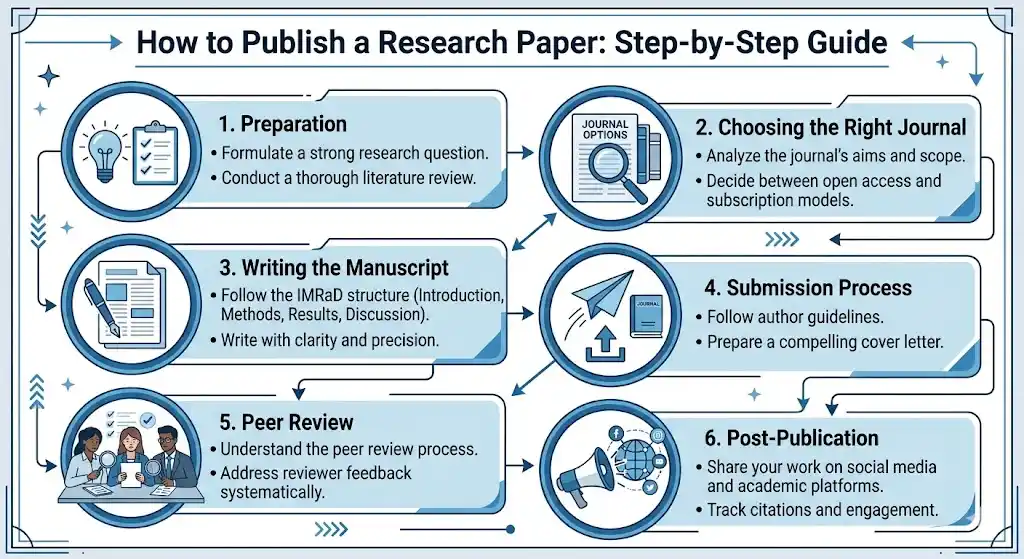
Table of Contents
How to Publish a Research Paper: A Step-by-Step Guide
Publication of a research article in any field of study or practice is one of the most fulfilling achievements in anyone’s career. As a student, professor, or independent researcher, you will be making your contribution to the world of scientific information. However, this procedure may appear confusing at times, especially during the first try. This article will provide all the steps, from preparing the manuscript to seeing your name in the publication.
Why Publishing Your Research Matters
Before we get into the steps, we must understand the importance of going through the various process. Publishing your research is more than just adding another line to your resume.
- It can advance the field: Your research could be what others build on to create a breakthrough.
- It can build your credibility: Publishing in a peer-reviewed journal can get you seen as an expert.
- It can lead to opportunities: A good publication record can get you grants, promotions, and jobs.
Let us get into the steps of getting your manuscript published.
Step 1: Identify the Characteristics of a Publishable Research Paper
Before writing, consider whether the research possesses all the features that journals deem important.
Originality – The paper should bring some novelty either by presenting the results of new research or introducing a new method or approach to solving an issue.
Significant – It should have an impact on the development of the field. You should ask yourself, “Does this paper help solve an existing problem?”
Reliability – The methods used to obtain results should be clear enough for another researcher to carry out the same experiment and check your conclusions.
Accuracy – All the information mentioned should be taken from reliable sources
Before you start writing, read about 10–15 publications from your targeted journal.
Step 2: Selecting the Appropriate Journal/Conference
The choice of journal/conference is as important as conducting good research because a submission to the wrong journal can waste time and result in rejection.
Types of Journals:
1) High-impact journals like Nature, Science, IEEE journals, etc. are difficult to publish, have a broad readership, take a long time to get reviewed, and are appropriate for revolutionary discoveries.
2) Specialist journals that focus on a particular subject have their target audience and usually have higher acceptance ratios for relevant papers.
3) Open Access journals, including PLOS ONE and Frontiers, whose papers are available free online, have global reach, but some of them require an Article Processing Charge (APC).
4) Conference proceedings are ideal for immediate publication and networking opportunities.
Selecting a journal or a conference:
Tools like Journal Finder (Elsevier), Journal Suggester by Springer, and Scimago could help you in finding relevant journals. Before submitting, always ensure that it is listed in Scopus, Web of Science, and UGC CARE.
Note : Avoid Predatory Journals! Predatory journals take money from you and publish without any real peer review process. Your reputation may get affected because of this. You can use Beall’s list or DOAJ for checking this.
Step 3: Proper Manuscript Format
Research papers are generally written according to the IMRaD format. Ensure that you follow the same format unless there are any other instructions given by the journal.
1) Title: Make it short, clear, and keyword-rich. Do not use too much technical language. The title must convey the essence of the paper.
2) Abstract: This 150 – 300 word summary highlights the problem you addressed, your methodology, results, and conclusion. Sometimes, the abstract may be all the editor looks at before sending your paper for peer review!
3) Introduction: This section gives some information on the topic, mentions the gap in current literature, and states your objectives and hypothesis.
4) Methods: In this section, you describe how you carried out your research—your methods, data source, tools used, data collection instruments, etc.
5) Results: Present your results in an unbiased manner. Support them using graphs, charts, and figures but do not discuss them at this stage.
6) Discussion: Analyze the results obtained in the light of existing knowledge. Highlight possible limitations and discuss what your findings contribute to the field.
7) Conclusion: Highlight the major findings from your study and its implications. Give suggestions for future research.
8) References As per the required citation style of the journal – APA, MLA, Vancouver, Chicago, or IEEE style.
Step 4: Writing Your Paper Effectively
Your academic paper should be clear, objective, and readable. Consider the following tips for effective writing:
- Your academic paper should be clear, objective, and readable. Consider the following tips for effective writing:
- Use an active voice whenever possible. Example: “We analyzed the data.” Instead of saying, “the data was analyzed.”
- Always provide definitions for abbreviations that you have used in the text.
- Have one point per paragraph.
- Check your document for plagiarism on Turnitin or iThenticate before submission.
- Get feedback from your coauthor, advisor, or more experienced peer before submission.
- Write the Introduction and Discussion based on the Methods and Results sections, which are more factual.
Step 5: Overcome Common Publishing Challenges
All journals have an electronic submission site such as Editorial Manager or Manuscript Central, or even their own website. Here’s what you need before you submit:
- Cover letter – Explain briefly what contribution your paper makes and why it is a good match for the target journal. It should be written in 3 to 4 paragraphs.
- Manuscript file – Your paper should be formatted in line with the journal guidelines and saved in a .docx or .pdf file.
- Figures and tables—Some journals submit these documents separately.
- Recommended reviewers – 2 to 3 potential referees are required by many journals. You can provide suggestions, but this step is optional.
- Ethical statements – Ethical approval, conflict of interest, and sources of funding statements are required if applicable.
Your cover letter will help you create a positive impression on the editor of the journal. Make sure that you clearly describe your contributions to the field and justify your choice of journal.
Step 6: Navigating the Peer Review Process
Once your manuscript is submitted, it undergoes two rounds of evaluation. In the first round, the editor evaluates whether your paper is within the journal’s scope and meets its criteria. If it passes, it is then forwarded to two or three expert referees for peer review. This entire process may take between 4 and 12 weeks.
Possible outcomes:
- Accept – It is not very common for a first-time submission. Good luck if this result is what you get.
- Minor revision – This means small changes need to be made, which is a positive thing.
- Major revision – Changes will need to be made so that your paper can be reconsidered.
- Reject and revise & resubmit – Big changes are required, and your paper is treated as a new submission.
- Reject – the paper fails to match the scope or requirements of the journal.
Step 7: Dealing With Revisions and Resubmissions
Getting feedback about revision is a common thing for a researcher. Always treat feedback from reviewers as a chance to improve your paper.
- Write an answering letter addressing each review individually.
- Use a table with three columns: Comment made by the reviewer | Your reply to this comment | What was changed in the paper in order to meet the comment.
- Make all revisions clearly visible in the text; highlight them or use the Track Changes option.
- Be respectful of the reviewer, regardless of whether you agree with him/her or not. You may argue, but support everything with relevant evidence.
In case your paper gets rejected, never lose hope, because most published articles have been rejected at least once. Make modifications and resubmit it to another journal from your list.
Step 8: After Acceptance – What’s Next?
Once your article is accepted, it moves into the publication process. This is how it will go down:
- Proofreading – The journal will send you a typeset version of your paper. Take note of any mistakes regarding formatting and typography before giving approval.
- Assignment of DOI – This phase is when a Digital Object Identifier is assigned to your paper, which gives it permanence.
- Online first/early access – Some journals make accepted papers available online ahead of time before publishing them in print.
- Promotion of your paper – Promote your paper via platforms such as ResearchGate, Academia.edu, LinkedIn, and Google Scholar. This includes:
- Mentioning the findings in your blogs and webinar presentations to reach out to a larger non-academic audience
- Posting the link of the research paper on various relevant groups or forums online
- Having some quick discussions about the findings via LinkedIn posts and threads
- Updating your records – Make sure that the new publication appears in your CV and on your ORCID or institutional page.
Step 9: Mistakes to Avoid When Submitting a Paper to Journals
Submitting the same manuscript to several journals simultaneously unless permitted by the journal.
- Ignore the guidelines given by the journal. A lot of journals will reject an article simply because it fails to meet the formatting standards required.
- Preparing a poor abstract since many editors base their first impression on the abstract.
- Mentioning claims without substantial evidence to back them.
- Submitting papers to predatory journals that lower your professional standing.
- Not declaring any conflicts of interest with funding agencies.
- Forgetting to check for grammatical errors in the language.
Need Help Getting Published?
Knowing how to publish a research paper is one thing, but executing all these steps to perfection is quite another. Between managing intricate rules of paper formatting, perfecting your use of the English language, and navigating peer review, this process requires a tremendous amount of time, effort, and energy.
But if you wish to increase your chances of getting published, you don’t have to go through this process alone. At Idealaunch, our academic support services are available to help you perfect your manuscript even before you hit submit.
Whether you need extensive manuscript editing, precise manuscript formatting according to your desired journal, or even help with writing a compelling cover letter, these experts bridge the gap between your manuscript draft and published article.
So, focus your time and energy on what you do best: conducting incredible research! Leave all the intricacies of the publishing process to the experts. Begin preparing your manuscript today, and take your first step towards leaving a lasting impact in your chosen field!