

How to Write a Term Paper, A Complete Step-by-Step Guide 2026
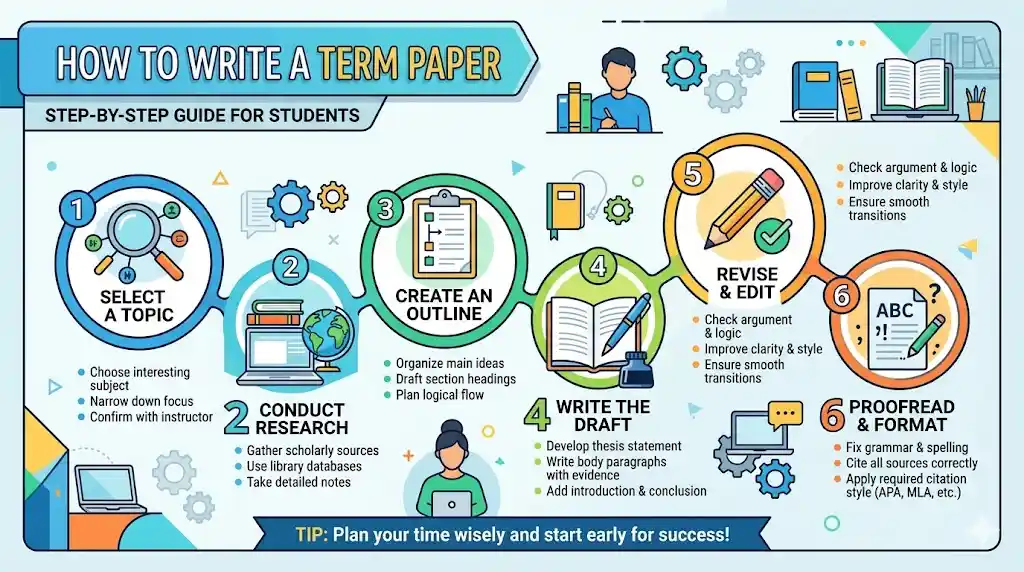
How to Write a Term Paper: A Complete Step-by-Step Guide for Graduate Students
Every semester, thousands of graduate students sit in front of a blank document with the same question echoing in their minds: Where do I start?
A term paper is more than just another paper. For Ph.D. scholars and Master’s students, it is the ultimate litmus test of your “scholarly identity” – your capacity to synthesize complex research, create a defendable argument, and articulate it with precision. Your term paper, if executed well, could be the key to unlocking publication opportunities, professorial recognition, and improved dissertation chapters.
If executed poorly, however, it could mean wasting weeks of your life.
This guide is designed to lead you through every step of the term paper process – from choosing a research-based paper to submitting your final draft. Whether this is your first term paper or your fifteenth, the process outlined here will enable you to be more effective and productive.
What is a Term Paper?
A term paper is an in-depth, research-based academic document written at the conclusion of a term or semester. It is usually worth a substantial percentage of the final grade in any academic course. A term paper involves original analysis, synthesis of previous knowledge, and logical argumentation around an argument or claim encapsulated in a thesis statement.
While an essay or journal is simply an academic write-up, a term paper is more than that. A term paper requires:
- Conducting independent research using credible academic sources
- An arguable thesis statement
- Logical argumentation
- Use of a particular academic citation style (APA, MLA, Chicago, etc.)
- Formal academic writing conventions
Length of Term Papers: Most graduate-level term papers vary in length from 10 pages to 25 pages.
Why Term Papers Matter in Graduate Education
Term papers in graduate-level programs, whether Master’s or PhD, are not simply tests of memory. They are preparation for the kinds of thoughts and reasoning that will be required throughout your graduate and professional life.
Here’s what is actually developed through a successful term paper:
- Disciplinary Knowledge: The in-depth reading and understanding of literature in your discipline will lay the groundwork for your thesis or dissertation.
- Argumentation: The ability to develop and defend an argument is essential for publishing in journals and conferences, as well as for committee work.
- Research Acumen: The ability to work with databases and synthesize information is something that will be looked for in graduate students and professionals.
- Academic Voice: The more term papers you write, the better your academic writing will be.
Term papers are not obstacles; they are opportunities.
Step-by-Step Guide to Writing a Term Paper
Step 1: Choose the Right Topic
Topic selection is where most students either set themselves up for success or silently condemn themselves to frustration.
What makes a good term paper topic?
- Is it specific enough to be managed within the page limit?
- Does it have sufficient scholarly literature to support a research-based argument?
- Does it relate to the central themes of your course or your broader research interests?
- Does it have a genuine question at its core, rather than a subject or a field of study?
Example of a weak vs. strong topic:
| Weak Topic | Strong Topic |
|---|---|
| Climate change | The role of carbon pricing mechanisms in reducing industrial emissions in the EU, 2010–2023 |
| Social media | Instagram's influence on body image perception among female university students in South Asia |
The stronger form indicates scope, perspective, and a research question. Start there.
Practical tip: If your institution permits topic selection, survey 3-4 recent issues of the first journal in your field that is generally recognized as first-rate. The gaps and debates you see there may be more promising than your own familiar topics.
Step 2: Conduct Targeted Research.
Research is not simply Googling your topic. In grad school, your source quality is an indication of your academic commitment. Where to find credible academic sources:
| Platform | Description |
|---|---|
| Google Scholar | Free, wide, and good for citation tracking |
| JSTOR, Scopus, Web of Science | Peer-reviewed journals across disciplines |
| PubMed | Essential for health, life sciences, medicine |
| Institutional Library Database | Often includes sources not found elsewhere |
Research strategy for term papers:
- Begin with 2-3 foundational sources (books or original papers), which provide an overview of the area.
- Explore the ‘cited by’ feature of sources to find more recent sources that have cited the sources.
- Maintain a reference log from the beginning of your project. It is essential to record all the details of sources as you go along, and not wait until later.
- Take down notes while reading each source, which include the argument of the source, the evidence used, and its connection to your thesis.
Note on the quality of sources:
Wikipedia is only to be used to get an overview of the area and not as a source.
Step 3: Create a Strong Thesis Statement
The backbone of your entire paper, your thesis statement, is what all the rest of your work revolves around.
For your term paper, your strong thesis statement should have three key components:
- It should make a specific claim (not a general fact or observation)
- It should announce your analytical approach to the topic
- It should hint at the way your argument is structured
| Type | Thesis Statement |
|---|---|
| Weak | Social media has altered the way young people interact with each other. |
| Strong | The emphasis on emotionally charged media content by the algorithms of various prominent social media outlets has contributed to an increase in political polarization among 18- to 34-year-olds, as demonstrated by three separate longitudinal studies conducted between 2017–2022. |
Notice the difference: the strong version is specific, debatable, and points toward what the paper will actually prove.
Step 4: Create a Detailed Outline
An outline is not something you do if you feel like it. An outline is something you must do. It is the blueprint for your paper. Without an outline, your paper is like a building without a plan. You might build something, but it won’t be straight.
| Section | Description |
|---|---|
| Title Page | Includes the title of the paper, author name, institution, and date |
| Abstract (150–250 words) | A brief summary of the research problem, methodology, key findings, and conclusions |
| Introduction | Hook, background, research problem, and thesis statement |
| Literature Review | Overview of existing scholarship and identification of research gaps |
| Main Body | Your argument developed across 2–4 sections, each with a clear sub-claim |
| Discussion | Analysis of findings and their implications |
| Conclusion | Synthesis of key points, limitations, and future research directions |
| References | List of all sources cited in the paper |
| Appendices (if applicable) | Supplementary materials such as data, charts, or additional documents |
When creating your outline, give each part of your paper a tentative page count. This way, you do not spend five pages on your introduction and only two paragraphs on your analysis.
Step 5: Write the First Draft
The hardest part is starting. The best advice any academic with experience can offer is to write badly.
Your first draft is a thinking draft, not a polishing draft. It is meant to get your ideas down on the page.
Practical writing tips:
- Write your introduction last, or at least again, after you’ve finished the body. You will understand your argument by then.
- Write in focused blocks, 45 to 60 minutes. Quality is more important than quantity.
- Use placeholder citations, [CITE], if you need to look something up but don’t want to break your train of thought.
- Have your outline visible to you as you write. It prevents you from going off-topic.
Some academic writing tips to remember:
- Use topic sentences to begin each paragraph.
- Every claim should have evidence, every quotation should have analysis.
- Try not to use the passive voice. “The study found” is better than “It was found by the study.”
Discipline-specific vocabulary is okay, but not jargon for its own sake.
Step 6: Revise, Edit, and Proofread
This is usually treated as one step by most students. However, there are actually three different activities involved in this single step.
- Revision is structural. Read your work and ask yourself: “Does the argument hang together? Is my thesis statement supported? Is the order of sections correct?”
- Editing is at the sentence level. “Is each sentence clear? Is my voice consistent? And have I cited everything I should have?”
- Finally, there is proofreading. “Spelling, grammar, punctuation, formatting. Run it through a spell checker, then read it again.”
- One trick for revising your work: Read your paper out loud. The places where you have trouble reading your work are the places your readers will have trouble reading your work.
Term Paper Format and Structure
The following are the most common academic formatting standards that you are likely to come across in your graduate studies.
Standard Term Paper Format
| Element | Guideline |
|---|---|
| Font | Times New Roman or Arial, 12pt |
| Line spacing | Double-spaced throughout |
| Margins | 1 inch on all sides |
| Page numbers | Top right or bottom center |
| Paragraph indent | 0.5 inches for APA/MLA |
| Abstract | Required at PhD level; 150–250 words |
| Title page | Required; format varies by citation style |
Citation Styles at a Glance
| Citation Style | Used In |
|---|---|
| APA (7th ed.) | Social sciences, psychology, education |
| MLA (9th ed.) | Humanities, literature, languages |
| Chicago/Turabian | History, philosophy, arts |
| IEEE | Engineering and computer science |
| Vancouver | Medicine and life sciences |
Common Mistakes to Avoid
Even seasoned graduate students can fall into these pitfalls. The first step to avoiding them is to be familiar with them.
- A thesis that is a topic, not an argument. “This paper will explore the relationship between poverty and education” is not a thesis. It is a summary of what you will be discussing. Your thesis will be a position.
- Ignoring the literature review. While in an undergraduate paper, a literature review is not always necessary, at a graduate level, it is. It will demonstrate that you know the field and that you have made a real contribution.
- Too much quoting, not enough analysis. Quotations will support your argument; they will not be your argument. For every quotation you include, you will need at least as much analysis.
- Leaving the bibliography until the end. The most common cause of grade reduction for graduate students is citation errors. Keep your reference list up throughout the writing process.
- Ignoring the assignment rubric. Your instructor’s grade criteria is really a blueprint for exactly what they want to “see” in your work. Read it before you write, before you are writing, and before you submit your work.
- Not having your work peer reviewed. Before you submit your work, have at least one other person, preferably in your field of study, read your work and give you feedback. What is obvious to you is not necessarily obvious to your reader.
Pro Tips from Academic Experts
After consulting academic advisors and researching top universities’ advice on how to approach term papers at a graduate level, several best practices emerged:
Work backwards from your due date. Set internal deadlines for your outline, draft, revision, and proofread. A 4-week paper should have at least 3 of those weeks planned out.
Read in layers. First, skim sources to make sure they are relevant. Next, read in-depth only those sources directly related to your argument. It is a time sink to read in-depth all the sources.
Create a “parking lot” document. If you have a great idea that doesn’t quite fit into your current section, add it to a separate document rather than forcing it into your current work. It may come in handy later.
Utilize the abstract as a planning tool. Write an abstract of 200 words before you begin to draft the paper. This will ensure that you have a clear argument. If you cannot summarize an argument in 200 words, you cannot be sure that you have a clear argument.
Think forward, not backward, in your conclusion. Don’t summarize what you have shown; point to what you still need to know. This is a mark of a mature scholarly approach.
Tools and Resources for Writing a Term Paper
| Tool | Purpose |
|---|---|
| Zotero / Mendeley | Reference management and citation generation |
| Google Scholar | Free academic source discovery |
| Grammarly / QuillBot | Grammar checking and sentence clarity |
| Hemingway Editor | Readability and sentence complexity analysis |
| Scrivener | Long-document writing and organizational tool |
| JSTOR / Scopus | Peer-reviewed journal access |
| Turnitin / iThenticate | Plagiarism and originality checking |
| Notion / Obsidian | Research notes and outline organization |
A word of caution with these AI tools: use them for brainstorming, outlining, or grammar checking, but don’t rely on them to write your argument. It is your academic voice and intellectual contribution that your professors will be grading.
Conclusion
One of the most important skills that you will learn in graduate school is how to craft a good term paper. The process of research and writing is exactly the same process that you will use in your dissertation chapters and articles throughout your career.
The students who succeed are not those who have the most knowledge. The students who succeed are those who are deliberate in their planning and writing and who are willing to revise and edit their work carefully.
So, if you want to know the secret to writing a good term paper, here it is:
Start with a good topic. Start with a good thesis. Follow the outline. Allow time for revision.
That is the secret to writing a good term paper – one deliberate step at a time.
Need Expert Academic Support?
If you are having a tough time in your current semester and need guidance on your research and writing process, or even formatting requirements, Ideal Launch is here to offer PhD students and graduate students the kind of academic writing support that is required for such high-level work.