

How to Write References for a Research Paper

How to Write References for a Research Paper: A Complete Guide
The problem with comments like “Please ensure that your referencing is consistent” is that it is very difficult to detect the problems caused by improper referencing. While it will likely not make the paper fail altogether, it will gradually destroy your credibility as far as other things you say go.
Proper referencing is more than bureaucracy. It is a record of your research process; an indication that you know what you are talking about and that you have looked into everything thoroughly. Bad referencing reflects badly on your credibility and leaves your reader wondering if maybe there is something else you messed up along the way.
This guide will take you step by step through the process of writing a proper reference: the reasoning behind it, various popular citation styles, actual formatting examples, and all the common mistakes you need to avoid.
Why References Are More Important Than You Think
Three things happen with a single reference:
It provides acknowledgement. Every time you use findings, theories, or methodologies from other studies, you are using the intellectual labor of others. Referencing it gives proper acknowledgment of that contribution.
It helps verify your claims. By citing a particular study in the process of proving an assertion, you need the readers to find that study and check its accuracy. This would become impossible if the references provided were incomplete or inaccurate.
It establishes your position in the field. The references at the end of the paper give reviewers a good picture of where your study sits intellectually speaking. Failure to cite relevant works within the field shows the reviewer that you don’t know much about it.
Two Components That Have to Be Done Right
1. The In-Text Citation
It refers to the brief signal that is placed in your text in case you mention the ideas of other authors. Depending on the style you choose, it may look as follows:
- (Watson & Crick, 1953) – author-date system in APA and Chicago author-date styles;
- (Watson and Crick 737) – author-page system in MLA;
- [1] – numbered system in IEEE and Vancouver styles.
2. The Reference List
It stands for the list of all sources you cite in your paper. All necessary details about each source will be included there in order for a reader to find it.
There is one rule common to all citation styles. In particular, there must be correspondence between an in-text citation and a reference list entry, and vice versa. If not, it will be viewed as an error, even more so if it is a year or surname that causes the discrepancy.
What Every Reference Must Include
Regardless of citation style, a complete reference answers four questions:
| Question | What to include | Common mistake |
|---|---|---|
| Who? | Author surname and initials (or full name depending on style) | Wrong order of surname vs. initials |
| When? | Year of formal publication — not the year you found it online | Using access year instead of publication year |
| What? | Article title, book title, or chapter title | Wrong capitalisation — sentence case vs. title case |
| Where? | Journal name, volume, issue, pages, and DOI | Omitting the DOI when it exists |
A note on DOIs: DOI (Digital Object Identifier) refers to a permanent and unique number used in identifying published information. As opposed to the URL, which may become broken at times, the DOI remains intact. In case there is an available DOI, it must be provided in full form as a web address in the following format: https://doi.org/10.xxxx/xxxxx
Understanding the Five Common Citation Styles
APA Style (7th Edition) – Social Science, Psychology, and Health
This style uses author-date referencing. APA in-text: (Watson & Crick, 1953). The reference list is alphabetically arranged and in sentence case.
Journal article: Watson, J. D., & Crick, F. H. C. (1953). Molecular structure of nucleic acids: A structure for deoxyribose nucleic acid. Nature, 171(4356), 737–738. https://doi.org/10.1038/171737a0
Book: Kuhn, T. S. (1962). The structure of scientific revolutions. University of Chicago Press
MLA (9th Edition) – Humanities, Literature, Languages
The MLA style uses the author-page system citation without mentioning the year: (Watson and Crick 737). This list should be titled as Works Cited and organized alphabetically.
Journal article: Watson, J. D., and F. H. C. Crick. “Molecular Structure of Nucleic Acids: A Structure for Deoxyribose Nucleic Acid.” Nature, vol. 171, no. 4356, 1953, pp. 737–738, https://doi.org/10.1038/171737a0.
Chicago Style (17th Edition) - History, Arts, Philosophy
Chicago provides two formats – make sure to select the correct one:
- Note-Bibliography format (NB): Used for humanities. The citation style is superscript numbers referring to the footnote. At the end, there is a bibliography.
- Author-date (AD): Used for scientific works. It is similar to APA: (Author Year).
Footnote (NB): ¹ James D. Watson and Francis H. C. Crick, “Molecular Structure of Nucleic Acids,” Nature 171, no. 4356 (1953): 737, https://doi.org/10.1038/171737a0.
Bibliography (NB): Watson, James D., and Francis H. C. Crick. “Molecular Structure of Nucleic Acids: A Structure for Deoxyribose Nucleic Acid.” Nature 171, no. 4356 (1953): 737–738. https://doi.org/10.1038/171737a0.
IEEE Style – Engineering, Computer Science & Electronics
For IEEE, authors cite using numerical systems according to order: [1], [2], [3]. The bibliography is in numerical order rather than alphabetical. Author initials precede the last name (J. D. Watson, not Watson, J. D.).
Journal article: [1] J. D. Watson and F. H. C. Crick, “Molecular structure of nucleic acids: A structure for deoxyribose nucleic acid,” Nature, vol. 171, no. 4356, pp. 737–738, Apr. 1953, doi: 10.1038/171737a0.
Vancouver — Medicine, Clinical Research, Biomedical Sciences
The Vancouver style employs numbered references according to their first appearance using the guidelines of NLM. Surnames followed by initials for author names; no separation marks in between (Watson JD).
Journal article:
- Watson JD, Crick FH. Molecular structure of nucleic acids: a structure for deoxyribose nucleic acid. Nature. 1953;171(4356):737–8. doi:10.1038/171737a0.
References Writing in Research Paper: A Step-by-Step Guide
References writing may seem confusing until broken down into steps. If you follow these six steps, referencing will never pose a problem for you anymore.
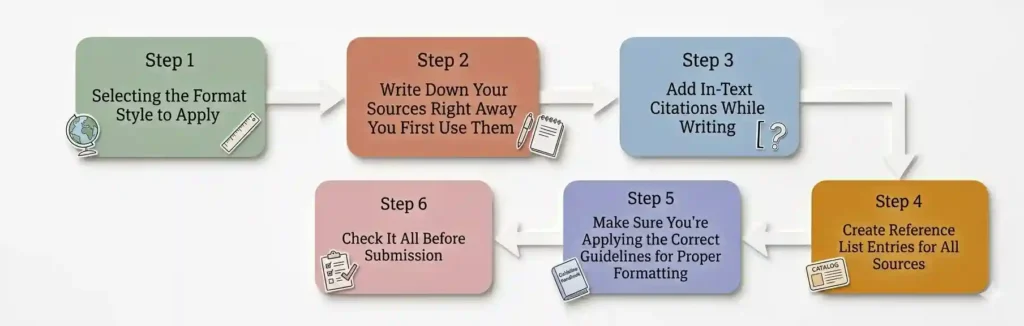
Step 1: Selecting the Format Style to Apply
Never start formatting references before finding out what format style should be used in your paper. This format style is not up to you — it depends on your institution or journal requirements.
Format styles that are frequently used:
- APA – psychology, social sciences, and health sciences
- MLA – literature, humanities, languages
- Chicago – history, arts, philosophy
- IEEE – engineering, computer science
- Vancouver – medicine, clinical/biomedical research
Keep in mind that, regardless of how hard it may be, you must always maintain one format style. This is probably one of the most frequent problems that editors encounter.
Step 2: Write Down Your Sources Right Away When You First Use Them
As soon as you read any paper or book and intend to reference it, make sure to capture this information:
- Full names of the authors – spelled accurately
- Publication year
- Title of the article or book
- Name of the journal, along with its volume number and pages
- DOI – write it down straight away without hoping for it later
- Name of the publishing company (in case of books)
Never wait until the end; do it when you are in the process of writing.That’s how you can save yourself from making referencing mistakes.
Step 3: Add In-Text Citations While Writing
Whenever you make an indirect citation, paraphrasing or summarizing someone else’s work, put your in-text citation right there. Don’t just add a footnote with the message “insert citation” and move on. You may forget what source you took that information from.
This varies depending on your citation format:
- APA / Chicago Author-Date Citation Format: (Watson & Crick, 1953)
- MLA Citation Format: (Watson and Crick 737)
- IEEE/Vancouver: [1] or superscript ¹
Another point where scholars sometimes find themselves surprised is that paraphrasing needs an in-text citation, too. Just changing how the idea is said does not mean you’ve come up with it yourself.
Step 4: Create Reference List Entries for All Sources
Create each reference list entry immediately after using an in-text citation. This task should not be saved till after you have completed the paper – at this point, you would be scrambling to locate pages and confirm DOIs.
Sample references in three styles:
APA: Watson, J. D., & Crick, F. H. C. (1953). Molecular structure of nucleic acids: A structure for deoxyribose nucleic acid. Nature, 171(4356), 737–738. https://doi.org/10.1038/171737a0
IEEE: [1] J. D. Watson and F. H. C. Crick, “Molecular structure of nucleic acids: A structure for deoxyribose nucleic acid,” Nature, vol. 171, no. 4356, pp. 737–738, Apr. 1953, doi: 10.1038/171737a0.
Vancouver:
- Watson JD, Crick FH. Molecular structure of nucleic acids: a structure for deoxyribose nucleic acid. Nature. 1953;171(4356):737–8. doi:10.1038/171737a0.
Step 5: Make Sure You’re Applying the Correct Guidelines for Proper Formatting
The attention to detail that makes a properly formatted bibliography shine, compared to an editor’s headache. The three most troublesome guidelines for proper formatting are:
Capitalization: APA and IEEE style capitalize all words in the title except for the articles ‘a’, ‘an ’, and ‘the’. MLA and Chicago capitalize all significant words in the title (including articles). It’s the number one mistake made when formatting bibliographies.
Arrangement of entries: APA, MLA and Chicago require the entries to be arranged alphabetically according to the author’s last name. IEEE and Vancouver require the entries to be arranged numerically according to how the citation was mentioned in the text.
Indentation: Every entry in a bibliography must have a hanging indent. The first line starts at the margin, following lines must be indented. To do this in Microsoft Word: Select all the references → Format → Paragraph → Special → Hanging → 1.27 cm.
Step 6: Check It All Before Submission
This step takes ten minutes and avoids having to do all those revisions that take days to make. Use this checklist before submitting:
Check that each source cited is listed on the reference list. All in-text citations must have corresponding entries on the reference list bearing identical author names and dates.
Make sure there are no orphan references. These arise when you cut paragraphs but neglect to remove the reference from your reference list.
Test every DOI link by clicking it. Make sure it links to the right paper. A DOI link that is dead or links to the wrong paper is considered a lack of integrity by peer reviewers.
It should maintain a consistent format style. For instance, when the specified format is APA, all sources used should be presented following the APA style format, regardless of their origin being some other style format.
The Capitalisation Rule That Stumps Just About Everybody
This is the format detail which even experience writers find tricky; hence, it gets a special mention in this lesson.
Sentence case refers to the rule where only the first letter of the sentence and proper nouns are capitalized: The structure of scientific revolutions, Molecular structure of nucleic acids: A structure for deoxyribose nucleic acid.
Note that the first word following the colon is also capitalized when using sentence case in APA format.
Title case refers to the practice of capitalizing almost all important words: The Structure of Scientific Revolutions, Molecular Structure of Nucleic Acids: A Structure for Deoxyribose Nucleic Acid.
| Style | Article titles | Book titles | Journal names |
|---|---|---|---|
| APA | Sentence case | Sentence case | Title case |
| MLA | Title case | Title case | Title case |
| Chicago | Title case | Title case | Title case |
| IEEE | Sentence case | Title case | Title case (abbreviated) |
| Vancouver | Sentence case | Title case | Abbreviated |
The "et al." Rules — Exactly When to Use Them
| Style | In-text: use "et al." from... | Reference list: truncate from... |
|---|---|---|
| APA 7th | 3 or more authors (always) | 21+ authors — list first 19, then "et al." |
| MLA 9th | 3 or more authors | 3 or more authors |
| Chicago (Author-Date) | 3 or more authors | 10 or more — list first 7 |
| IEEE | 7 or more authors | 7 or more authors |
| Vancouver | 7 or more authors | 7 or more authors |
Note that some journals impose their own thresholds on top of these base rules. Always verify with the author guidelines of your specific target journal.
The Most Frequent Referencing Errors
Referencing something you have not read yourself: Let’s say that you found Watson & Crick cited in some other author’s article. You are not allowed to use their paper in your referencing as you did not read it. Instead, you should state that you found Watson & Crick’s paper in Doe’s article from 2022.
Citation orphans: You have cited something in your bibliography that is not cited in your paper’s body. This happens if you accidentally cut a section from your paper without removing its citation.
Ghost Citations: In-text citation exists, but the complete reference is not included in the list of your references. This is the opposite of orphaned references and equally damaging.
DOI not verified: All the DOIs used must be valid and direct readers to the correct paper. Always verify your DOI by clicking on it before submitting.Mixed referencing styles. The referencing style within one paper must be consistent. Using references from other articles without formatting them into your desired style causes a mixed style.
Frequently Asked Questions
A reference list contains only the sources you cited in your paper. A bibliography may also include sources you consulted but didn't directly cite. Most scientific journals require a reference list. Always check the author guidelines.
Start the entry with the title of the work, then continue with date, source, and DOI. For the in-text citation, use a shortened version of the title. If the work belongs to an organisation, the organisation serves as the corporate author.
Most journals specify a maximum — typically 30 to 60 for original research articles. Beyond any imposed cap, cite what's genuinely relevant. Padding the reference list with tangential papers is transparent and weakens, not strengthens, your work.
Search CrossRef (crossref.org) using the article title and author name. For genuinely older papers without DOIs, follow your style's guidance — some require a URL, others allow you to omit the digital locator field.
Create Your References As You Go
The single best piece of advice is not to wait until the last minute.
Anytime that you cite something within your paper, make sure you immediately include the full reference in your list. That way, you won’t have to worry about forgetting one or having trouble locating the DOI at the last minute because by then, all you need to do is review the list.
In essence, referencing is a habit, not a problem. Scientists who know how to handle it aren’t putting any extra effort into that; referencing just happens together with their writing process.
Need Expert Academic Support?
If you find yourself struggling in your present semester and require assistance regarding your research paper and the entire process of writing it or even formatting it, Idea Launch is the place where we can provide Ph.D. and graduate students with the academic writing help needed at their level.