

Scopus Indexed Indian Journals
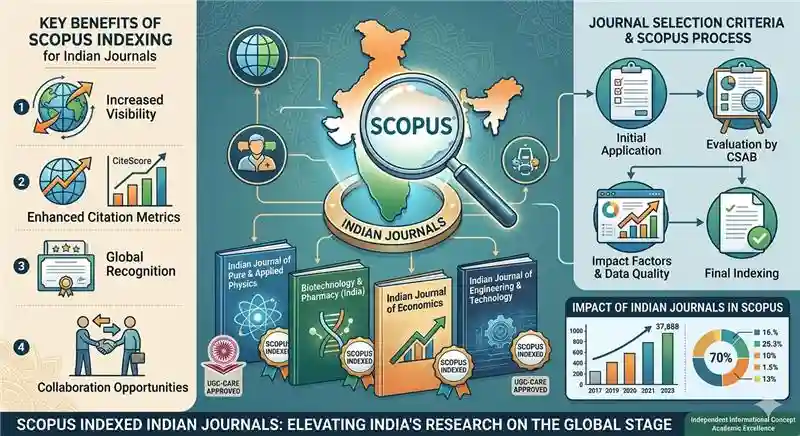
Table of Contents
What Is Scopus and Why Does It Matter in 2026?
How Scopus Decides What Gets Indexed
Scopus Metrics You Need to Know in 2026
Indian Scopus Scenario in 2026: What’s Changed Since 2023?
The ‘Quality vs Quantity’ problem — And Its Impact on Your Career
Predatory Journals Have Escalated Their Threat
New List of Indian Journals Indexed by Scopus (2026)
Scopus Vs UGC CARE vs Web of Science: What Matters In 2026?
How to Select the Right Indexed Indian Journal in Scopus? – A 2026 Guide
Step 1 – Check that the Journal is Currently Indexed (Mandatory)
Step 2 – Match Topic at the Sub-Level
Step 3 – Map Quartile to Readiness of Manuscript
Step 4 – Look at APC and Open Access Policy
Step 5 – Compare Turnaround Times to Your Deadlines
Common Mistakes Made by Indian Researchers in 2026
Relying on Old Lists
Mistaking ISSNs
Double Publishing (Self-Plagiarism)
Supporting Researchers Beyond Scopus Indexed Journals
IdeaLaunch offers comprehensive academic and research assistance to help scholars succeed throughout their research journey. Whether you’re preparing a manuscript, publishing in a Scopus-indexed journal, or completing your PhD research, our experts provide end-to-end support.
Expertise That Supports Your Research
- PhD Research Assistance
- Research Paper Writing Help
- Thesis & Dissertation Writing
- Manuscript Writing & Editing
- Scopus Journal Publication Support
- Literature Review Writing
- Research Methodology Assistance
- Statistical Data Analysis (SPSS, AMOS, SmartPLS)
- Plagiarism Checking & Proofreading
- Journal Submission & Reviewer Response Support
Scopus Indexed Indian Journals 2026: The Most Complete Guide for PhD Scholars & Researchers
Here’s what most blogs tend to overlook: from January 2020 to May 2025, India accounted for over 16 lakh research papers published in Scopus-indexed journals – the largest number of publications worldwide, exceeding even the USA, UK, and China. But at the same time, it is also important for every Indian researcher who is serious about their career development in 2026 to remember one thing: high-volume publishing is not always synonymous with influential publishing.
India is now ranked 3rd in the world in terms of total scientific output yet places somewhere in the middle in H-index – a measure of real scientific influence. But such an imbalance cannot be a cause of demotivation – it should, rather, highlight the importance of selecting the right journal, crafting an outstanding paper, and publishing strategically. And here comes the role of our guide.
This 2026 publication guide will provide any Indian researcher – be it a PhD student on the verge of submitting their dissertation or an independent academic looking to boost their international visibility – with all necessary information: up-to-date stats, journal list, indexing details, and more.
What Is Scopus and Why Does It Matter in 2026?
Scopus is an abstract and citation index database, which is controlled by Elsevier. It currently includes over 31,000 actively published peer-reviewed titles from all over the globe, in fields such as science, technology, medicine, social sciences, arts, and humanities. For Indian academics, Scopus is more than just a database.
University Grants Commission (UGC) accepts Scopus publications as one of the criteria for promotion, calculation of API scores, and assessing research productivity. NIRF, which is used to rank 674+ Indian institutions, directly uses the research score based on Scopus citations and publications for its ranking. All Indian Institute of Technology (IIT), central universities, and NAAC-accredited institutes insist upon at least one Scopus publication for PhD viva and grants from DST and fellowships.
Scopus in 2026: 143 sources were added between February 2023 and June 2025, out of which 57 additions occurred in June 2025. During this period, 335 journals were deleted due to quality violations. Always ensure the journal is active before submission.
How Scopus Decides What Gets Indexed
Only after a systematic review process conducted by the Content Selection and Advisory Board (CSAB) is a journal listed on the database. The review touches upon five major criteria:
- clarity in terms of journal aims, scope, and editors;
- high-quality peer review process and promptness;
- ethics in publishing;
- proper citation practice, which excludes manipulative behavior; and finally,
- regularity in issuing journals for at least two years.
Since there is such a thing as the discontinued status of a journal, it is crucial to find out about it each time you decide to submit your paper.
Scopus Metrics You Need to Know in 2026
CiteScore
Most common metric. Measures average citations per document published during the past four years. Better is higher. Replacement for the now-outdated concept of an Impact Factor on the Scopus platform.
SJR (SCImago Journal Rank)
Measures citation prestige, not number. A citation from a top-tier journal will count more than a citation from a Q4 journal, much like Google’s PageRank does.
Source Normalized Impact per Paper (SNIP)
Adjusts for impact by field. SNIP index of 1.0 means performance is on par with the average journal in that field.
Indian Scopus Scenario in 2026: What's Changed Since 2023?
Several fundamental changes in the Indian research publishing scenario post-2023 do not find mention in the competing document. This is what has changed:
The 'Quality vs Quantity' problem — And Its Impact on Your Career
Although in 2024, the country’s H-index stands at 925 — which is 71% lower than the U.S. H-index (3,213) — India has produced 3.3 million Scopus publications compared to 2023. Other nations, such as Australia and the Netherlands, which publish fewer documents, have higher H-indexes. The rationale behind it is that citations depend on the quality and journal selection of your work, not necessarily its sheer existence.
The implication of this for the researchers is that they should strategize their publications such that their papers will be published in relevant Indian journals indexed in Scopus. They will get more citations for their research when this is done compared to random publications.
Key Takeaway: The percentage of international collaboration among publications in India rose from 23% to 36%. Articles with an international editorial committee involved are likely to be cited more frequently. Consider the diversity of the audience and editors when selecting the appropriate journal for your publication.
Predatory Journals Have Escalated Their Threat
From 2020 to 2025, Scopus took down a total of 335 predatory journals in order to maintain the integrity of its database. It was revealed in a study carried out in 2024 that the pressure on academics to publish had compelled them to resort to plagiarism, fake data, and salami-slicing (breaking one paper into several).
Predatory journals have become adept at copying Scopus-indexed journals, even down to using similar ISSN numbers and journal titles. They collect APCs from researchers, perform no real peer review of articles, and claim they will provide acceptance decisions within days. Authors can suffer irreparable harm when such practices are uncovered by their university or a promotion panel.
New List of Indian Journals Indexed by Scopus (2026)
This list provides information about Scopus-indexed Indian journals in various fields. The Cite Score values are calculated according to the year 2024. Check if the journal is indexed currently from scopus using its ISSN number.
| Journal Name | Discipline | Publisher | Quartile | CiteScore | Access |
|---|---|---|---|---|---|
| Indian Journal of Medical Research | Medicine | ICMR | Q2 | 4.8 | Open |
| Journal of Earth System Science | Earth Sciences | Indian Academy of Sciences | Q2 | 3.1 | Open |
| Sādhanā – Engineering Sciences | Engineering | Springer India / IAS | Q2 | 2.9 | Hybrid |
| Economic and Political Weekly | Social Sciences | Sameeksha Trust | Q1 | 1.8 | Subscription |
| Indian Journal of Pharmaceutical Sciences | Pharmacy | IPA | Q2 | 3.4 | Open |
| Current Science | Multidisciplinary | Current Science Association | Q2 | 2.5 | Open |
| Journal of Biosciences | Life Sciences | Indian Academy of Sciences | Q2 | 4.2 | Hybrid |
| Bulletin of Materials Science | Materials Science | IAS / Springer | Q3 | 2.8 | Hybrid |
| Pramana – Journal of Physics | Physics | Indian Academy of Sciences | Q3 | 2.1 | Hybrid |
| Vikalpa: Journal for Decision Makers | Management | SAGE / IIM Ahmedabad | Q2 | 1.9 | Open |
| Indian Journal of Psychological Medicine | Psychiatry | SAGE / IPSB | Q2 | 3.6 | Open |
| Indian Journal of Pure & Applied Mathematics | Mathematics | Springer / INSA | Q3 | 1.6 | Hybrid |
| International Journal of Advances in Signal & Image Sciences | Engineering / CS | IJASIS | Q3 | 1.4 | Open |
| Journal of Orthopaedics | Orthopaedics | Elsevier India | Q2 | 2.3 | Open |
| Indian Journal of Chemistry Section A | Chemistry | NISCAIR-CSIR | Q3 | 1.7 | Open |
| Resonance | Science Education | Indian Academy of Sciences | Q4 | 0.9 | Open |
Note: Cite Score metrics are estimates and revised every year. The quartile ranking depends on the subject category ranking of the journal and not the Cite Score itself. For example, Q2 in the category of Medicine means a lot more than Q2 in other categories.
Scopus Vs UGC CARE vs Web of Science: What Matters In 2026?
One of the frequent questions that pops up in the mind of Indian researchers, particularly those struggling to cope with their promotion processes, is whether there is any difference between Scopus, UGC CARE, and Web of Science (Clarivate) journals with respect to their importance and practical utility. Below is the difference in perspective of 2026:
| Criteria | Scopus | UGC CARE | Web of Science |
|---|---|---|---|
| Global Recognition | ✔ Worldwide | ✔ India-only | ✔ Worldwide |
| Citation Tracking | ✔ CiteScore / SJR | ✖ Not tracked | ✔ Impact Factor |
| Journal Count (India) | ~533 active titles | ~37,000+ listed | ~120 Indian titles |
| Quality Threshold | High (CSAB review) | Variable | Very high (JCR) |
| Predatory Risk | Low – periodic audit | Moderate | Very low |
| UGC / NIRF Accepted | ✔ Yes | ✔ Yes | ✔ Yes |
| Open Access Options | ✔ Many OA journals | ✔ Many OA journals | Selective |
Conclusion: For almost all purposes, from PhD submissions to API points and even the NIRF ranking of institutions and DST and ICMR grants, an Indian Journal indexed in Scopus would suffice. However, when it comes to getting the most citations internationally, journals ranked Q1 in Web of Science are considered ideal but highly competitive.
How to Select the Right Indexed Indian Journal in Scopus? – A 2026 Guide
Most researchers select the right journal through general association with the journal. This guide is observational and practical.
Step 1 - Check that the Journal is Currently Indexed (Mandatory)
- First of all, go to scopus
- Use ISSN to search (NOT name — journal name could be spoofed)
- Check whether you see that “Coverage” for the journal shows “Active”
- Also ensure it includes a year which does not precede 2024 (that means the journal was already terminated)
- Do NOT trust the information on the journal’s own site
Step 2 - Match Topic at the Sub-Level
Any journal indexed in Scopus has its own aims and scope. Check the last five to ten papers published by reading their content rather than only checking the aims and scope of the journal. It may appear that your manuscript on machine learning algorithms used for diagnosing in healthcare has two themes: computer science and medicine. However, journals in both fields will review it from very different perspectives.
Step 3 - Map Quartile to Readiness of Manuscript
Manuscripts that belong to Q1 journals generally have an acceptance rate of less than 20%, require methodological novelty and international importance. Q2 journals are easily accessible but are equally strict– good choices for disciplinary contributions. If your manuscript is in early stages or related to a specific audience, Q3 and Q4 are better choices. Do not be too ambitious and aim high at the risk of wasting precious months on rejections.
Step 4 - Look at APC and Open Access Policy
There are increasing instances where universities in India and other funding agencies like SERB (Science and Engineering Research Board, DST) are demanding open access publication. Find out if the journal allows gold OA publication, how much the article processing charge is, and whether the APC lies within the scope of your budget. Many Indian Academy of Sciences journals have a free open-access option.
Step 5 – Compare Turnaround Times to Your Deadlines
Review processes can range from taking just 4 to 8 weeks to even 16 to 24 weeks for some Indian Scopus-indexed journals. Consider your PhD viva or promotion deadline, which will help you factor in an adequate time buffer. You may also find the average review process duration at the respective journals’ websites and then check this information with user reviews on Research Gate/Google Scholar forums
Common Mistakes Made by Indian Researchers in 2026
Here are some common mistakes made by Indian researchers that cost valuable time and credibility:
Relying on Old Lists
A list published prior to 2024 for Indian journals included in Scopus is risky since 335 journals have been excluded between 2020 and 2025. Use only live databases or other reliable sources.
Mistaking ISSNs
Predatory journals create very similar ISSNs to legit Scopus-indexed journals, often differing just by one number. Search for the ISSN both on Scopus sources and on portal.issn.org.
Double Publishing (Self-Plagiarism)
With the advent of Scopus indexing audit system and mandatory plagiarism screening by institutions, it is risky to submit any significant portion of previously published work without citing the source. It is especially true because all Scopus-indexed journals use iThenticate. Check that the similarity index of your paper does not exceed the journal’s limit (15-20%).
Failing to Respond to Reviewers’ Comments Appropriately
Revision and resubmission do not constitute rejection in disguise; it is your chance. Authors who make a cursory response to reviewers’ comments by answering only easy questions and ignoring more substantial criticism get rejected at last. The chances for acceptance are much higher if the author responds to all comments, whether agreed with or not.
From Research to Publication: Effective Professional Support You Need
It is one thing to understand what is required by the Indian journals indexed in Scopus. It is quite another thing altogether to develop a manuscript that will meet those requirements and get past the peer review stage successfully. Unfortunately, many researchers with excellent research skills find themselves struggling in the rejection loop, not due to their poor research but due to the manuscript development, journal selection, or even reviewer communication strategy.
Effective publication assistance makes the difference.
Our publication team at IdeaLaunch offers specialized services to help Indian PhD scholars, faculty, and independent researchers make their way into Scopus publications.
What We Offer – In Detail
- Journal Matching: Your manuscript will be matched against active Indian Scopus-indexed journals as per scope relevance, journal quartile, preference of the current journal editor, and your deadlines. Outdated journal lists are not recommended by us.
- Manuscript structuring: We will ensure that your work is structured in accordance with the format expected by Scopus-indexed journals’ editors, from abstracts all the way up to discussion sections.
- Language editing: Grammar corrections alone won’t cut it when you’re submitting to a prestigious journal. We edit manuscripts to native-level academic English standards.
- Plagiarism detection and removal: With our help, your manuscript will pass iThenticate checks without raising red flags. The similarity percentage will be within acceptable ranges for the journal.
- Cover letter composition: The cover letter must be convincing in order to ensure a positive initial assessment. Assuming that your research article merits the attention of our journal, we will guarantee that it receives the attention it deserves.
- Response letters: Once a revision and resubmission recommendation has been issued, rest assured that we will write an effective response to all reviewer comments.
Who We Work For: PhD students who are completing their thesis on time. Faculty members who are compiling their portfolios for promotion purposes, and first-time authors who are submitting papers to Scopus. Experienced researchers planning to publish in top Indian journals like Q1 and Q2.
Frequently Asked Questions
Approximately 533 active Indian journals are listed in the Scopus database at present. This number constantly changes because new journals keep being listed (143 since February 2023 until June 2025), and poorly performing or those that are involved in academic misconduct may be de-listed. Make sure you frequently update information about journals from the official Scopus site
They are both valid in India, but Scopus has more global prestige. UGC CARE list comprises 37,000+ journals with varying standards of quality assurance, whereas Scopus has fewer journals — 31,000+ — but with stringent evaluations based on the CSAB criteria. In terms of international visibility and citation analysis, Scopus is superior. However, a few institutions insist on dual listing in Scopus and UGC CARE.
Simply insert the ISSN number of the journal (not the title) in scopus.com/sources and confirm whether "active" is ticked with an ongoing coverage year. If there is any expiry date for the coverage prior to 2024, then it means that the journal is no longer functioning. It would only take two minutes.
The CiteScore benchmark varies across disciplines. For Medicine & Life Sciences, a CiteScore above 3.0 is acceptable. For Social Sciences & Management, a CiteScore above 1.5 is good. For Mathematics & Humanities, even a CiteScore of 0.8-1.2 could denote a highly regarded journal. The Quartile (Q1-Q4) measure is better than CiteScore for interdisciplines comparison.
Yes. There are service providers like IdeaLaunch that offer complete support for publishing in Scopus journals. From selecting a journal to developing the paper, from language editing and plagiarism check to reviewer response drafting. Having an expert publication team helps avoid rejections.
Conclusion: Strategic Publishing, Not Merely Regular Publishing
The volume of scholarly publications in India is rising rapidly compared to almost all countries in the world. The coming era in Indian academic research will be about publishing not only more but also better. Choosing the best Scopus-indexed journal in India, developing an internationally recognized quality manuscript, and creating a citation profile that truly represents your academic contribution – these are some of the practices that distinguish researchers who shape the agenda from those who just follow.
Utilize this guide as your future 2026 reference. Evaluate journals before submitting your work. Choose the correct publication venue for your manuscript. When the time comes to take action with the professional assistance of the IdeaLaunch team, we are here for you.
Need Expert Academic Support?
If you find yourself struggling in your present semester and require assistance regarding your research paper and the entire process of writing it or even formatting it, Idea Launch is the place where we can provide Ph.D. and graduate students with the academic writing help needed at their level.