

Sources of Literature Review in Research, Complete Guidance 2026
Smart Ways to Use Sources of Literature Review in Research
Most literature review papers do not succeed – not due to poor research methods, but due to using wrong sources. Your choice of sources makes all the difference. The approval of your supervisor, the success of your proposal, and the integrity of your research.
All covered in one comprehensive guide here.
Types of Sources of Literature Review in Research Explained
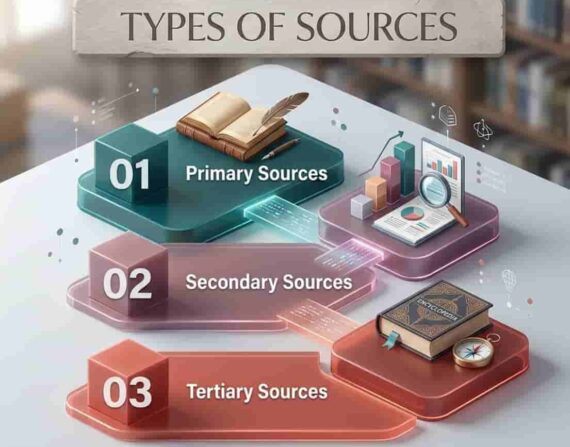
Sources differ in quality. Some sources fulfill different functions than others. Understanding this classification of sources is critical to begin your search process.
Category 1 – Primary Sources (Essential Evidence)
Primary sources represent original research. They are the real study itself. They are the very first time that something is reported. They represent an essential component of a literature review.
| Source Type | What It Is | Where to Find It |
|---|---|---|
| Peer-reviewed journals | The gold standard. Published in indexed journals after peer review | Scopus, Web of Science, PubMed, IEEE Xplore |
| PhD theses & dissertations | Exhaustive reviews – Often point you to sources you would never find otherwise | ProQuest, Shodhganga, EThOS (UK) |
| Conference papers | Essential for rapidly evolving domains such as engineering, CS, and AI | IEEE, ACM Digital Library, Springer |
| Government & institutional reports | Important for public policy, health and economics | WHO, RBI, NITI Aayog, Ministry of Education |
| Clinical trial registries & patents | For establishing novelty in the fields of medicine and engineering | ClinicalTrials.gov, Indian Patent Office, Google Patents |
Practical tip: If your literature review contains less than 60-70% primary sources, your advisor will know!
Category 2 – Secondary Sources (Interpretive)
Secondary sources include those which discuss, comment on, or summarize primary research results. This will save you time to figure out the pattern or theory without going through each source individually.
Examples of secondary sources include:
- Literature reviews and meta-analysis – they are also literature reviews that use formal methodology. If you find a strong literature review paper published in a reputable journal, then it might be worth considering twenty research papers in guiding your direction.
- Academic textbooks – useful for basic theories and principles, not for state-of-the-art research. Reference the first edition and see whether there is a later edition.
- Review papers – not a systematic review but an article written by a subject matter expert. Very helpful for MOFU research. Search for review articles via Google Scholar and Scopus filters (“review articles” box).
- Book chapters edited by editors – usually contain discipline-defining information. Routledge, Springer, and Sage have plenty of books in this category.
- The danger of using secondary sources: You may unintentionally adopt the perspective of the writer who has already written the literature review.
Category 3 – Tertiary Sources (Your Discovery Tools)
Tertiary sources are not usually used in your literature review because they are simply the means by which you discover primary and secondary sources. The researchers who don’t understand this difference waste countless hours trying to cite sources they shouldn’t.
Main Tertiary Sources and Their Appropriate Uses:
| Database | Best for | Free? |
|---|---|---|
| Google Scholar | Broad discovery, citation tracking | Yes |
| Scopus | Citation analytics, journal ranking, STEM + social science | Institutional access |
| Web of Science | High-impact research, SCIE/SSCI indexed papers | Institutional access |
| PubMed / MEDLINE | All biomedical and health sciences research | Yes |
| ERIC | Education research | Yes |
| ACM Digital Library | Computer science and information technology | Partial |
| JSTOR | Humanities, social sciences, older literature | Partial |
| ResearchGate | Full-text access, author contact | Yes |
| Shodhganga | Indian PhD theses (all disciplines) | Yes |
Use Google Scholar initially and then refine your search with the help of filters available in Scopus and Web of Science. Access your texts from institutional databases or ResearchGate.
Steps Involved in Conducting the Literature Review - 5 Step
Here are five easy steps to conduct a literature review effectively.
Step 1 — Define Your Scope Before Searching
Before opening any databases, list out:
- The date range for your publications (for most universities, you should use 70-80% of sources within the last 10 years)
- Scope for geography and language
- Types of studies included/excluded.
This will be your methodology. You will need this when your professor queries about your source selection.
Step 2 – Construct Your Search Strings
Use Boolean operators to narrow down your search:
- AND – combines ideas: machine learning AND healthcare
- OR – searches for alternatives: diabetes OR blood sugar disease
- NOT – eliminates words: social media NOT Facebook
Repeat the same search query on at least three databases. Make sure to keep all your search strings; PRISMA will require this in systematic reviews.
Step 3 – Assess Each Source Before Downloading It
Assess each source using the following four criteria:
- Is the paper peer-reviewed?
- Is the source new enough for your discipline?
- Are its methods scientifically robust?
- Is the journal credible? (Look up Scimago, Clarivate, or UGC-CARE journals)
If you cannot answer three out of the above four affirmatively, do not include it.
Step 4 – Synthesise, not Summarise
Here is where most academics get penalised.
Saying something like “According to Smith (2021),… According to Jones (2022),…” is just summarising. It’s not a literature review.
A real literature review will:
- Organise information according to themes, not authors
- Point out the agreements, disagreements and contradictions between the works.
- Highlight what all this means to you.
Step 5 – Organize It to Lead Your Reader
All literature reviews must contain three sections:
- Introduction – introduce the scope and structure of the review.
- Body section – develop themes logically from the general background to your research gap.
- Conclusion – identify the research gap that you need to fill
Failure to include one of these three sections is the most common cause of returned literature reviews.
Tips on How to Verify Your Sources
Check out this short list before bookmarking anything:
✅ Is it published in an indexed and peer-reviewed journal?
✅ Is the journal available on the Scopus, Web of Science, or UGC CARE list?
✅ Is the publication date in your timeframe?
✅ Does it have a clear methodology that can be replicated?
✅ Does the author belong to a known institute?
✅ Has it already been quoted by reliable sources?
Warning signs you need to be aware of:
- Those that accept articles within 24-48 hours without editing
- Those with no indexing or even an editorial board
- Those lacking methodology at all
- Websites, blogs, and other free sources
How to Balance Primary, Secondary, and Tertiary Sources
Most supervisors and universities expect roughly this balance:
| Source Type | Recommended % |
|---|---|
| Primary sources | 60–70% |
| Secondary sources | 20–30% |
| Tertiary sources | 0% (not cited, only used for discovery) |
Some Common Errors
- Dependence on textbooks for the latest research — only theoretical basis
- Including irrelevant articles — every source should be related to the research problem.
- Quoting old sources without a proper reason
- Taking information from a review paper without reading the primary source
- Submission in predatory journals — one wrong citation may affect the whole literature review
Is It Possible to Publish a Literature Review?
Yes, and most researchers do not realize that. It is possible to publish a literature review as an article before submitting your dissertation.
Requirements:
- topic without an authoritative review,
- PRISMA,
- correct target journal (Systematic Reviews by BioMed Central, or Research Synthesis Methods by Wiley).
Publishing a review prior to your defense is a good achievement for any scholar because it means that your scholarly thinking was already approved by peer reviewers.
Conclusion
A good literature review does not depend on the quantity of sources, but rather the quality with which you assess, relate, and analyze them. With the right sources, you will be able to identify gaps in current knowledge, support your arguments, and ensure that there is an academically sound basis for your work. Rather than just discussing previous research, try to identify trends, draw comparisons, and show how prior studies have paved the way for your research.
Seek professional assistance? IdeaLaunch has assisted over 1,200 doctoral candidates in developing their literature reviews without needing any changes.
Need Expert Academic Support?
If you find yourself struggling in your present semester and require assistance regarding your research paper and the entire process of writing it or even formatting it, Idea Launch is the place where we can provide Ph.D. and graduate students with the academic writing help needed at their level.