

How much Plagiarism is Allowed in PhD
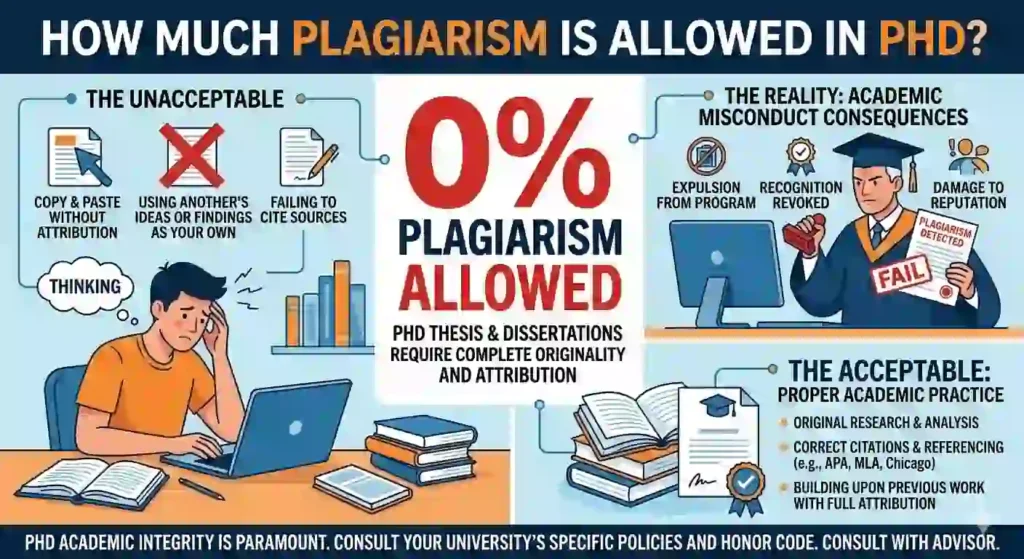
Table of Contents
- What Is Plagiarism Percentage & How Is It Measured?
- How Much Plagiarism Is Allowed in a Thesis?
- How Much Plagiarism Is Allowed in a Research Paper?
- How Much Plagiarism Is Allowed in a Review Paper?
- How Much Plagiarism Is Allowed in a Dissertation?
- How Much Plagiarism Is Allowed in a Conference Paper?
- How Much Plagiarism Is Allowed in a Journal?
- Plagiarism Limits — Quick Reference Table
- Tips to Minimize Plagiarism in Your Document
- Struggling With Plagiarism? We Can Fix It
How Much Plagiarism Is Allowed? Complete Guide for Students & Researchers
You spent months working on your thesis, research paper, or dissertation. Finally, you run your paper through a plagiarism checker and discover your paper has 14% plagiarism. What are the chances it will be rejected?
It is the biggest fear that students and research scholars face all over the world. The reality is that the allowed percentage of plagiarism varies depending on the type of paper and the institution or conference to which the paper is being submitted.
In this article, we will outline the allowed percentage of plagiarism for all the major types of research papers and documents, including the thesis, research paper, review paper, dissertation, conference paper, and journal article.
What Is Plagiarism Percentage & How Is It Measured?
To get into the specifics of the percentage limits, let’s first understand what this percentage actually represents.
Software like Turnitin, iThenticate, and Grammarly reads your document, comparing it to billions of web pages, academic papers, and even published books online. This process gives us a similarity index, which represents the percentage of your written work compared to other written works online.
Important Note: A high similarity index does not necessarily mean you’re guilty of plagiarism. Quoted texts, common phrases used in academic writing, and even a list of references are some of the common culprits of a high similarity index.A 0% similarity index is impossible in any written work, but the goal here is to keep your similarity index within an acceptable range, which is what this article aims to help you achieve.
How Much Plagiarism Is Allowed in Thesis?
Generally speaking, the maximum percentage of plagiarism allowed in a thesis is 10 to 15%. However, the “safest” percentage is less than 10%, and this is the percentage that most lecturers will recommend.
Here’s what to look out for:
Even self-plagiarism is not allowed. It means that if you copy from your own work without disclosing the fact that it is your own work, it will be picked up as plagiarism.
References will not be checked for plagiarism in most cases.
Some universities will have chapter-by-chapter requirements. It means that each chapter has to be less than the percentage allowed.
Some universities will allow as much as 20%, while others will be very strict about the less-than-10% rule.
Best practice: For under 10% in total, and always consult your university’s plagiarism policy before submission.
How Much Plagiarism Is Allowed in Research Paper?
For a research paper submitted as coursework or to a journal, the standard limit of similarity is between 10% to 20%. This, however, depends on a variety of factors.
Key points to know:
- For top-tier publishers, journals published by Elsevier, Springer, Wiley, IEEE, etc., usually employ iThenticate, requiring a similarity score of much less than 15%.
- Quoted content cited correctly does not constitute plagiarism, but still shows up in the similarity score.
- Each journal has different requirements; hence, always check the “Author Guidelines” section of the journal’s webpage before submitting a manuscript.
- A research paper, if heavily dependent on literature, needs to make up for this with proper paraphrasing and citation.
Best practice: For journal submission, try to keep the similarity score under 15%. However, some journals explicitly mention the similarity score they allow, so make sure to check those as well.
How Much Plagiarism is Allowed in a Review Paper?
Review papers are an exception because the whole purpose of writing a review paper is to summarize, analyze, and synthesize the research done by others. Review papers tend to have higher similarity scores than original research papers.
However, the majority of journals demand a similarity score below 15-20% for review papers.
It’s challenging because:
- You are constantly referencing and explaining others’ work.
- It’s not enough to change a few words and call it a day. You need to paraphrase the content in your own words
. - It’s also important to understand the difference between a literature review section and a review paper. A review paper is held at the same level as a research paper.
Best practice: The best way is to paraphrase as much as possible and always reference your content. It’s also a good idea to keep your similarity score below 15%.
How Much Plagiarism is Allowed in Dissertation?
A dissertation, especially a PhD dissertation, is the most scrutinized piece of writing you will ever do in your academic career. The maximum allowed is 10-20%. However, the recommended level is below 10%
Important Considerations:
- PhD and Master’s Dissertations: PhD Dissertations are more strictly examined. A 15% pass in a PhD dissertation would be questionable in a Master’s dissertation
Library Searches by Institutional Library Databases: The institutional library databases will scan your work and match it against global academic databases. If you have published research papers as part of your research, they will be matched against your own work. This is known as self-plagiarism.
Published Work in the Dissertation: If your work has been published as research papers in journals as part of your research, then it is important to bring this to the attention of your institution.
Best practice: Aim for under 10%. Discuss any content overlap with your own previously published work with your supervisor early on.
How Much Plagiarism Is Allowed in Conference Paper?
Conference papers are more flexible than journal papers, mostly because they are, in effect, extended versions of previous abstracts, posters, or short papers presented at earlier conferences.
The accepted norm is 20-30% similarity, but only if the similarities are cited.
Key Facts:
- IEEE conferences employ Cross Check, which uses iThenticate, and allow a similarity of up to ~30% before a paper is sent to the review process.
- If the paper overlaps with previous work of yours, this is common, but you still need to declare this.
- Always check the Call for Papers document of the conference, as some conferences now clearly state what level of plagiarism they allow.
Best practice: Try to keep the similarity level below 25%. If your paper overlaps with previous work, declare this, but try to keep the similarity level below 25%.
How Much Plagiarism Is Allowed in Journal?
For journal publications, the standards are the highest, and this is the most stringent form of academic document writing. Editors use tools like iThenticate to scan the papers before they are sent for peer review.
For most journals, the limit is 10–15% similarity, and for top-tier journals, it is less than 10%.
What You Need to Know:
- For Elsevier, Wiley, and Springer journals, any level greater than 20% is sent for editorial review, and in some cases, the manuscript is rejected without review.
- For self-plagiarism, the rules are the same as any other form of plagiarism. If you are reusing your previously published work, it is unethical and considered plagiarism.
- Most journals’ policies on plagiarism are mentioned in their “Author Guidelines” section, so be sure to check that before submitting your manuscript.
- Some journals may specify word limits per section, such as the introduction or methodology section, instead of the total document.
Best practice: Keep it under 10% before submitting to any journal. If your work is a follow-up to a prior conference paper or preprint, be sure to mention this in your cover letter.
Plagiarism Limits — Quick Reference Table
| Document Type | Allowed % | Ideal Target | Strictness | Common Tool Used |
|---|---|---|---|---|
| Thesis | 10–15% | Under 10% | HIGH | Turnitin |
| Research Paper | 10–20% | Under 15% | HIGH | iThenticate |
| Review Paper | 15–20% | Under 20% | MODERATE | iThenticate |
| Dissertation | 10–20% | Under 10% | VERY HIGH | Turnitin |
| Conference Paper | 20–30% | Under 25% | MODERATE | CrossCheck / iThenticate |
| Journal Article | 10–15% | Under 10% | VERY HIGH | iThenticate |
Some Tips to Minimize Plagiarism in Your Document
If you find your similarity percentage higher than you would like it to be, here are some tips for you:
- Paraphrasing: While paraphrasing, avoid changing only a few words in a sentence to different words. Try to change the entire thought in a different sentence structure.
- Citation Tools: Citation tools such as Zotero, Mendeley, or EndNote can be extremely helpful in reducing plagiarism in your document.
- Check Your Document Before Submitting: Before you submit your document officially, you can use Turnitin (if your university provides access), PlagScan, or Quetext to check your document for plagiarism.
- Avoid Copying Your Previous Work: If you want to reuse your previous work in your document, you need to paraphrase it and cite it as you would cite someone else’s work.
- Ask Your Supervisor: Plagiarism policies differ from university to university or even from department to department in a university. Your supervisor can guide you on how much similarity is allowed in your document.
Struggling With Plagiarism? We Can Fix It
The quick answer to “how much plagiarism is allowed?” is this: for almost all kinds of documents, under 10% is safe. The flexible end of this scale goes up to 20-30% for conference papers, but for journals, dissertations, and theses, it is generally better to be lower rather than higher.
The most important thing to keep in mind, however, is that there is no fixed rule for plagiarism anywhere, and it is different for every institution, every journal, and every conference.
So, if your plagiarism score is higher than your acceptable limit, there is no need to panic! You still have time to bring it down to acceptable limits—and you don’t have to face it alone.
At IdeaLaunch, we are here to help you bring down your plagiarism score without compromising on your content or quality of writing. It may be your thesis, dissertation, research paper, or journal submission; we are here to rewrite your content professionally so that it is still your own, just expressed in a much better way.