

How to Write Synopsis for Dissertation
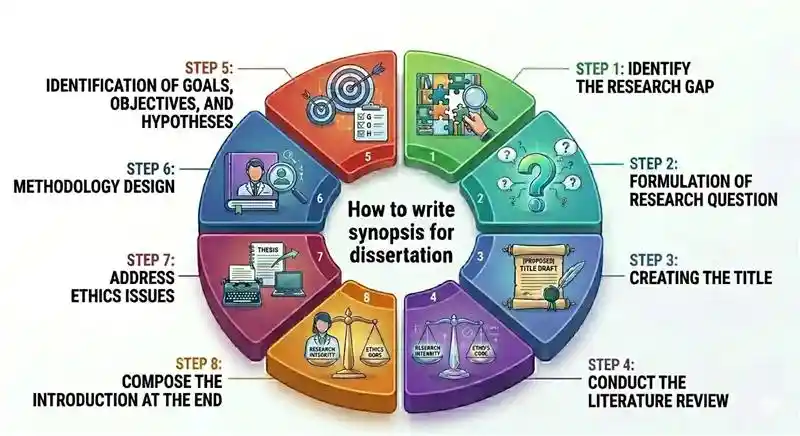
Table of Contents:
- What is synopsis for dissertation?
- Why is Dissertation Synopsis important?
- Format of Dissertation synopsis
- Guidelines for the Dissertation Synopsis
- Step by step of Dissertation Synopsis writing
- Dissertation Synopsis vs Proposal vs Dissertation
- Common mistakes for the dissertation synopsis rejection
- FAQ
Complete Dissertation Synopsis Writing Guide for Master's and PhD Students
What is Synopsis for Dissertation ?
A dissertation synopsis is a well-organized document ranging between 1,500 to 3,000 words that explains your research proposal, basically an outline of your dissertation describing your intended research, its importance, and methods employed.
Main Difference: It is different from a summary of any previous study because it is a convincing statement to highlight the significance and feasibility of your upcoming research.
It is usually required to be scrutinized and approved by a departmental panel before you can officially enroll in a topic for supervised research.
Who Requires It?
MPhil/PhD candidates, Postgraduate MA/MSc/MBA, Medical MD/MS/MDS, and LLM Thesis students, mostly in India under UGC requirements and Commonwealth countries.
Why Is a Dissertation Synopsis Important?
1. Forces Intellectual Clarity
Compels you to define your research question early, helping you identify if your idea is too vague, broad, or already over-explored — before wasting months of effort.
2. Shapes Supervisor Relationship
It’s often the first academic work your supervisor evaluates, directly influencing their perception of you and the tone of the entire supervisory relationship.
3. Protects You Academically
An approved synopsis formally registers your topic, preventing overlap disputes. Significant deviation from it in your final dissertation can cause serious problems at the viva stage.
4. Provides Access to Resources
Grants, library access, lab allocation, etc.
Format of Dissertation synopsis
The format for the dissertation synopsis, although differing slightly from institution to institution, is a tried-and-tested format in academic circles. The format presented below conforms to the standards set forth by some of the leading Indian universities, such as DU, Mumbai University, Jamia, and IGNOU.
| Section | Recommended Length | Purpose |
|---|---|---|
| Title Page | 1 page | Formal identification of researcher, topic, and institution |
| Introduction | 300–400 words | Context, rationale, and scope of the study |
| Statement of the Problem | 200–300 words | Articulate the specific research gap or problem |
| Review of Literature | 400–600 words | Demonstrate existing knowledge and identify gaps |
| Aims and Objectives | 150–200 words | Specify measurable research goals |
| Research Hypotheses / Questions | 100–150 words | State testable predictions or guiding questions |
| Research Methodology | 400–500 words | Describe design, sampling, data collection, analysis |
| Ethical Considerations | 100–150 words | Address consent, confidentiality, and IRB clearance |
| Timeline / Work Plan | Table format | Demonstrate feasibility and time management |
| Bibliography | 15–25 sources | Evidence of preliminary reading (APA / MLA / Chicago) |
FORMAT INSTRUCTIONS:
It is recommended to use a 12-point font size Times New Roman or Garamond with 1.5 lines and 1 inch margin on all sides, except as required by your institution’s specific guidelines, which should always be consulted.
FORMAT INSTRUCTIONS:It is recommended to use a 12-point font size Times New Roman or Garamond with 1.5 lines and 1 inch margin on all sides, except as required by your institution’s specific guidelines, which should always be consulted.
Guidelines for the Dissertation Synopsis
Ethics Issues (usually overlooked — now penalised)
- Participant informed consent process
- Anonymity, confidentiality and data management policy
- If necessary, IRB/EC approval
- Participants’ risk evaluation and reduction
Scholarly Integrity
- Each factual statement must have a citation
- Separate the information derived from secondary sources and your ideas
- Do not cite the sources that you have never read before — examiners detect it during a viva voce
Ethics Issues (usually overlooked — now penalised)
- Participant informed consent process
- Anonymity, confidentiality and data management policy
- If necessary, IRB/EC approval
- Participants’ risk evaluation and reduction
Useful Software
- Zotero/Mendeley – References management tool
- Grammarly – Grammar checking tool
- iThenticate/Turnitin – Plagiarism checker
- Connected Papers – Academic literature visualisation
PRO-TIP: Supervisor ApproachSubmit your 2-page idea note to the supervisor for feedback before the formal submission. This will save you from any drastic changes later.
Need expert guidance? Our Dissertation Writing Services can help you prepare a structured, university-compliant dissertation from topic selection to final submission.
Need expert guidance? Our Dissertation Writing Services can help you prepare a structured, university-compliant dissertation from topic selection to final submission.
Step by step of Dissertation Synopsis writing
These next eight points are carefully ordered. The main source of structural incoherence among submitted synopses lies in neglecting any of these points in order, especially in drafting the introduction before carrying out the literature review.
Step 1: Identify the Research Gap
- Read 30-40 recent papers in your field before writing anything
- Look for the topics that have never seen studied before
- Identify areas researched only in narrow or limited terms
- Note the topics with conflicting or inconclusive results across studies
- Track recurring limitations mentioned in “future research” sections
Step 2: Formulation of Research Question
- Use the PICOS framework: Population, Intervention, Comparison, Outcome, Study design.
- Or use the SPIDER framework: Sample, Phenomenon of interest , Design, Evaluation, Research type.
- Your question must be specific, answerable, and researchable
- Avoid questions that are too broad(“How does education affect society”) or too narrow
Test it:can it be answered with data you can realistically collect?
Step 3: Creating the Title
- Be specific – avoid vague titles like “A study on education”
- Use the structure: ”Effect of X on Y among Z:A [Method] Analysis”
- Include your population, variable, and methodology in the title
- Keep it under 15-20 words while remaining descriptive
- The title of your thesis should make your exact scope and approach clear at a glance
Step 4: Conduct the Literature Review
- Organise by themes, not chronology – group related findings together
- Cover both seminal(foundational) works and recent literature
- Synthesis findings across studies – do not just summarise each paper separately.
- Identify contradictions,debates and patterns across the literature.
- End with a clear conclusion that names your specific research gap.
Step 5: Identification of Goals, Objectives, and Hypotheses
- Aim: one sentence – your overall general purpose
- objectives 3-5 specific, attainable steps that break down the aim.
- Hypotheses: testable predictions written in both null(H0) and alternative (H1) forms.
- Objectives start with action verbs: ”to examine” , ”to compare”, ”to assess”.
- Every objective must be directly answerable by your methodology.
Step 6: Methodology Design
- Justify every decision – why this design, sample, and data collection method?
- Explain your choice of research design (quantitative, qualitative, mixed)
- Justify your sample size with reference to power analysis or saturation
- Describe your data collection instruments(surveys, interviews, observations)
- Address validity, reliability , and potential limitations explicitly
- Unjustified methodology choices are the most common cause of thesis revisions.
Step 7: Address the Ethics Issue
- Treat this section with full seriousness – it is not a formality
- Explain whether institutional ethics approval is required and how it will be obtained
- Describe informed consent procedure for all participants
- Address data privacy , confidentiality , and storage measures
- Consider and document any potential harms or risks to participants
- Note any special consideration for vulnerable populations.
8: Compose the Introduction at the End
- Write the introduction after all other sections are complete
- You can only introduce what you fully understand – and you only understand it after writing it.
- The introduction must set up the gap , purpose, and structure of what follows.
- Start broad(the field), narrow to your gap, then state your aim and approach
- End with a brief roadmap sentence describing each chapter or section
TIP FOR EFFECTIVE WRITING PROCESSApply the "reverse outline" strategy. This involves writing down all of your paragraphs, then identifying the first sentence in each paragraph. If the first sentences are not making sense when read in a sequence, then the paragraph structure requires modification.
Dissertation Synopsis vs Proposal vs Dissertation
These three documents are frequently misunderstood and, in some cases, have disastrous consequences. By knowing the differences between the three documents, one can avoid the mistake of writing an overview that is too much like a proposal and vice versa.
| Aspect | Synopsis | Research Proposal | Dissertation |
|---|---|---|---|
| Purpose | Topic registration & committee approval | Detailed plan for funding / advanced approval | Complete presentation of conducted research |
| Stage | Before research begins | Before or during early research | After research is completed |
| Length | 1,500–3,000 words | 3,000–8,000 words | 40,000–100,000 words |
| Literature Review | Selective, gap-focused | Comprehensive and critical | Exhaustive, thematic chapters |
| Methodology | Outlined and justified | Detailed with pilot data (sometimes) | Fully executed and reported |
| Findings | None (anticipated only) | None or very preliminary | Detailed results and analysis |
| Tense | Future | Future / Present | Past (for completed work) |
| Audience | Department committee | Funding body / ethics board | Supervisor, examiners, scholarly community |
Common mistakes for the dissertation synopsis rejection
A majority of the rejections can easily be avoided by doing a self-checklist before submission.
A very general research question – “Exploration of the influence of social media on youth” is an example of a topic statement and not a research question. Variables, population and context should all be well defined.
Objectives that contradict methodology – Where you intend to conduct qualitative research involving people’s experiences, but use Likert scale surveys, for example.
Superficial literature review – Reviewing papers rather than analysing them critically. Literature review always involves arguing a point.
Not giving adequate justification to the methodology – Use of terms such as purposive sampling, but without justification in your particular study.
Poor ethics chapter – This chapter will make your synopsis look incompetent, lacking detail, especially in cases such as social sciences, medical and educational research.
Feasibility not adequately established – Where the proposal entails conducting research among ten thousand participants alone within six months.
Incorrect tenses: As this is a proposal for research to be conducted, using the past tense will clearly show lack of understanding.
Inconsistencies in citation – Making statements without citations or referring to sources that are not included in your bibliography
There is no significance statement — This is a wasted chance that the committee will not ignore.
There are proofreading issues — Grammar mistakes and poor formatting indicate careless work, which is not a trait desired in someone the committee will have to work with for several years.
Frequently Asked Questions
The synopsis length ranges from 1,500 to 3,000 words, excluding the title page, reference list, and appendices. The medical field can have a synopsis of 1,000 words. On the contrary, PhD studies can include a synopsis of up to 5,000 words. Always refer to your research guide at your institution, as going beyond the word limit renders your work ineligible for review.
Minor modifications are normal. Still, substantial changes like altering your thesis topic, methods, and study population may necessitate a formal request and re-approval process. In severe cases, you might have to rewrite the whole synopsis. Consult your supervisor first.
Ensure that your synopsis contains at least 15-30 quality peer-reviewed papers published in the last decade. Do not pad your bibliography section with uncited references – reviewers will notice.
While full clearance is not necessary prior to submission, your synopsis must reflect how you will obtain it. If you are working on medical research, there might be an ethics application running in parallel. You should never overlook ethical approval, since secondary data collection also requires ethical consideration.
The meeting is conducted on a monthly or quarterly basis, while the decision takes 4-8 weeks. The revision stage presupposes that the process of getting approval needs to be repeated from scratch. Thus, one should wait for 3-4 months before approval altogether.
Conclusion
The synopsis of a doctoral dissertation is much more than just a bureaucratic ritual – it marks your entrance into the world of academia with a contribution to make. Superb synopsis aren’t composed by the smartest students, but by the best-prepared students – the ones who knew what the paper needed, took literature seriously, explained their methods truthfully, and looked for input at the start. IdeaLaunch is here to guide you through the process.
Need Expert Academic Support?
If you find yourself struggling in your present semester and require assistance regarding your research paper and the entire process of writing it or even formatting it, IdeaLaunch is the place where we can provide Ph.D. and graduate students with the academic writing help needed at their level.