

PhD Research Topics in Computer Science
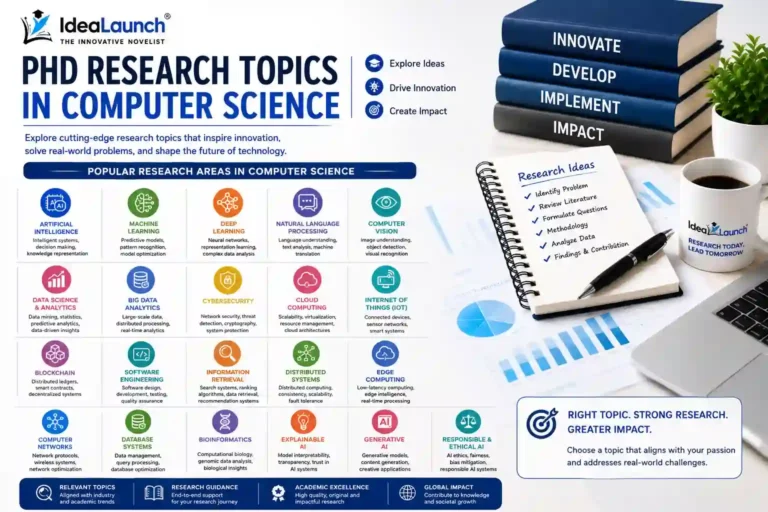
Latest PhD Topics in Computer Science 2026: Research Areas and Topic Ideas
A PhD topic choice in Computer Science forms the basis of your doctoral study. An appropriate topic is one that goes beyond a current technology or trend. It should have an identified research problem, a relationship with the literature, a justified research gap, and adequate scope to make a methodological or technical contribution.
An appropriate PhD research topic in Computer Science should be narrow in focus, researchable technically/theoretically, relevant to your specialization area, and involve appropriate data sets, computational facilities, and research methods. It should also have enough scope for conducting a literature review, system development or experimentation, analysis and evaluation, and an academic contribution.
PhD Research Topics in Computer Science
Computer Science has various research areas related to technology and other disciplines. According to your education and research interest, you may consider studying:
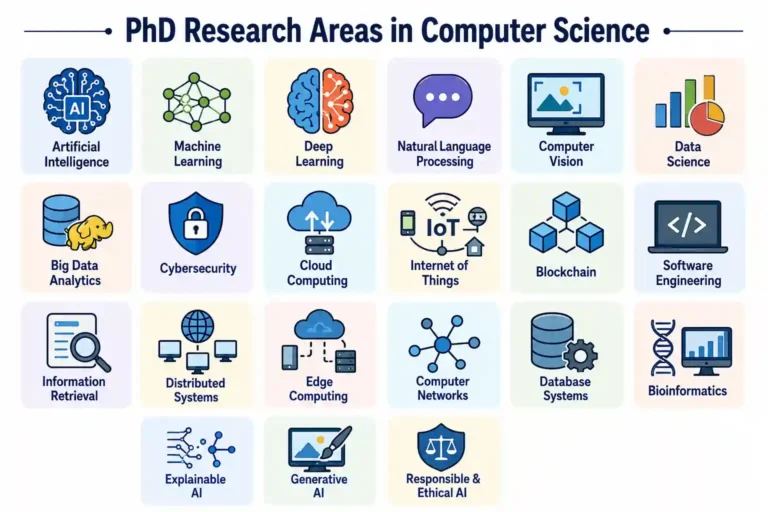
The best topic is not the one that has the latest technology. The best topic is one where you can find an interesting research problem, justify the gap in the literature, find appropriate data/computational facilities, and show your contribution.
1. PhD Topics in Artificial Intelligence
Research on Artificial Intelligence can include topics such as intelligent systems, automated decision-making, generative models, ethical AI, knowledge representation, and applications of AI.
Artificial Intelligence Research Topics Ideas
Generative AI & Large Language Models
- Generative AI for Automated Knowledge Acquisition
- Large Language Models for Domain-Specific Question Answering
- Detecting and Preventing Hallucinations in Generative AI
- Retrieval-Augmented Generation for Domain-Specific Applications
Responsible & Ethical AI
- Explainable and Transparent AI-Based Decision Making
- Bias Detection and Prevention in Artificial Intelligence
- Fairness-Aware Machine Learning for Automated Decision Making
- Privacy-Preserving Artificial Intelligence
AI-Based Decision Systems
- AI-Based Decision Support Systems for Complex Environments
- Intelligent Decision Making Through Multi-Agent AI
- Adaptation of AI for Real-Time Decision Support
- Knowledge-Based AI for Automated Reasoning
AI & Industry Application
- AI for Healthcare Decision Support Systems
- AI-Based Fraud Detection in Financial Services
- Artificial Intelligence for Smart Manufacturing
- AI-Based Predictive Maintenance Systems
AI & Human Interaction
- Collaborative Human and AI-Based Decision Making
- Trust in AI-Based Decision Support Systems
- Adoption of Generative AI by Users
- Human-Centered AI Systems
AI Security & Reliability
- Adversarial Attacks on Artificial Intelligence Systems
- Secure AI Models for Critical Security Applications
- AI Model Security and Threat Detection
- Reliability Evaluation of AI-Based Decision Systems
2. PhD Topics in Machine Learning
Machine Learning is full of research topics related to predictive modeling, representation learning, reinforcement learning, machine learning model optimization, automated machine learning, and practical use cases.
Machine Learning Research Topics Ideas
Predictive Machine Learning
- Machine Learning for Predictive Business Analytics
- Financial Risk Assessment via Predictive Models
- Machine Learning for Disease Prediction
- Predictive Analytics of Consumer Behavior
Deep Learning
- Deep Learning for Pattern Recognition
- Deep Neural Networks for Image Classification
- Deep Learning for Anomaly Detection
- Transfer Learning for Application Domains
Explainable Machine Learning
- Explainable Machine Learning for High-Risk Decision Making
- Interpretable Machine Learning for Financial Prediction
- Explainable AI for Medical Diagnosis
- Machine Learning Model Interpretation and User Trust
Federated & Privacy-Preserving Learning
- Federated Learning for Privacy-Preserving Data Analysis
- Secure Federated Learning for Distributed Data
- Privacy-Preserving Machine Learning for Health Care Data
- Communication-Efficient Federated Learning
Reinforcement Learning
- Reinforcement Learning for Intelligent Resource Management
- Deep Reinforcement Learning for Autonomous Systems
- Reinforcement Learning for Decision Making under Uncertainty
- Multi-Agent Reinforcement Learning for Distributed Systems
Automated Machine Learning
- Automated Machine Learning for Specific Domain Prediction
- AutoML for Small and Unbalanced Data Sets
- Automated Feature Engineering for Predictive Models
- Optimization of Machine Learning Pipelines
3. PhD Topics on Data Science and Big Data
Data Science can be researched by studying large-scale data processing, predictive analytics, data quality, data visualization, knowledge discovery, and data-driven decision-making.
Data Science Research Topic Ideas
Big Data Analytics
- Big Data Analytics for Decision Making in Real Time
- Scaling Up the Data Processing for Large-Scale Applications
- Big Data Analytics and Decision Making in the Organization
- Distributed Data Analytics for High-Volume Data
Predictive Analytics
- Predictive Analytics of Consumer Behavior
- Predictive Analytics Based On Demand Forecasting Using Machine Learning
- Predictive Analytics for Financial Risk
- Predictive Models of Business Failure
Data Quality & Management
- Data Quality Evaluation in Large-Scale Information Systems
- Data Cleaning Techniques for Big Data Application
- Data Integration Techniques for Heterogeneous Data Sources
- Data Governance Framework for Data-Driven Organizations
Real-Time Data Analytics
- Real-Time Data Analytics for Intelligent Systems
- Real-Time Anomaly Detection in Data Streams
- Streaming Data Analytics in IoT Environment
- Event-Driven Real-Time Analytics
Data Visualization
- Interactive Data Visualization for Complex Decision Making
- Visual Analytics for Large Datasets
- Explainable Data Visualization for Business Intelligence
- Human-Centred Visual Analytics
Data Privacy & Security
- Privacy-Preserving Big Data Analytics
- Secure Data Sharing in Distributed Settings
- Privacy-Aware Data Mining
- Differential Privacy for Large-Scale Data Analytics
4. PhD Topics on Natural Language Processing
Topics for NLP may focus on natural language understanding, opinion mining, information retrieval, multilingual systems, conversational AI, and large language models.
NLP Research Topic Ideas
Large Language Models
- Domain-Specific Large Language Models for Knowledge Retrieval
- Hallucination Detection in Large Language Models
- Retrieval-Augmented Generation for Enterprise Knowledge System
- Evaluation of Large Language Models for Special Domains
Sentiment & Opinion Mining
- Aspect-Based Sentiment Analysis of Online Reviews
- Multilingual Sentiment Analysis using Deep Learning
- Sentiment Analysis of Social Media Data
- Emotion Detection in Natural Language
Multilingual NLP
- Multilingual NLP for Low-Resource Languages
- Machine Translation for Indian Languages
- Cross-Language Information Retrieval
- Code-Mixed Language Processing for Indian Languages
Information Extraction
- Information Extraction from Unstructured Documents
- Named Entity Recognition for Domain-Specific Text
- Knowledge Extraction from Scientific Literature
- Automated Document Understanding with NLP
Conversational AI
- Context-Aware Conversational AI
- Personalized Dialogue Systems with Large Language Models
- Trust and Reliability in AI Chatbots
- Conversational AI for Domain-Specific Assistance
NLP Security & Reliability
- Prompt Injection in Large Language Model-Based Applications
- Toxicity in Online Text
- Misinformation Detection with NLP
- Robust NLP Against Adversarial Text
5. PhD Topics in Computer Vision
Computer Vision may include topics such as Image Understanding, Object Detection, Medical Imaging, Video Analytics, Face Recognition, Remote Sensing, and Multimodal AI.
Computer Vision Research Topics Ideas
Image Classification & Recognition
- Image Classification Using Deep Learning Techniques
- Few-shot learning for image recognition
- Transfer Learning for domain-specific image analysis
- Robust image recognition in difficult conditions
Object Detection
- Object detection in real-time using deep learning
- Lightweight object detection algorithms for edge devices
- Small object detection in complex environments
- Multi-object tracking in real-time video
Medical Image Analysis
- Medical image classification using deep learning techniques
- Explainable AI for medical image analysis
- Automatic abnormality detection in medical images
- Multimodal medical image analysis
Video Analytics
- Intelligent video surveillance using deep learning techniques
- Human activity recognition from video data
- Real-time anomaly detection in video streams
- Deep learning techniques for crowd behavior analysis
Remote Sensing
- Satellite image classification using deep learning techniques
- Remote sensing-based land cover detection
- Artificial intelligence-based change detection in satellite images
Multimodal AI
- Multimodal learning for image and text understanding
- Vision-language models for domain-specific applications
- Multimodal retrieval using artificial intelligence
- Vision-language models for document understanding
6. PhD Topics in Cybersecurity
Cybersecurity offers opportunities to research intrusion detection, malware analysis, privacy, authentication, blockchain security, network security, and AI-based threat detection.
Cybersecurity Research Topic Ideas
AI & Cybersecurity
- Machine learning for cyber threat detection
- Deep learning-based intrusion detection
- Explainable AI for cybersecurity threat detection
- Malware classification using artificial intelligence
Network Security
- Intelligent intrusion detection systems in computer networks
- Anomaly detection in network traffic
- Machine learning in network attack detection
- Adaptive network security systems
Privacy & Data Security
- Privacy-preserving data sharing in cloud environments
- Data management security in distributed systems
- Privacy-preserving machine learning
- Data privacy frameworks in IoT environments
Authentication & Identity
- Behaviour-based user authentication systems
- Continuous authentication using machine learning
- Biometric authentication system security
- Multi-factor authentication in digital services
Malware & Threat Intelligence
- Malware detection using machine learning
- Automated analysis of cyber threat intelligence
- Behaviour-based malware detection
- Intelligent phishing detection systems
IoT & Cybersecurity
- Intrusion detection in Internet of Things Networks
- Lightweight security mechanisms for IoT devices
- Using AI for IoT threat detection
- Secure communication in resource-constrained IoT environments
7. PhD Topics in Cloud Computing
Research on cloud computing can include areas such as cloud security, resource allocation, serverless computing, distributed systems, virtualization, and cloud service optimization.
Cloud Computing Research Topic Ideas
Cloud Security
- Cloud Computing Threat Detection Based on AI
- Preservation of Privacy in Managing Cloud Data
- Cloud Intrusion Detection
- Multi-Tenant Cloud Architecture
Resource Management
- Resource Allocation in Cloud Computing
- Cloud Resource Management Using Machine Learning
- Energy-Efficient Cloud Resource Management
- Workload Allocation in Cloud Environments
Serverless Computing
- Performance Optimization in Serverless Computing
- Resource Allocation for Serverless Computing
- Cost-Conscious Serverless Computing
- Serverless Architectures for Scalable Applications
Cloud Performance
- Predictive Cloud Performance Management
- Cloud Workload Prediction Using Machine Learning
- Optimization of Cloud Services Quality
- Performance-Aware VM Allocation
Edge-Cloud Integration
- Intelligent Resource Allocation in Edge-Cloud Environments
- Edge-Cloud Computing for Real-Time Applications
- Offloading in Edge-Cloud Systems Using AI
- Latency-Aware Computing in Edge Environments
Sustainable Cloud Computing
- Energy-Efficient Cloud Data Center Management
- Carbon-Conscious Workload Scheduling in Cloud Computing
- Green Cloud Computing Resource Optimization
- Sustainable Cloud Infrastructure Management
8. PhD Topics in Internet of Things
Research in IoT can focus on connected devices, edge computing, smart environments, IoT security, intelligent sensing, and real-time data analysis.
IoT Research Topic Ideas
IoT Security
- Detecting Intrusions in IoT Networks Using Machine Learning
- Light‑Weight Security Methods for IoT Devices
- Keep Privacy Safe in IoT Data Management
- Secure Ways to Authenticate IoT Devices
Smart Cities
- Managing Smart City Resources with IoT
- Smart Traffic Control Using IoT
- IoT for Smart Waste Management
- Smart Energy Control with IoT
IoT in Healthcare
- Remote Health Monitoring with IoT
- Smart Monitoring of Healthcare Using IoT and AI
- Secure Handling of IoT Data in Healthcare
- Predictive Analysis with IoT Data in Healthcare
Industries IoT
- Predictive Maintenance in Industrial IoT
- Detecting Anomalies in Industrial IoT Using AI
- Optimizing Resources in Industries with IoT
- Secure Communication in Industrial IoT Networks
Edge Computing & IoT
- Edge Computing for Real‑Time IoT Applications
- Offloading Tasks in IoT‑Edge Networks Using AI
- Distributed Intelligence in IoT
- Latency‑Aware Edge Computing for IoT
IoT Data Analytics
- Real‑Time Analysis of IoT Data with Machine Learning
- Detecting Anomalies in IoT Data Streams
- Predictive Analysis in Smart IoT Environments
- Context‑Aware Data Processing in IoT
9. PhD Topics in Blockchain Technology
Research ideas in blockchain technology can focus on decentralization, smart contracts, security, privacy, digital identity, blockchain supply chain, and decentralized applications.
Blockchain Research Topic Ideas
Blockchain Security
- Blockchain-based System Security Analysis
- Machine Learning in Blockchain Threat Detection
- Privacy-preserving Architecture for Blockchain Systems
- Blockchain-based Data Sharing Security
Smart Contracts
- Vulnerability Detection in Smart Contracts
- Automated Testing of Smart Contracts
- Machine Learning in Vulnerability Detection of Smart Contracts
- Formal Verification of Smart Contracts
Blockchain & Supply Chain
- Traceability of Supply Chain using Blockchain Technology
- Decentralized Supply Chain Management Systems
- Blockchain-based Authenticity Verification of Products
- Blockchain-based Logistics Data Management
Digital Identity
- Decentralized Identity Management using Blockchain
- Privacy-preserving Digital Identity Systems
- Self-sovereign Identity based on Blockchain
- Identity Verification in Decentralized Systems
Blockchain & IoT
- Security of IoT Networks using Blockchain Technology
- Decentralized Data Management for IoT
- Access Control in Decentralized IoT using Blockchain
- Data Sharing between IoT Devices
Scalability & Performance
- Scalability Optimization of Blockchain Technologies
- Energy-efficient Consensus Mechanisms
- Performance Optimization of Distributed Ledgers
- Blockchain-based Distributed Data Management
10. PhD Topics in Software Engineering
Topics of software engineering research can include software quality, DevOps, requirements engineering, software testing, maintenance, technical debt, and AI-assisted software development.
Software Engineering Research Topic Ideas
AI & Software Engineering
- AI-Generated for Automated Software Development
- Large Language Models for Software Testing
- Software Defect Prediction With AI Assistance
- AI-Based Requirements Engineering
Software Testing
- Machine Learning-Based Automated Software Testing
- Intelligent Test Case Generation
- Software Bug Detection With AI Assistance
- Regression Testing Using Machine Learning
Software Quality
- Predictive Models for Software Quality Assessment
- Machine Learning-Based Software Defect Prediction
- Automated Code Quality Analysis
- Software Maintainability Prediction With Machine Learning
Devops & Continuous Engineering
- AI-Based Optimization of DevOps Pipelines
- Predictive Analytics for Continuous Software Delivery
- Automated Fault Detection In DevOps
- DevOps Practices and Software Delivery Performance
Requirements Engineering
- NLP-Based Automated Requirements Analysis
- AI-Based Requirements Prioritization
- Automated Requirements Traceability
- Ambiguity Detection In Software Requirements Using NLP
Software Maintenance
- Predictive Software Maintenance Using Machine Learning
- Technical Debt Prediction and Management
- AI-Based Code Refactoring
- Software Evolution and Maintenance Optimization
11. PhD Topics in Computer Networks
Network research can cover network optimization, 5G/6G, software-defined networks, network security, edge computing, and intelligent communication networks.
Computer Networks Research Topics Ideas
Software-Defined Networks
- Machine learning for optimization of SDN
- Intelligent traffic management in SDN
- Detection of security threats in SDN
- Adaptive resource allocation in SDN
5G and 6G Networks
- Artificial intelligence for resource allocation in 5G networks
- Machine learning for 6G network optimization
- Intelligent network slicing in 5G and 6G
- Energy-efficient next-generation networks
Network Security
- AI-based intrusion detection in computer networks
- Anomaly detection in high-speed networks
- Machine learning for network traffic classification
- Adaptive cybersecurity for communication networks
Edge & Fog Computing
- Task offloading in edge computing networks
- Intelligent resource allocation in fog computing
- Edge computing for low-latency applications
- AI-based edge network optimization
Network Performance
- Machine learning-based network traffic prediction
- Quality of service optimization using artificial intelligence
- Congestion prediction and control in computer networks
- Energy-efficient network resource management
Wireless Networks
- Intelligent resource allocation in wireless networks
- AI-based optimization of wireless communication
- D2D(Device to Device) communication optimization
- Machine learning for wireless network management
12. PhD Topics in Databases and Information Systems
Database research can look at distributed databases, data management, query optimization, knowledge graphs, data security and smart information systems. I find these areas exciting and full of potential.
Database Research Topic Ideas
Distributed Databases
- Making queries faster in Distributed Database Systems
- Building fault‑tolerant Distributed Database Architectures
- Managing data consistency in Distributed Systems
- Scaling Distributed Data Management
Database Security
- Creating database systems that preserve privacy
- Using machine learning to detect anomalies in databases
- Controlling data access securely in Distributed Databases
- Managing data in cloud databases
Intelligent Databases
- Using AI to optimize queries
- Using machine learning to predict database performance
- Smart indexing techniques for data
- Automating database administration with AI
Knowledge Graphs
- Using knowledge graphs to retrieve information
- Building domain‑specific knowledge graphs
- Combining knowledge graphs with language models
- Automating the completion of knowledge graphs
Data Integration
- Integrating data across information systems
- Matching schemas with machine learning
- Using knowledge to integrate data
- Integrating data in real‑time for distributed applications
Information Retrieval
- Using methods for domain‑specific search
- Semantic search, with large language models
- Personalized retrieval systems
- Retrieving information from modalities
Emerging Areas for Computer Science PhD Research
| Emerging Research Area | Potential PhD Research Directions |
|---|---|
| Artificial Intelligence and Generative AI | Large language models; Generative AI; Retrieval-Augmented Generation; AI agents; multimodal AI; AI; AI explainability; AI safety; domain-specific AI |
| Machine Learning | Deep learning; federated learning; reinforcement learning; explainable AI; AutoML; transfer learning; few-shot learning; privacy-preserving machine learning |
| Cybersecurity | AI-based threat detection; intrusion detection; malware analysis; privacy-preserving systems; zero-trust security; authentication; IoT security |
| Big Data | Predictive analytics; real-time analytics; data mining; data visualization; data quality; data governance; privacy-preserving analytics |
| Cloud and Edge Computing | Cloud optimization; serverless computing; edge intelligence; resource allocation; cloud security; energy-efficient computing |
| Internet of Things | Smart cities; IoT; healthcare IoT; IoT security; edge computing; intelligent sensing; real-time IoT analytics |
| Human-AI Interaction | AI trust; explainability; human-AI collaboration; conversational AI; user experience; responsible interaction; accessibility |
| Quantum Computing | Quantum algorithms; quantum machine learning; -quantum cryptography; quantum optimization; quantum software; hybrid quantum-classical computing |
Research Gap Suggestions for Computer Science PhD Research Topics
| Type of Research Gap | Explanation | Example / Area of Research |
|---|---|---|
| Dataset Gap | The current research makes use of small, out-of-date, or domain-specific datasets, which leaves room to assess models against new or better datasets. | Current benchmark dataset → domain-specific or real-world dataset |
| Application Gap | While a certain technique is well researched in one field, it has not yet been explored in another. | Healthcare → agriculture, finance, education, or manufacturing |
| Population Gap | The research uses a limited user population or demographic group to evaluate a system. | General users → elderly users, rural users, or accessible users |
| Context Gap | A computational method used in one scenario needs testing in other environments that vary geographically, organizationally, technologically, or operationally. | Developed country dataset → Indian context or emerging market context |
| Algorithmic Gap | Current models may suffer from shortcomings regarding accuracy, efficiency, interpretability, scalability, or robustness. | Current machine learning algorithm → hybrid, explainable, or efficient algorithm |
| Methodological Gap | Most research has used only one experimental or computational method, providing room for new approaches. | One-model strategy → multi-model or comparative approach |
| Performance Gap | Current systems can be efficient enough but still have problems with speed, power usage, computation time, or scaling. | Accurate model → efficient and light model |
| Security Gap | The technology might have functionality, but still could have some security or privacy risks. | AI/IoT/Cloud technology → privacy- or security-aware technology |
| Interpretability Gap | Accurate models might give little information about how their decisions are made. | Black box AI → interpretable AI |
| Generalization Gap | The model is effective on one dataset or environment, but its effectiveness in other data environments is questionable. | Model works on one dataset → cross-dataset validation |
What Determines Whether an Idea for a Computer Science PhD Topic Is Feasible?
When selecting your topic, consider the following:
| Factor | Questions |
|---|---|
| Research problem | Is there a clear computational or theoretical problem that needs to be solved? |
| Research gap | Can the gap be justified using recent scholarly literature? |
| Originality | What novel algorithm, approach, architecture, model, dataset, evaluation, or theoretical contribution can the research provide? |
| Data | Do suitable datasets exist, or is it possible to collect or generate the necessary data? |
| Computing resources | Do you have enough hardware, cloud computing, or computational facilities? |
| Technology | Is it possible to access the necessary programming languages, software, or other technological tools? |
| Variables/metrics | Is it possible to measure the performance of the model or results of the research using the relevant metrics? |
| Methodology | Is there a viable research methodology, be it experimental, computational, analytical, or theoretical? |
| Literature | Is there enough peer-reviewed literature for establishing the research foundation? |
| Scope | Can the research be carried out within the available PhD time frame? |
| Evaluation | Is it possible to compare the proposed solution to appropriate baseline solutions or existing approaches? |
| Contribution | Can the research make a significant contribution? |
How is a Good Doctoral Topic in Computer Science Defined?
A good doctoral topic in Computer Science should show:
- A well-defined research question
- A justified research gap
- A good relationship to academic literature
- Relevant theoretical or computational background
- Well-defined research objectives
- Suitable methodology
- Reliable data sets or experimental environment
- Relevant criteria for evaluation
- Comparison with relevant approaches
- Reproducibility of results when applicable
- Potential technical/theoretical contribution
- Potential practical/social significance
- Adequate scope of original research
At the doctoral level, using an already existing machine learning algorithm on a new data set might not always give enough originality. A more valuable contribution could be developing or enhancing an algorithm, framework, architecture, model, evaluation approach, theory, data set, or problem-specific solution. A topic of this quality also carries through the rest of the doctoral journey, from the thesis to publication in Scopus indexed journals.
Common Challenges in Selecting a Computer Science PhD Topic
Many researchers have in mind a particular technology field to focus on but have problems formulating it into an appropriate computer science PhD topic.
Common Challenges are:
- Choosing too broad a topic
- Picking a technology for which there is no research question
- Finding a true research gap
- Coming up with a unique technical contribution
- Selecting proper data sets
- Having enough computational resources at hand
- Choosing the right algorithms and models
- Defining proper evaluation metrics
- Choosing proper baseline models
- Keeping pace with the rapid evolution of technology
- Reproducing and comparing other works
- Formulating research questions that require routine implementation
Even though a topic sounds innovative because it uses phrases like “Artificial Intelligence”, “Generative AI”, “Blockchain” or “Quantum Computing”, the technology itself does not provide research originality. What determines originality is the research question, gap, methodology, and contribution.
Frequently Asked Questions
Identify gaps in recent academic literature in relation to algorithms, datasets, performance, security, scalability, interpretability, or application context. Develop your research question based on this gap. A structured literature review is usually the fastest way to surface those gaps.
The topic should be precise enough to define a research question, technology, application domain, approach, and contribution, but have enough space for original doctoral-level research.
Compare recent papers in terms of their approaches, datasets, algorithms, shortcomings, and results. A research gap is justified by literature, not mere novelty of a technology itself.
Not necessarily. Your contribution might include development of a new algorithm, architecture, framework, dataset, optimization procedure, evaluation technique, or improvement of existing technology.
Yes, Computer Science research can be conducted in conjunction with Healthcare, Finance, Agriculture, Education, Engineering, and Biology if the interdisciplinary research is solving an important research problem.
Struggling With Computer Science PhD Topic Selection?
Selecting a good computer science PhD topic is not easy when you have a general technology or research interest area but are confused about how to find a research gap, methodology, dataset, technical contribution, or feasibility of research.
Here at IdeaLaunch, we help researchers develop their initial research concepts into specific Computer Science PhD topics with well-defined research directions and academic contribution through our PhD topic selection service.