

PhD Research Topics in English Literature
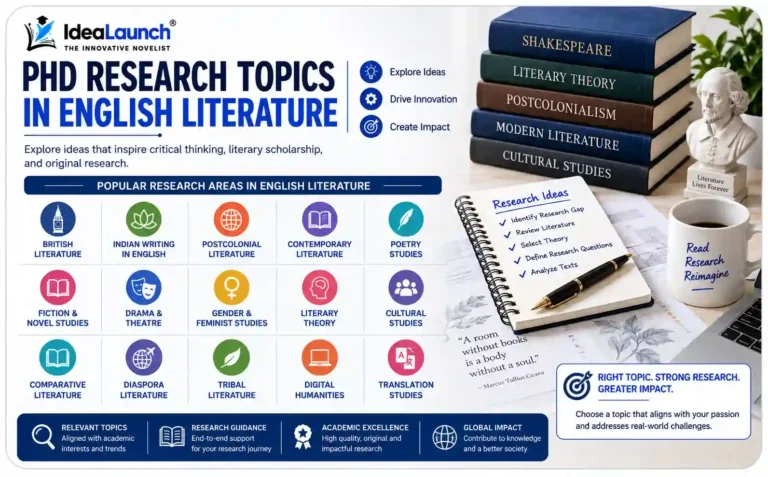
PhD Topics in English Literature 2026: Areas of Research and Topic Ideas
English Literature PhD topic is the basic element of your doctoral research. A good topic goes beyond the analysis of a certain author or literary piece. It helps formulate a research question, connect with existing literature, find a research gap, and make an original literary contribution.
An appropriate PhD topic in English Literature must be narrowed, researchable, theoretical, relevant to your specialization, and based on ample primary and secondary resources. It should also have enough space for carrying out a literature review, employing literary methodology, analyzing texts, and constructing your own original argument.
Why Choosing the Right English Literature PhD Topic Matters
Selecting an appropriate English Literature PhD topic allows your research to have a defined direction from the very beginning. An appropriate topic will help you form a good research question, identify the actual research gap, and select appropriate literary texts and literary theories for the research.
An appropriate topic will allow you to:
- Formulate a focused research problem
- Find relevant primary and secondary sources
- Choose a proper literary theory and research method
- Not go into too broad or too repetitive research areas
- Formulate a coherent research argument
- Finish the research within the allocated time and resources
The appropriate topic should be linked with your academic interests and researchable problems.
How to Select English Literature PhD Topics?
1. Determine Your Research Interest Area
First, select an interesting area, including literary theory, feminism, postcolonial literature, Indian literature, modern fiction, digital humanities, and environmental literature.
2. Explore the Existing Research on the Topic
Look at recent journal publications, books, and other scholarly discussions on the topic. Indian doctoral theses listed on Shodhganga are a useful starting point for mapping what has already been done.
3. Define a Research Gap
Find an area that has not been researched yet and that can serve as a basis for further work. A systematic literature review is the most reliable way of evidencing that gap.
4. Narrow Your Topic
Narrow down the topic by choosing an interesting literary corpus, period, theory, geographical context, or research problem.
5. Create Research Questions
Transform the chosen research gap into several answerable questions.
6. Verify Feasibility and Originality of the Study
Make sure you have access to the primary texts, scholarly materials, and theoretical literature necessary for your research.
Current PhD Topics in English Literature
1. PhD Topics in Literary Theory and Criticism
There are many ways to analyze literary texts using various approaches in theoretical literary research, such as structuralism, poststructuralism, deconstruction, reader response, Marxism, psychoanalysis, feminism, and cultural studies.
Literary Theory Research Topic Ideas
Structuralism & Poststructuralism
- Structuralist Analysis of Narrative Patterns in Modern Fiction
- Poststructuralist Views on Meaning and Identity in Literature
- Deconstruction and the instability of significance in literary texts
- Language, Power and Meaning in Poststructuralist Literary Theory
Marxist Literary Criticism
- Class Struggle in Contemporary British Fiction
- Labour Representation and Capitalism in Contemporary Literature
- Consumer Culture and Its Literary Representation
- Contemporary Fiction and Ideology and Social Class
Psychoanalytic Criticism
- Trauma and Memory in Recent Literature
- Psychoanalytic portrayals of identity in fiction
- The Function of Unconscious Desire in Literary Character Creation
- Anxiety and Psychological Conflict in Modern Narratives
Reader-Response Theory
- Reader Interpretation and Meaning-Making in Modern Fiction
- Cultural background and interpretation of literature
- The Reader in Experimental Narratives
- Multiple Readings of Contemporary Literary Texts
2. PhD Topics in Postcolonial, Decolonial, and World Literature
Postcolonial, decolonial, and world literature provide research prospects for looking into colonial history, cultural identity, immigration, resistance, systems of knowledge, and the global movement of literature.
ostcolonial, Decolonial & World Literature Topics Ideas
Decolonisation, Colonialism and Identity
- Colonialism and Identity in Postcolonial Fiction
- Identity Decolonisation in Contemporary Literature
- Colonial Power and the Representation of Culture
- World Literature and the Formation of Identity in Decolonisation
Diaspora, Migration & Cultural Hybridities
- Diasporic Identity and Cultural Memory in the Literature
- Migration and Belonging in Contemporary World Literature
- Displacement, Exile and Transnational Identities
- Cultural Hybridity in the Postcolonial Literary Studies
Resistance, Representation & Decolonial Ideas
- Colonial Resistance in Postcolonial Fiction
- Resistance to Decolonisation in the Contemporary Novel
- Postcolonial and World Literatures: Subaltern Voices
- Indigenous Knowledge and Representation in Literature of Decolonisation
World Literature, Translation and Global Perspectives
- World Literature: Translation and the Exchange of Cultures
- World Literary Circulation and Cultural Transformation
- The Canon and the Marginalised Literatures
- Comparative Decolonial Narratives amongst Literary Cultures
3. PhD Topics in Feminist Literature
Topics on feminist literature include exploring women’s experiences, gender discrimination, patriarchy, female identity, female agency, and the feminist perspective.
Feminist Literature Research Topic Ideas
Feminist Literary Studies
- Feminist Perspectives on the Representation of Women in Modern Fiction
- Patriarchy and Women’s Identity in Recent Literature
- The Function of Women in Modern Literary Narratives
- Feminist Resistance in the Fiction of the Twenty-First Century
Women Identity & Agency
- Women’s identity and self-representation in modern literature
- Women’s Voices and Experiences in Fiction Today
- Female Subjectivity in Contemporary Women’s Writing
- Literary Discourse on Women’s Agency and Empowerment
Feminism & Social Issues
- Women’s Studies And Equality In Contemporary Fiction
- Women’s Fiction and Social Oppression: Patriarchy
- Women’s Views on Marriage, Family and Society
- Women’s Social Change, Feminism and Literature
Feminist Representation & Women Writers
- Feminist Representation and Female Authorship in Contemporary Literature
- Feminist Perspectives in Contemporary Women’s Literature
- Women Writers and the Representation of Female Experience
- Feminist Social Transformation and Women’s Writing
4. PhD Topics in Modern and Contemporary Literature
Modern and contemporary literature offers many areas of study for topics dealing with identity, technology, society, politics, trauma, globalization, and shifting narrative practices.
Modern and Contemporary Literature Research Paper Topic Ideas
Contemporary Fiction
- Contemporary Fiction: Identity and Belonging
- Literary Representation and Social Change in Twenty-First Century Fiction
- Contemporary Narratives: Memory and Trauma
- Fragmented Identity in Recent Fiction
Literature & Technology
- The human self and technology in contemporary fiction
- Literary Representation and Digital Culture
- The question of artificial intelligence and human identity in modern literature
- Technology, surveillance and power in modern literature.
Globalisation
- Modern Fiction and Cultural Identity in an Age of Globalisation
- Transnational Identity in Modern Literature
- Migration, Literature and the Global
- Cultural Conflict in Modern Global Fiction
Trauma and Memory
- Characteristics of Historical Trauma in Contemporary Literature
- Memory and Self in Post-Traumatic Narratives
- Contemporary Fiction and Social Memory
- Trauma, Silence and Narrative Reconstruction
5. PhD Topics in Indian Writing in English
There are many research areas within Indian Literature in English, such as identity, colonization, cultural change, caste, gender, migration, nationalism, and multilingual literature. Scholars working in this area often begin by scanning Indian doctoral work through Shodhganga research topics.
Indian Writing in English Research Topics Ideas
Culture & Identity
- Cultural Identity in Contemporary Indian Writing in English
- Negotiating Tradition and Modernity in Indian Fiction
- Indian Cultural Representation in Modern English Literature
- Identity and Belonging in Indian English Fiction
Gender & Societ
- Women’s Representation in Contemporary Indian English Fiction
- Gender and Patriarchy in Indian English Literature
- Women’s Identity and Social Change in Indian Literature
- Feminist Perspectives in Modern Indian English Fiction
Caste & Social Inequality
- Caste Representation in Modern Indian English Literature
- Social Inequality and Literary Representation in Indian Novels
- Contemporary Indian Literature: Marginalised Voices
- Caste, Identity and Resistance in Indian Literature
Migration & Diaspora
- Contemporary English Literature and the Indian Diaspora Identity
- Migration and Cultural Memory in Indian Diaspora Literature
- Home and Belonging in Indian Diaspora Literature
- Cultural Hybridity in Diasporic Indian Literature
6. PhD Topics in Victorian Literature
Victorian Literature provides opportunities for scholars to investigate industrialization, class, gender, imperialism, morality, social reform, urbanization, and new cultural values.
Victorian Literature Research Topic Ideas
Society & Class
- The Representation of Class in Victorian Fiction
- Industrialization and Social Changes in Victorian Literature
- Poverty and Social Inequalities in Victorian Literature
- City Life and Social Changes in Victorian Fiction
Gender &Women
- Women in Victorian Literature
- Gender and Social Norms in Victorian Fiction
- Femininity in the Work of Victorian Women Authors
- Marriage and Women’s Agency in Victorian Literature
Empire & Colonization
- The Empires in Victorian Literature
- Ideologies of Colonialism in Victorian Fiction
- Race and Imperial Identity in Victorian Literature
- Victorian Literature and Empire, Culture, and Politics
7. PhD Topics in Comparative Literature
Comparative literature is a discipline that allows scholars to compare writings from different languages, cultures, literary traditions, authors, periods, and places.
Comparative Literature Research Topic Ideas
Cross-Cultural Studies
- Comparative Literature and Cultural Identity
- Migration in many literary traditions
- Comparative Pictures of Home and Removal
- Cultural Memory in Various Literary Traditions
Gender Studies in Comparison
- The Female Self in Western and Postcolonial Essays
- Women in Contemporary Fiction: A Comparative Representation
- Gender and power in various literary cultures
- Feminist Literary Perspectives in Different Cultural Contexts
Comparison of Literary Forms
- Narrative Techniques in Modern Fiction: A Comparative Study
- Myth and Transformation in Literary Traditions
- A Comparison Between Memory and Trauma
- Storytelling and Cultural Identity in the Literary Traditions
8. PhD Topics in Cultural Studies and Literature
Cultural Studies enables the study of literature in terms of popular culture, media, ideology, identity, politics, society, and daily life.
Cultural Studies Research Topic Ideas
Popular Culture & Literature
- Representation in Popular Culture and Literature
- Literature and Changes in Cultural Values
- Popular Media and Modern Literary Narratives
- Representations of Consumer Culture in Fiction
Society & Identity
- Cultural Identity in Modern Fiction
- Literature and the social construction of identity
- Marginalised Communities’ Representation in Modern Literature
- Cultural Struggle and Self-identity in Contemporary Narratives
Literature & Media
- Digital Media and Current Culture and Literature
- Literary Texts Adapted into Digital Media
- Contemporary Literary Culture and Social Media
- The Digital Age and Changing Reading Lifestyles
9. PhD Topics in Digital Humanities Literature
Digital Humanities is an intersection of literary studies with digital technologies, computational techniques, textual analysis, archiving, and digital cultural studies. Scholars entering this area should also be aware of the UGC norms on AI usage in PhD research.
Digital Humanities Research Topic Ideas
Digital Textual Analysis
- Digital Tools for Analysing Big Literary Data Sets
- Computational Study of Narrative Structures
- Digital Methods for the Analysis of Literary Style
- Text Mining in Contemporary Literary Studies
Digital Archives
- Digital Preservation of Literary Archives
- Digitization and Access to Literary Resources
- Digital Archives in Literary Research
- Digital Representation of Cultural Heritage
AI & Literary Studies
- Artificial Intelligence in Literary Analysis
- Generative AI in Contemporary Literary Studies
- AI-based Analysis of Literary Texts
- Human-AI Cooperation in Digital Literary Research
10. PhD Topics on Environmental Literature
Environmental Literature studies the connection between people and nature, ecological crisis, climate change, animals, landscapes, and environmental justice.
Environmental Literature Research Topics Ideas
Ecocriticism
- Ecocritical Readings of Contemporary Fiction
- Human and Nature Relations in Modern Literature
- Environmental Representations in Modern Fiction
- Ecological Consciousness in Modern Poetry
Literature on Climate Change
- Climate Change in Contemporary Fiction
- Climate Anxiety in Modern Literature
- Literary Narratives of Environmental Crisis
- Literature, Climate Change and Future Imaginaries
Environment Justice
- Contemporary Literature and Environmental Justice
- Environmental Inequality: Literatures and Representations
- Indigenous Ecological Knowledge in Modern Literature
- Fiction and the Environmental Crisis of Marginalised Communities
Emerging Areas for English Literature PhD Research
| Emerging Field of Research | Possible PhD Topics |
|---|---|
| Digital Humanities | Digital textual analysis; text mining; digital archives; computational literary studies |
| AI and Literature | Generative AI; AI in literary analysis; authorship; machine interpretation |
| Postcolonial Theory | Identity; hybridity; diaspora; migration; colonial memory; resistance |
| Gender Theory | Feminism; masculinity; intersectionality; gender identity; women’s writing |
| Environmental Humanities | Ecocriticism; climate fiction; environmental justice; ecological identity |
| Trauma Theory | Memory; historical trauma; cultural trauma; testimony; narrative construction |
| Cultural Studies | Popular culture; media; identity; ideology; representation |
| Digital Culture | Social media; digital storytelling; online literature; new modes of reading |
| Comparative Literature | Comparative studies; translation; comparative identity; literary traditions |
| Diaspora Theory | Migration; displacement; belonging; cultural memory; transnational identity |
Research Gap Suggestions for English Literature PhD Research Topics
| Type of Research Gap | Explanation | Example / Area of Research |
|---|---|---|
| Textual Gap | A significant literary text, author, genre, or body of literature has been neglected by scholars. | Contemporary emerging author → thorough analysis |
| Theoretical Gap | Studies have not made use of a specific theory to any great extent. | Contemporary fiction → use of an intersectional or ecocritical approach |
| Comparative Gap | Two literary traditions, authors, periods, or cultures have not been compared extensively enough. | Postcolonial fiction → cross-cultural comparison |
| Contextual Gap | A literary work has been analysed from a general perspective, but not in a specific context. | Contemporary fiction → migration context |
| Methodological Gap | Studies have relied extensively on a single method of criticism. | Traditional close reading → digital humanities and textual analysis |
| Representation Gap | Some groups of people or their experiences remain unrepresented in literary criticism. | Marginalized voices → contemporary literature |
| Interdisciplinary Gap | Literary studies have not been conducted through other academic disciplines. | Literature → psychology, sociology, environmental studies |
| Period Gap | Existing literature is dominated by older books rather than more recent ones. | Classical literature → twenty-first-century fiction |
| Geographical Gap | Existing literary studies cover some regions but pay less attention to others. | Western literature → literature of the Global South |
| Interpretative Gap | An existing interpretation leaves space for an alternative interpretation/theoretical approach. | Existing interpretation → a new theoretical approach |
What Determines Whether an Idea for an English Literature PhD Topic Is Feasible?
When selecting your topic, consider the following:
| Factor | Questions |
|---|---|
| Research problem | Is there a literary or theoretical problem that needs to be researched? |
| Research gap | Can a gap be demonstrated via the existing literature? |
| Originality | What novel interpretation/criticism/theoretical application/argument can your research offer? |
| Primary texts | Are your selected novels, poems, plays, etc. available? |
| Secondary literature | Is there enough literature? |
| Theoretical framework | Is there an applicable literary theory for the research? |
| Methodology | Is there a suitable literary methodology for the research? |
| Scope | Is the topic feasible within the PhD period? |
| Research questions | Is there room for formulating specific research questions? |
| Contribution | Can the research make any worthwhile contribution to English Literary Studies? |
Common Challenges in Selecting an English Literature PhD Topic
Many academics are generally interested in literature; however, it can be challenging to translate that interest into a clear PhD research topic. Several of these issues later resurface as common mistakes in a PhD research proposal.
The Common Problems Include:
- Selection of a topic that is too broad
- Selection of the author without the definition of the research problem
- Identification of the research gap
- Selection among several literary theories
- The choice of too many primary sources
- Identification of the scholarly sources
- Development of the research questions
- Repetition of the existing scholarly work
- Linkage between the literary theory and the textual analysis
- Keeping the research scope under control
- Selection of the literary methodology
- Definition of the academic contribution
The topic might seem to be innovative due to the inclusion of concepts like postcolonialism, feminism, AI, digital humanities, climate change, or identity. However, it is necessary to bear in mind that the research area does not provide automatic originality.
Frequently Asked Questions
You need to explore the most recent scholarly literature on your favourite author, genre, period, theory, or literary issue and find out where there are still gaps in interpretations.
The topic must be narrow enough to formulate a research question, corpus of literary works, theoretical approach, and methodology. But at the same time, you must have enough space for original doctoral research.
Explore recent journal articles, books, and academic debates related to your area of interest and identify any under-explored authors, literary texts, themes, theories, comparative approaches, contexts, or interpretations.
Not necessarily. PhD originality may consist in some new interpretation, theoretical approach, comparison, context, or methodology related to already known literary texts.
Yes. English Literature may engage with disciplines such as history, sociology, psychology, gender studies, cultural studies, environmental studies, media studies, philosophy, and digital humanities on the condition that an interdisciplinary study solves some research problem.
Why students trust IdeaLaunch for English Literature PhD topics
IdeaLaunch enables PhD candidates to convert their general interest in English Literature into feasible, researchable, and research-gap-based topics through end-to-end PhD guidance.
Domain Specific Guidance
These topics will be in line with your author, genre, period, theory and research interests.
Research Gap Specificity
Identification of potential textual, theoretical, comparative and contextual research gaps, supported by a structured literature review.
Research Direction Specificity
Receive guidance in connecting your topic, research question, research objectives, theory and methodology.
Multiple Literature Domains
Guidance in Postcolonial, Feminist, Victorian, Comparative, Indian Writing, Digital Humanities and Environmental Literature.
Original and Feasible Topics
These topics are generated to be specific, relevant, feasible, and appropriate for PhD-level research.
Struggling to How to Choose a Research Topics in English Literature? IdeaLaunch Can Help!
It may be hard to come up with an English Literature PhD research topic, especially if you have a wide interest in an author, literary period, literary theory, genre, or theme but don’t know how to convert that interest into a research question, research gap, theory, methodology, and contribution.
If you need help transitioning from your general literary interest into a well-formed PhD topic, you should try PhD topic selection assistance. If you are still not sure about how to start your research topic, then Idealaunch is the perfect place to get PhD Guidance for your research projects.
📞 Call or 💬 WhatsApp us today: +91 7904479887 / +91 7548889787 / +91 9342492103
📧 Mail us: info@idealaunch.in
📝 Get Expert Ph.D. Guidance: Topic selection, thesis writing, and research support