

Steps in Research Process
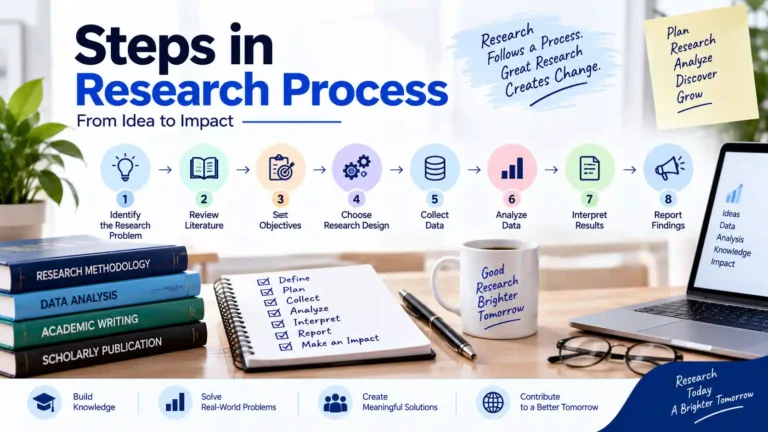
Steps in Research Process: 10 Essential Stages from Topic Selection to Publication
Research is not just the process of gathering information and putting together a document. An efficient study goes through a number of related decisions in the sequence that starts with determining the research topic and ends with presenting the results.
The knowledge of the steps in the research process will help the researchers to formulate the questions, choose the methods and collect the data, and present their results in order to make an academic contribution of significance.
The research process can be organized into these 10 essential steps:
- Choose a research topic
- Identify and define the research problem
- Conduct a literature review
- Formulate research questions and objectives
- Choose the research design and methodology
- Define the population, sample and data sources
- Collect data ethically and systematically
- Analyse and validate the data
- Interpret findings in relation to the literature
- Write, review and communicate the research
Research Process: Quick Overview
- Choose a Topic→
- Identify the Research Problem→
- Literature Review→
- Research Questions & Objectives→
- Research Design & Methodology→
- Population, Sample & Data Sources→
- Data Collection→
- Data Analysis & Validation→
- Interpretation→
- Writing & Communication
1. Choose a Research Topic
The first thing one should do while conducting research is to select an appropriate topic. A suitable topic should be relevant, significant from an academic perspective, and feasible considering the time and other resources at hand.
Researchers can identify potential topics by examining:
- Current trends in their area
- Results from previous research work
- Open research questions
- Limitations of previously adopted research work
- New technologies and social concerns
- Knowledge gaps
- Practical problems that require further exploration
For instance, artificial intelligence in education is an example of a general subject area that can be refined to become a research topic, such as the effects of generative AI software on the academic writing of postgraduate students.
At this point, it is important for researchers not to choose a research topic based on its popularity. A research topic should present an opportunity to formulate a well-defined research problem and research questions.
2. Identify and Define the Research Problem
Once a topic is chosen, the next stage would be determining the particular research problem.
A research problem refers to an issue, uncertainty, contradiction or lack of knowledge that requires investigation.
Researchers should ask:
- What is currently unknown?
- What problem has previous research not adequately addressed?
- Why does the problem matter?
- Which population or context is affected?
- What evidence is needed to understand the issue?
A broad topic is not necessarily a research problem. It is upon the researcher to refine the topic into an identifiable research problem that can be examined.
An identifiable research problem forms the basis of a literature review, research questions and objectives, among others.
3. Conduct a Literature Review
The next step is a systematic and critical literature review.
The reason for this is not simply to gather many papers. Rather, one needs to know what has been done before and find out what further research is needed.
A literature review should examine:
- Theories and concepts that already exist
- Findings from past research
- Research methodologies used by other researchers
- Dissimilarities and similarities in the literature
- Limitations in past research
- Research gaps
- Emerging trends
Researchers should assess the reliability of their sources instead of considering all publications to be of equal value.
The literature review eventually assists in answering one important question:
What does my study add that existing research does not already explain?
4. Formulate Research Questions and Objectives
After identifying the research gap, it is important to turn it into research questions and objectives.
The research questions will outline what the study is all about, while the research objectives will outline what the researcher aims to accomplish.
A strong research question should be:
- Well-defined and clear
- Researchable
- Relevant to the identified problem
- Feasible within the available resources
- Consistent with the research methodology
Moreover, depending on the methodology employed by researchers, they may formulate hypotheses that can be proved using the collected data.
The research questions and objectives need to stay consistent throughout the research process. If the research questions have changed significantly, the methodology and data requirements may also need to change.
5. Choose the Research Design and Methodology
Step five involves making a decision on how to carry out the research.
Research methodology is used in answering the research questions. The selection of the research methodology should be dependent on the research problem, not necessarily the familiarity with the technique.
Common approaches include:
- Qualitative research
- Quantitative research
- Mixed-methods research
- Experimental research
- Survey research
- Case study research
- Descriptive research
- Systematic review research
At this stage, researchers may also determine:
- Research variables or concepts
- Data collection tools
- Sampling technique
- Data analysis methods
- Research procedures
- Ethical considerations
- Timeline of project
There needs to be a logical flow of research questions, data, and conclusions in the methodology.
6. Define the Population, Sample and Data Sources
Once the methodology is set out, it is then necessary to identify the source of the evidence.
For primary research, this means identifying the target population and the sample.
Important decisions include:
- Who will participate in the research?
- What are the inclusion and exclusion criteria?
- What sampling method will be used?
- What sample size is appropriate?
- What characteristics of participants are relevant?
In secondary research, researchers could alternatively choose appropriate data bases, data sets, government documents, academic publications, archives, etc.
The design of an investigation may not be sufficient when poor samples and/or improper data sources have been used to collect information. Thus, these choices should be explained prior to data gathering.
7. Collect Data Ethically and Systematically
The seventh step will be gathering data needed to address research questions.
Depending on the study, researchers may use:
- Questionnaires and surveys
- Interviews
- Focus groups
- Observations
- Experiments
- Laboratory measurements
- Existing datasets
- Archival documents
- Published research
There must be a standardized process for data collection in order for it to be reliable and ready for analysis.
Research Ethics During Data Collection
Ethical issues become significant especially when the research deals with individuals and sensitive data.
Researchers should consider:
- Informed consent
- Confidentiality
- Participant privacy
- Secure data storage
- Responsible data sharing
- Institutional ethical approval where required
Digital or decentralized research environments present further considerations with regard to data governance. If data is hosted on cloud servers, collaborative platforms, or other locations, then researchers must define access rights for the data, its location, and what measures will be used for safeguarding sensitive information.
8. Analyse and Validate the Data
After data collection, the researcher needs to analyse the evidence.
It will depend on the methodology used.
Quantitative research may use:
- Descriptive statistics
- Inferential statistics
- Correlation
- Regression
- Hypothesis testing
- Statistical modelling
Qualitative research may use:
- Coding
- Categorisation
- Thematic analysis
- Content analysis
- Narrative analysis
The researchers should also analyze the quality of the data in terms of missing values, inconsistencies, measures, biases, and other constraints.
The goal is not to complicate the analysis. The analysis must answer the research question directly and generate evidence to justify the conclusion.
9. Interpret Findings in Relation to the Literature
Data analysis produces results, but researchers must then determine what those results mean.
Interpretation is a process of linking the results to the problem, research questions and related literature.
Researchers should consider:
- Do the findings support previous studies?
- Do they contradict earlier findings?
- What could explain the results?
- What are the theoretical implications?
- What are the practical implications?
- What limitations affect the interpretation?
Researchers need to make a distinction between results that are supported by evidence and broader interpretations.
This step is crucial as statistically significant or interesting results do not necessarily mean that researchers understand the reason for a particular phenomenon or can generalize the results to another population.
10. Write, Review and Communicate the Research
The last step involves presenting the research results using an appropriate academic format.
Depending on the purpose, the research may become a:
- Thesis or dissertation
- Research paper
- Journal article
- Conference paper
- Research report
- Book chapter
A typical research paper or thesis includes:
- Introduction
- Research problem
- Literature review
- Research methodology
- Results or findings
- Discussion
- Conclusion
- References
- Appendices, where applicable
Before submission, researchers should review the work for:
- Consistency in methodology
- Precision of data and analysis
- Citation and referencing
- Plagiarism or inappropriate text reuse
- Academic language
- Requirements for formatting
- Ethical consideration
- Alignment between objectives, findings and conclusions
Responsible Use of AI in Research
AI tools can help with tasks like language editing, code writing assistance, idea generation, and organization of information. Nevertheless, researchers have to verify information and maintain academic integrity along with abiding by the standards of the university/journal.
AI should not be responsible for interpreting evidence and formulating arguments related to research.
AI ethics is also an issue for peer review, where confidential papers, reviewer feedback, and unpublished research must not be fed into external AI programs if doing so goes against the confidentiality policies of the journals and institutions involved.
How IdeaLaunch Can Support Your Research Process
Moving from topic selection to completing a research paper may present problems in a number of areas. The researchers may require assistance in a structured form in regard to topic formulation, literature review, methodology, proposal writing, manuscript development, or publishing.
IdeaLaunch provides academic research support through areas such as literature review support, research proposal support, PhD research methodology support and research paper support.
The objective is to help researchers maintain logical alignment between their research topic, problem, literature, methodology, findings and final academic document.
Final Takeaway
The 10 steps involved in the research process offer an operational guide in transforming an initial idea into an actual academic research.
Begin with a relevant topic, define the problem for research, study the literature, formulate research questions, establish objectives, choose the research method, determine the sources of data, collect data ethically, analyze and validate the data, interpret results, and convey the research findings.
When these stages remain connected, researchers can build studies that are more systematic, transparent and academically meaningful.