

RESEARCH METHODOLOGY
PhD Research Methodology Services for University-Compliant Research Design
Research methodology plays an essential role in making your PhD a success. It provides you with validation of your research methodology, sampling, data collection process, and analytical method, which form the basis of thesis evaluation.
The PhD Research Methodology services at IdeaLaunch consist of providing research consultancy for PhD Scholars and Master’s students, helping them to develop their own research methodology which would be appropriate for their research.
Years Of Experience
0
+
Projects Completed
0
+
On-Time Delivery
0
%
Google Ratings
0
+
Scholars Trust US
Since
0
What is Research Methodology in a PhD?
Research methodology explains the overall approach, methods, and rationale used to answer your research questions effectively. This is done through the research design, research method (qualitative, quantitative or mixed methods), sampling procedure, research instruments, and analysis technique.
For your PhD thesis, the research methodology section illustrates how the methodologies adopted are consistent with the intended research objectives and generate accurate and credible results for academia. The research methodology is an important part of your thesis and one of the parts that is examined.
Research Methodology vs Research Methods
One of the most common confusions is the distinction between research methods and research methodology. Methods are the techniques; methodology is the rationale behind them.
| Research Methodology | Research Methods |
|---|---|
| The rationale for your approach – why survey rather than interviews, why this sample, why this technique is appropriate to answer your question? | The techniques you will use – surveys, interviews, regressions, thematic analysis, etc. |
| It addresses the question “Why?” | It addresses the question “What?” |
Common Problems Faced by PhD Scholars When Working on Research Methodology
- Wrong choice of methodology – for instance, use of a quantitative survey method when the question asked is “how” or “why”.
- Mixing up qualitative and quantitative reasoning and understanding the conditions in which to use mixed methods.
- Poor or inappropriate sampling – wrong sampling technique or using very few samples for the analysis planned.
- No clear framework – lack of clarity in defining the variables and relationships involved.
- Use of invalid instruments – using a questionnaire without pilot testing, reliability, and validation of the tool.
- Justification problem – explaining what was done but failing to justify why, the most common complaint from examiners.
- Supervisor’s revision of the methodology chapter.
- Ethics approval problems – failure to get the consent, confidentiality, or data-handling requirements sorted out.
Types of Research Methodologies We Support
We assist you in choosing any type of research methodology and designing research methodology to suit your research question. These are the primary types of research methodologies that we deal with.
| Types of Qualitative Research | Types of Quantitative Research | Mixed Methods and Data Sources |
|---|---|---|
| Grounded theory qualitative research | Descriptive research methodology | Sequential explanatory/exploratory |
| Phenomenology | Correlational research | Concurrent triangulation |
| Ethnography | Experimental design in research methodology | Embedded design |
| Case study | Quasi-experimental design | Primary data in research methodology |
| Content/thematic analysis | Survey research | Secondary research methodology |
Research Software We Support
We help you in choosing and applying the proper software and interpreting its output so that you may conduct your own analysis. Want us to analyze your data? Find out more about data analysis assistance from us.
| Software | Typical Use Cases |
|---|---|
| SPSS | Statistical testing and descriptive analysis |
| R | Statistical computation and modeling |
| Python | Data analysis and machine learning |
| AMOS | Covariance-based Structural Equation Modeling |
| SmartPLS | PLS-SEM for advanced models |
| NVivo | Qualitative coding and analysis |
| MATLAB | Engineering and numerical analysis |
| Excel | Data handling and basic statistical analysis |
Our PhD Research Methodology Assistance
We assist you wherever you are, from starting off with an empty methodology section to one that has been designed but which your supervisor has questioned. All our assistance revolves around the learning of how to defend your decisions as all you are going to have to do is that.
How We Assist You in Choosing the Proper Methodology
Do you need assistance in choosing the proper research methodology for your thesis? Yes, we will help you in that before doing anything, we help you make the decision on which everything else depends and provide you with a written justification for that which you can put forward to your supervisor. It begins the topic selection and research problem identifications.
| Your research question is likely to be… | Because it often suggests… | Typical Method |
|---|---|---|
| The number, size, extent, or relationship between X and Y | Quantitative | Survey/experiment, statistics |
| How or why something happens and the experience | Qualitative | Interview, grounded theory, phenomenology |
| Both measurement and interpretation of the meaning | Mixed Methods | Sequential/concurrent methods |
| What is happening in an emerging field without any theory | Exploratory/qualitative | Case study/in-depth interviews |
| The prevalence of a well-known phenomenon | Descriptive/quantitative | Survey/secondary data analysis |
Selection of Research Design
We match your question with the suitable research design, which is either exploratory, descriptive, correlational, experimental, or case study design, and we help you justify why that design suits and why other competing designs don’t.
Qualitative Research Methodology
Qualitative research methodology is applied here for conducting qualitative research by using various techniques like interviews, focus groups, grounded theory, phenomenological research, ethnography, content or thematic analysis, along with an audit trail that goes with qualitative rigor.
Quantitative Research Methodology
Quantitative research methodology is used for conducting research, which includes the design of surveys, experiments, and quasi-experiments, hypothesis formation, variable identification, and statistical data analysis.
Mixed-Methods Research Methodology
Mixed-methods methodology approach, in which your research question calls for a sequential (explanatory or exploratory), concurrent, or embedded research design and real integration, not just parallel use of two approaches.
Research Framework Formulation
We assist you in developing the conceptual and theoretical frameworks that support your research, variable mapping, and the development of the theoretical foundation of your research model.
Selection of Sampling Technique and Determining Sample Size
Appropriate selection and rationalization of sampling technique (random, stratified, purposive, snowball, or cluster sampling techniques) and sample size determination with power analysis.
Questionnaire/Instrument Development
Creation of instruments that can withstand close examination: scales (Likert, among others), pilot studies, and reliability and validity testing.
Data Collection Strategy
Development of a data collection strategy in primary research methodology (interviews, surveys, observation, and experiments) and secondary research methodology (published databases).
Research Ethics Help
Ethical research advice, no mere plagiarism detection: informed consent, participant confidentiality and data security, ethics committee (IRB) preparations, and research integrity practice.
Research Methodology Writing Service
We can assist you in writing your research methodology chapter in terms of its structuring and logic, the proper methodology chapter format, tone, citations, and your University format. Our service is developmental and editorial in nature and comes naturally along with thesis chapterization and synopsis writing. Your authorship remains.
Research Methodology Support Across Academic Disciplines
Methodology practices differ greatly among disciplines; what will wow in one discipline will seem rather than another discipline. Our subject matter consultants provide these PhD research methodology services.
Our Research Methodology Development Process
STEP-01
Requirement discussion
We know your research topic, stage, university requirements, and where you got stuck.
STEP-02
Research objective analysis
We fine-tune your questions so that the design knows where it is heading.
STEP-03
Method selection
We help you select and defend your design, and also present the alternative methods.
STEP-04
Research design development
We develop the whole research design process.
STEP-05
Sampling approach
We discuss method, size, and recruitment.
STEP-06
Instrument development
We develop your questionnaires, protocols, or experiment design.
STEP-07
Validation
Pilot testing, reliability and validity checks and ethics preparation.
STEP-08
Final methodology writing
We assist you in developing an acceptable methodology chapter.
What Makes IdeaLaunch Ideal for PhD Research Methodology Assistance?
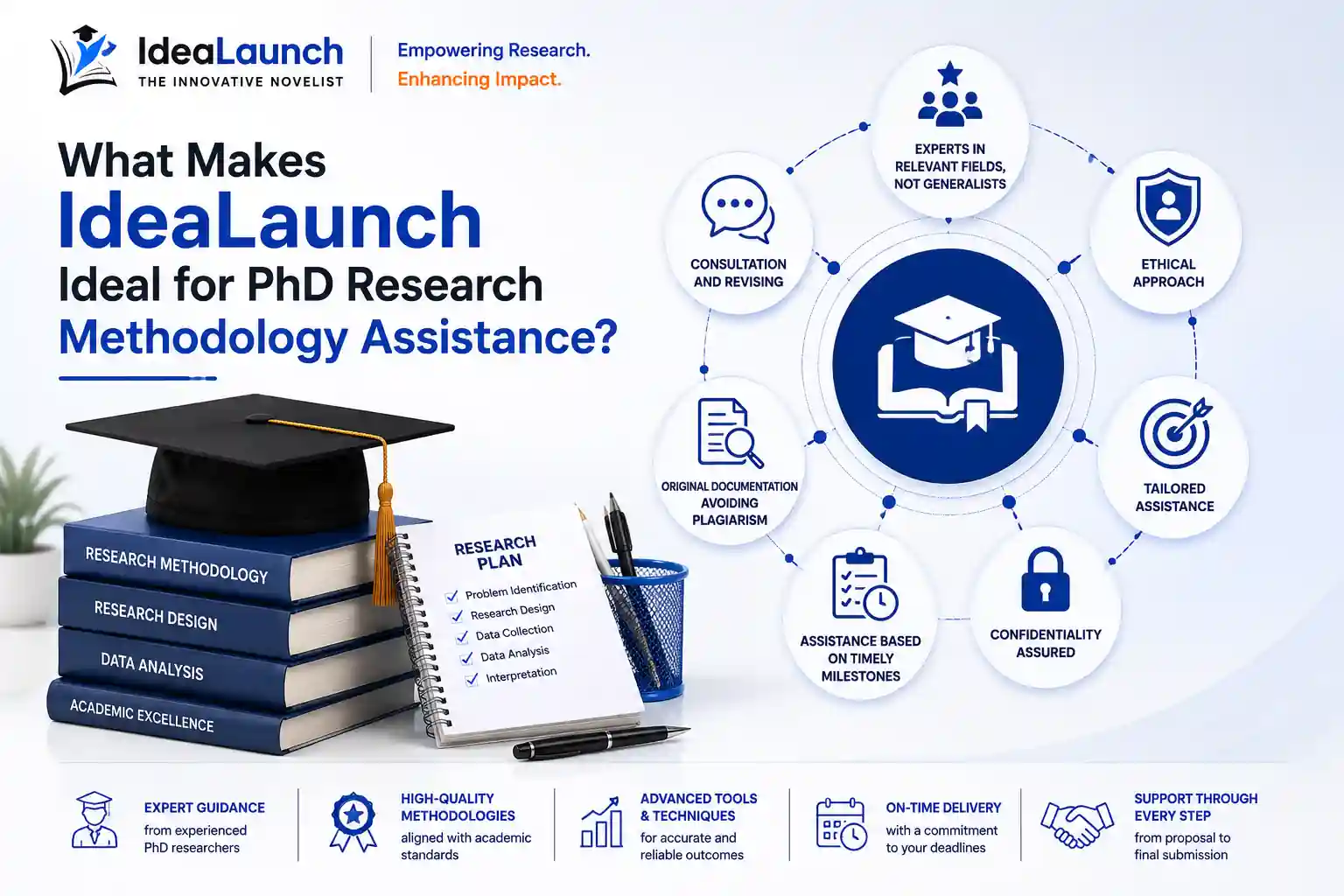
Experts in the relevant fields, not generalists
Your mentor understands the methodologies employed in your field.
Ethical approach
Based on mentoring, ensuring development of your capacity and preservation of your authorship and integrity.
Tailored assistance
according to the requirements of your particular university.
Confidentiality
your topic, information, and draft will remain confidential.
Original documentation avoiding plagiarism
Frameworks prepared just for your research.
Assistance based on timely milestones
Assistance structured according to your deadlines.
Consultation and revising
We will work with you through supervisor consultations until your chapter is finalized.
Who can benefit from our research methodology services?
PhD and MPhil students, Master’s students, faculty members, researchers in industry and R&D, professionals looking to return to academics, and scholars studying abroad who have to adapt to their university conventions. If your research depends upon a design that has to be evaluated against the standard, our services are right for you.

Why Researchers Choose Our Methodology Specialists
We have put together a team of experienced research experts, methodology and statistics experts, and academic editors who have multi domain knowledge that has been developed over a decade of providing PhD thesis writing services. We operate through an open process where you will always be aware of where you are, what is being done, and why it is being done. This ensures that you come to your own conclusions – the only type of assistance that will survive a viva.
Frequently Asked Questions
Clearly define your philosophy and approach, introduce your design and justify its use, explain the sample and data collection process, discuss instruments used and their validity, provide an analysis plan and deal with ethics and limitations, with all decisions being linked to your research question.
A popular format is: research philosophy, approach & design, population and sampling, data collection instruments, validity and reliability, data analysis, ethics, and limitations. We tailor it to your specific university.
It depends on the subject and university, however, the typical length of a methodology chapter for doctoral research is 4,000-8,000 words (15-30 pages).
Firstly, we will analyse your research question, knowledge state of your field, variables and data, your philosophical approach and constraints. Then we will help you write down your rationale for the selected methodology and against others.
Yes. We assist you in picking one among the three main methodologies - qualitative, quantitative, and mixed methods – along with the design and its justification.
Each methodology framework is created from scratch, tailored to fit your particular study, checked for consistency and scientific accuracy, compared to the literature, and jointly worked out.
Expert Assistance for Your PhD Research Methodology Required?
No matter if you need assistance with the beginning or revision of your methodology section, our research experts can assist you in designing your methodology and justifying the selection of methods depending on the aims of your study.