

Choosing the Right Journal for your Research
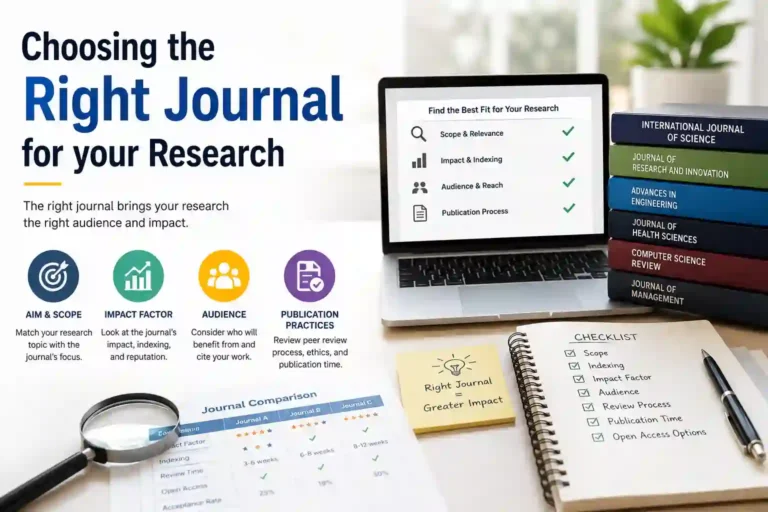
How to Choose the Right Journal for Your Research Paper
Submitting your research paper to an unsuitable journal can result in unnecessary delays, rejection, or limited visibility among researchers in your field. With thousands of academic journals available worldwide, selecting the right journal is one of the most important decisions researchers make before submission.
Why Choosing the Right Journal Matters for Your Research
The journal where your research appears affects visibility, citation potential, and research discoverability among relevant audiences. Even high-quality research may receive limited attention if published in a journal with poor indexing, limited visibility, or an unrelated audience.
Start Journal Selection Before Writing Your Manuscript
Identify your target journal before beginning manuscript preparation. Writing your manuscript with a target journal in mind helps you align the structure, discussion, and formatting requirements with the journal’s expectations. In addition, there is no need for major restructuring of your manuscript after completion.
Where to Begin When Choosing a Research Journal
Narrow down this vast field into a smaller number of realistic options to begin with:
- Desk research: Review journals frequently cited in your literature review and reference list. If the same journals appear frequently in your references, they may become strong candidates for your shortlist.
- Get recommendations from experts — Your supervisors, co-authors, and librarians can provide insights into journal reputation, review timelines, and suitability for your research area. Highly competitive journals often have very low acceptance rates, while reputable mid-tier journals may have higher acceptance rates depending on the discipline and submission volume.
- Use a journal matcher service: Submit your abstract to an automated tool to identify journals that publish similar research.
- Check call for papers — Special themed issues need your manuscript and have a quicker publication process.
How to Evaluate and Shortlist Potential Journals
Once you have some potential targets, test each of them based on actual criteria for a good fit:
- Scope and aims — Is the journal suitable for the type of manuscript you want to submit, and is the topic too narrow, too broad, or too close to what was recently published in the journal?
- Target audience — Determine whether the journal targets a broad academic audience or specialists within your specific research area. Reaching the right audience can improve research visibility and increase opportunities for citation.
- Editorial board composition and affiliations — A qualified editorial board and affiliation with recognized academic societies can indicate journal credibility.
- Review process — Review the maximum word count, figure limits, and reference requirements before writing.
- Article formats and constraints — Check out the maximum word count, figures, and references before you write.
Should You Mention Journal Scope in Your Cover Letter?
Yes. Mentioning the aims and scope of the journal, as well as the particular gap your paper seeks to address, indicates to the editor that you specifically indicate that your manuscript aligns with the journal’s aims and scope rather than being submitted without considering journal suitability.
It is here that authors tend to run into problems – not because of a lack of effort, but because they do not know what the crucial factor is. Many researchers face challenges identifying journal publications that match their manuscript scope and publication goals.
Understanding Journal Metrics
Journal metrics are a tool, not the final verdict. When taken together, they provide more information than any individual metric:
- Impact Factor: The most popular metric, but it describes the journal, not the article, and should be interpreted carefully, especially in smaller research fields where citation patterns may vary.
- CiteScore and SJR: Based on the Scopus database, SJR accounts for the prestige of the citing journal.
- SNIP: Normalized to the field, allowing cross-disciplinary comparisons.
- Altmetric Attention Score: Measures online attention by tracking mentions across news outlets, policy documents, social media platforms, and other digital sources.
Audience or Impact Factor: Which Matters More?
A lower Impact Factor does not necessarily indicate poor quality because a journal can still provide strong visibility if it reaches the right research community. First, think about the audience and relevance, then use metrics for decision-making. If a high-impact-factor, Q1-indexed journal is highly relevant to your research, publishing in such journals usually requires stronger methodology, rigorous analysis, and high-quality evidence.
Understanding Open Access Publishing Options
Publishing a paper via open access (OA) allows everyone in the world to read your research freely and complies with funders’ policies.
What Is the Difference Between Gold and Green Open Access?
| Feature | Gold Open Access | Green Open Access |
|---|---|---|
| Cost | Usually requires an APC (Article Processing Charge). | Free of charge. |
| What’s Shared | Final published article. | Accepted manuscript version. |
| Available When | Immediately after publication. | After the publisher's embargo period. |
| Best For | Immediate funder compliance and maximum visibility. | Researchers without an APC budget or funders that allow delayed access. |
Compare your budget with funders policy and remember to find out if the publisher gives APC waivers to authors from low- and middle-income countries.
Understanding Journal Indexing and Abstracting Databases
Publication doesn’t mean accessibility. Two different processes determine if your article really gets to researchers:
- Abstracting and indexing – databases such as Scopus, Web of Science, PubMed, and DOAJ help researchers discover published articles. The lack of abstracting and indexing can hide even the best research; always investigate it for the target journal before submission, not after.
- Discovery services – institutional discovery services such as ProQuest-ExLibris Primo, EBSCO Discovery Service, and WorldCat Discovery allow searching across all subscribed material. Having good discovery service coverage will help get your article read by those who wouldn’t even browse the journal otherwise.
Most journals indicate their abstracting and indexing status in the “About” or “Indexing” section of their websites, normally alongside the Impact Factor.
How to Identify and Avoid Predatory Journals
Predatory journals often use misleading practices, charge publication fees, and may lack transparent peer-review processes.
What Is Think. Check. Submit. and How Can Researchers Use It?
Run the Think. Check. Submit. checklist, which is an independent, publisher-supported project, and ensure that the journal has:
- An identifiable editorial board, complete with contact information
- An explicit description of the peer-review process and conflict of interest policy
- Verified inclusion in recognized databases such as Scopus, Web of Science, DOAJ, and PubMed.
After the journal itself is verified, it’s time for the manuscript to go through the same process. Proofreading and editing can help identify errors or inconsistencies that may affect reviewer perception.
Journal Publishing Trends Researchers Should Know in 2026
The journal environment is evolving faster than many lists account for. Be aware of these changes:
AI ethics in peer review: Individual journals rather than publishers have different AI disclosure policies, so review your target journal’s specific AI policies before submission. Rather than relying on any general policy. Many journals restrict reviewers from uploading confidential manuscripts into external AI tools because of privacy and confidentiality concerns – ensure compliance with journal AI policies and maintain originality before submission.
Data privacy and decentralised research: In light of stricter data protection and an increasing number of cross-site and cross-border studies, make sure that journal data-sharing and consent policies match your ethics approvals.
Funding and mandate changes – Zero-embargo is becoming increasingly common: Many research funders are moving toward immediate public access requirements for funded research outputs. Several major research funders are increasing requirements for immediate or faster public access to funded research.
Posting your preprints – As an initial step before submission is becoming a more common practice that is accepted by many publications , though there are those who treat preprints as prior publication, so make sure that your target allows that.
Making Your Final Journal Selection Decision
Selecting the right journal requires a holistic evaluation of scope, audience, indexing, metrics, and publication policies. In case the decision-making seems difficult because of multiple choices or the high quality of the target, then getting a second opinion is what makes the difference between publication and rejection.
Idealaunch Professional journal selection support can help researchers identify suitable journals aligned with their manuscript objectives.
Need help identifying suitable journals for your manuscript? Professional journal selection guidance can help you evaluate journal fit, indexing, and publication requirements before submission.