

How to Write a Review Paper for Publication
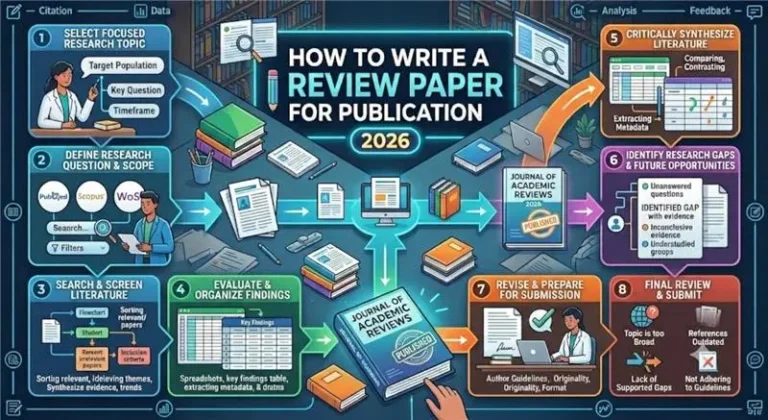
Table of Contents
Expert Tips, Steps & Structure for Writing a Review Paper for Publication
A review paper for publication is not just a compilation of previous studies. This is a comprehensive review of the current research, noting gaps in knowledge and explicitly stating where the current evidence fits in a field. For PhD scholars, postgraduate students, and academic researchers, a well-developed review paper can establish research expertise and provide valuable directions for future studies.
However, choosing appropriate literature, organizing the findings, and meeting the expectations of the journal can be challenging. The process of writing a review paper for publication is a way for researchers to develop a focused, evidence-based manuscript that meets the standards of the academic world.
What is a Review Paper?
A review paper is an academic paper that reviews, compares, and synthesizes existing research on a given topic. It is not primarily a report of fresh experimental data but an assessment of available evidence to account for known facts, conflicting data, methodological limitations, and directions for future research.
Review papers are helpful for researchers to understand the development of a discipline and to find out the questions that have not been answered. A good review goes beyond a simple summary of the literature and makes a distinct contribution to the existing body of knowledge by providing critical analysis.
Different Types of Review Papers
What would be the appropriate review for my research question and aims?
Narrative Reviews:
A narrative review is a critical assessment of the literature, ideas, and developments that exist on a topic.
Systematic review:
This method uses pre-defined search strategies and eligibility criteria to identify, evaluate, and synthesize relevant evidence. See our systematic literature review support
Scoping review:
Mapping the literature to identify key concepts, types of evidence, and research gaps.
Meta-analysis:
A statistical technique for integrating similar quantitative findings, commonly within the framework of a systematic review.
Select a format, but check the guidelines of your target journal. Some journals have special requirements for the submission of reviews.
Essential Components of a Well-Structured Review Paper
The structure may vary according to the discipline and periodical, but below is what a review paper normally contains.
Title, Abstract and Keywords:
State the topic, purpose, methodology, and main results.
Introduction and Research Objectives:
Creation of research context, need for the review, and scope of the review.
Method of literature search and review:
Describe databases used, search terms, and the process of screening and synthesis, where appropriate.
Critical analysis and thematic synthesis:
Analyze studies, appraise evidence, and highlight agreements and contradictions.
Research gaps and future directions:
Pinpoint issues that need clarification and outline research directions.
Conclusion and references:
Conclude on key takeaways and cite the sources used.
How to Write a Review Paper for Publication: 7 Practical Steps
Step 1 — Select a Focused Research Topic
Choose a subject that fits your area of study, that has enough literature to work with and that is not too broad. Analyze recent articles to see if there is any existing review available on the same phd research topic selection and how your article can contribute to it.
Step 2 — Define the Research Question and Scope
State your key question for discussion in the review. Outline the parameters for your study – subject area, goals, target population or technology, and timeframe – if needed. A well-defined scope ensures that your manuscript does not turn into an unconnected set of summaries. Learn more about identifying the research problem.
Step 3 — Search and Screen Relevant Literature
Search for an academic database relevant to your field of study, such as Scopus, Web of Science, PubMed or IEEE Xplore.Use Boolean logic to combine keywords and record your search strategy.
Make sure your inclusion/exclusion criteria are consistent. Deduplicate and evaluate the articles you have chosen. In case of a systematic review, follow the required reporting framework, for instance, PRISMA.
Step 4 — Evaluate and Organize Research Findings
Create a literature review matrix that includes the purpose, method, results, limitations, and contribution of each study. Organize the data in terms of themes, methods, theory used, or chronology of development. Tools like RefWorks can help with correct citations.
Step 5 — Critically Synthesize the Existing Literature
Focus on the comparison of the results rather than the individual papers. Understand how the research is similar or different, whether the methodology is valid, and what limitations might influence the outcomes.
For example, compare datasets, validation methods, performance measures, etc. in the review of machine learning techniques. Thus, an analytical review is carried out.
Step 6 — Identify Research Gaps and Future Opportunities
Identify the gaps in the form of unanswered questions, inconclusive evidence, understudied groups, and methodology flaws. Please elaborate on the importance of these gaps and provide recommendations for future research. Demonstrate each identified gap with evidence, not assumptions.
Step 7 — Revise the Manuscript and Prepare for Submission
Make sure the manuscript is structured, argued, cited, original, and well-written. Evaluate the manuscript in accordance with the author guidelines of the target journal. Seek comments from a peer prior to submitting the manuscript.
Common Errors to Be Avoided in Writing a Review Paper
Be aware of these common mistakes in writing a review paper:
- No comparisons between findings or limitations of the summarized studies.
- The topic is too broad; there is no research question.
- References are outdated / not relevant.
- Lack of supporting evidence to fill research gaps.
- Not adhering to the submission guidelines of the journal.
- Miscitations or not considering research ethics guidelines.
If you avoid these mistakes, you will improve the quality of the manuscript. If your draft already has these issues, review paper rewriting can help restructure it.
Research Ethics and Best Practices for Review Paper Publication
Responsible AI Use in Research and Peer Review
AI is able to help you organize your literature or improve your language, but the researchers have to check everything themselves. Follow journal policies on the use of AI. Do not upload any confidential peer-review manuscripts.
Data Privacy and Confidentiality in Decentralized Research
Review articles related to federated learning, distributed datasets, and multi-institutional research need to consider consent, privacy, data availability, and replicability when necessary.
Research Transparency and Reproducibility
Methods of document searches and screening are relevant for the type of systematic review. Transparency allows readers to comprehend the selection of evidence and conclusion generation process.
Emerging Research Trends and Changing Funding Priorities
Consider the impact of technology, interdisciplinary collaboration, and shifts in the focus of funding on research. Critically discuss these aspects and support your statements with reliable evidence.
Checklist for pre-submission review of a research paper.
Please verify before submitting your manuscript
- The research question, scope, and contribution are well characterized.
- The literature search and selection process are appropriate for the review type.
- This discussion critically evaluates evidence, rather than providing an overview of the research findings.
- All citations, references, tables, and figures have been cited correctly.
- Originality, confidentiality, and AI disclosure have been addressed.
- The chosen journal allows your review type, and the paper conforms to its guidelines.
Frequently Asked Questions
Choose a narrow topic. Critical review of suitable literature. Critically synthesize results. Find research gaps. Follow the directions of the journal to which you are submitting.
Review articles are a critical evaluation and summary of previous research and identify areas for further research.
Check the journal’s scope, accepted types of reviews, guidelines for authors, scopus indexing status , publication fee, and target audience.
Your journal has a particular referencing style to follow. You need to use reference management software to make sure your citations are accurate and consistent.
Briefly explain the purpose of the review, the process for selecting literature, important results, research gaps, and the importance of the review to the journal.
No plagiarism. Cite sources correctly—report methods, and include a declaration of competing interests. Follow the journal’s AI-use policies.
Strengthen Your Review Paper with Expert Research Support
A well-prepared review paper needs to have a proper research question, literature synthesis, referencing, and compliance with journal standards. If you need any help with your review paper preparation, we at IdeaLaunch are ready to help you with your research goals.
Looking for help in improving your review paper for publication? Reach out to IdeaLaunch about your manuscript, research needs, and chosen journal.