

Types of Literature Review
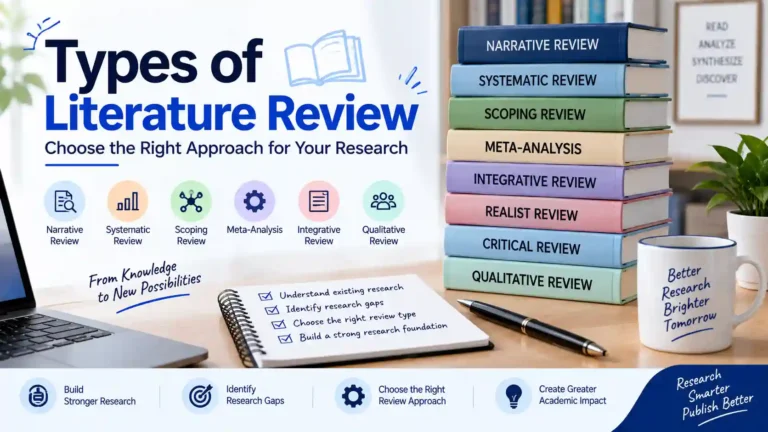
Table of Contents
Types of Literature Review: A Complete Guide for Researchers 2026
A literature review is a significant aspect of academic research. It allows you to know what previous researchers have found out about the same topic as well as where they are lacking in terms of knowledge gaps. A literature review is not merely a summary of the earlier studies conducted. It requires a comparison of various studies and identification of the gaps.
There are many types of literature reviews, including narrative, systematic, scoping, integrative, critical, and rapid reviews. All these have distinct purposes and can be used for different research topics.
The selection of an appropriate kind of literature review is based on the goal of research, the scale of research, and the kind of evidence available. The following paper will describe all significant types of literature reviews and when it is appropriate to use each of them.
What Is a Literature Review?
A literature review is an organized investigation of available literature on a certain topic or question of research. This method allows researchers to know more about what has been investigated before and use this information in order to conduct further research.
In other words, a literature review is used to find answers to the following questions:
“What has already been researched, what have researchers found, and what still needs to be studied?”
Importance of a Literature Review
Literature Review is essential for researchers as it enables them to:
Gain insight into existing research – Know what has been researched on the subject.
Establish research gaps – Determine the areas that require more research.
Prevent duplication – Ensure that the same research is not conducted again.
Compare existing results – Know the similarities and differences among various studies.
Developing a research base – Relate your research to existing theories, concepts, and evidence.
Developing research problem – Formulate the research problem.
Selecting proper methodologies – Learn from methodologies adopted by previous researchers and find the right methodologies for your research.
Defend your research – Explain the importance of conducting your research and its relevance to current knowledge.
Types of Literature Review
There is no single format of literature review applicable for all research work. The format required by the research will depend on the research question being asked, its purpose and the evidence to be analyzed.
1. Narrative Literature Review
Narrative literature review offers a comprehensive and descriptive insight into a research problem. The researcher finds suitable studies, groups them based on their major themes, and describes what has been discovered by previous researchers.
In general, it is quite flexible in terms of searching and selecting studies. Rather than using a very structured approach, the researcher employs academic judgement in identifying literature that is most relevant
🎓 EXPERT INSIGHT
For Example: If you are conducting a PhD study on the effect of AI on higher education, a narrative review can help you explore major developments, prominent theories, key discoveries, and different perspectives within the field.
Best suited for:
- Understanding your topic from a wide-angle perspective
- Gaining an introduction to a research field
- Building theoretical knowledge
- Identifying potential research gaps
Main limitation: Because the search and selection process is not fully standardized, there is a potential for researcher bias.
2. Systematic Literature Review
The systematic literature review is done following a specific process that is consistent in terms of identification, selection, appraisal, and synthesis of existing research evidence.
The researcher starts off with a research question and sets inclusion and exclusion criteria for selecting or deselecting the studies. A search is normally done through different academic databases and then screening of the study is done.
🎓 EXPERT INSIGHT
For Example: Rather than conducting a general research on AI in Education, you could consider asking:
What is the effect of AI-based learning tools on student academic performance?
The literature review would seek out and analyze those studies which match specific criteria.
Best suited for:
- Research questions for investigation
- Synthesis of existing literature
- Evidence-based research
- Identification of agreement or disagreement
Main limitation: This process involves a lot of time, planning, and methodology.
3. Scoping Review
The scoping review is a method that involves mapping the body of knowledge on a broad research topic. Unlike other types of review which attempt to answer a specific question, scoping reviews focus on what has been researched, how the research was conducted, and what still remains unstudied.
This type of literature review is especially helpful when a field of study is new, complicated, or undefined.
🎓 EXPERT INSIGHT
For Example: A person researching on "AI in healthcare" may employ a scoping review method to establish various uses of AI, the population studied, methodology used, and those topics that have been neglected.
Best applicable to:
- Wide-ranging research subjects
- New fields of research
- Literature mapping
- Research gap analysis
- Knowing the volume of existing literature
Main limitation: It often gives a map of the evidence rather than a thorough response on the effectiveness of the intervention.
4. Integrative Literature Review
An integrated literature review combines the findings from various forms of research, including quantitative research, qualitative research, and theory.
It is meant to provide a fuller understanding of the research problem through various perspectives and forms of evidence.
🎓 EXPERT INSIGHT
For Example: An example of how someone may conduct an investigation into employee well-being is by doing surveys, conducting interviews, and analyzing theoretical works.
Best used for:
- Research that is complex in nature
- Use of various evidences
- Generating new frameworks or perspectives
- Interdisciplinary research
Main limitation: Combining studies that have very different designs could be difficult.
5. Critical Literature Review
The critical literature review is not just about reviewing existing studies but goes further to analyze the quality, premises, arguments, strengths, weaknesses, and limitations of those studies.
🎓 EXPERT INSIGHT
The researcher asks questions such as:
- Are the research methods appropriate?
- Are the conclusions supported by the evidence?
- Do studies agree or contradict each other?
- What limitations exist in previous research?
- What assumptions have researchers made?
Most appropriate for:
- Assessing existing literature
- Questioning existing arguments
- Finding gaps in previous studies
- Constructing solid research justification
Main limitation: Strong analytical and critical thinking skills are necessary.
6. Theoretical Literature Review
Theoretical literature review is that which is concerned with the theories, concepts, models and theoretical framework regarding a research issue.
Instead of focusing on the results from each study, the review looks at the theories that explain the phenomenon and the connections between them.
🎓 EXPERT INSIGHT
For example: The theoretical review can help in comparing various motivation theories in relation to the research problem and determining the relevance of certain concepts in studying employee motivation.
Best suited for:
- Comparison of theories
- Conceptual framework development
- Theoretical gaps identification
- Research that heavily relies on theories
Main limitation: It is unlikely to provide enough evidence concerning real-world impacts by itself.
7. Methodological Literature Review
Methodological Literature Review involves a discussion about research methodology, design, technique, and approach that has been adopted by past research.
The researcher assesses how the past researchers have studied a particular issue and highlights the strengths and weaknesses of their methodology.
🎓 EXPERT INSIGHT
For example: A consumer behavior researcher could evaluate how past studies conducted surveys, interviews, experiments, or used mixed methods.
Best suited for:
- Choosing the right research methodology
- Recognizing gaps in methodological research
- Comparing different research methodologies
- Enhancing research methodology
Main limitation: It is mostly concerned with how the research was done rather than what the research discovered.
8. Rapid Literature Review
The rapid review offers evidence within a shorter period of time through a fast-tracked approach to conducting a systematic review.
Several aspects may be simplified or limited to shorten the process of searching, screening, and analysis.
🎓 EXPERT INSIGHT
Best suited for:
- Time-dependent research
- Decision making and policies
- Assessment of preliminary findings
- When conducting a systematic review is impractical
Main limitation: However, since some systematic processes can be simplified, it may result in missing out on some evidence.
9. Umbrella Review
An umbrella review consolidates evidence from prior systematic reviews and meta-analyses instead of investigating primary studies.
It is helpful in cases where there are numerous systematic reviews within a certain research field and an overall understanding of evidence is required.
🎓 EXPERT INSIGHT
For example: In case a number of systematic reviews have been published on various aspects of exercise and mental health, conducting an umbrella review could synthesize those studies.
Best suited for:
- Established domains of research
- Comparative analysis of results from several systematic reviews
- High-level summary of evidence
Main limitation: Its quality is highly dependent upon the quality of the systematic reviews used.
10. Meta-Analysis
Meta-analysis is a statistical technique that enables combining the numerical findings of several quantitative studies.
Rather than just reporting on findings of several research studies, the researcher combines their findings numerically.
🎓 EXPERT INSIGHT
For example: If 15 research papers are conducted to see if a particular approach to teaching enhances student achievement, then it is possible to conduct a meta-analysis that combines the results.
Best suited for:
- Quantitative research
- Similar findings in studies
- Determining a combined effect size
- Improving statistical power through study combination
Important: Meta-analysis can be regarded as evidence synthesis and not as a distinct literature review approach.
11. Qualitative Meta-Synthesis
Qualitative meta-synthesis is a process through which results of several qualitative studies are combined to obtain a more in-depth understanding of a subject matter of interest.
In contrast to statistical combinations of results, the researcher analyzes the themes, concepts, experiences and interpretations of qualitative studies.
🎓 EXPERT INSIGHT
For example: The experience of international students can be analyzed by the researcher using a synthesis of results from various studies based on interviews.
Best suited for:
- Experiences and perceptions
- Social and behavioral research
- Interviews and observations
- Interpretations and deeper understandings
Main limitation: Various qualitative studies may employ varying concepts and methods, making synthesis difficult.
Quick Comparison of the Major Types
| Type | Main Purpose | Best Used When |
|---|---|---|
| Narrative | Understand and explain a topic | You require a broad understanding |
| Systematic | Ask a relevant question | You need organized information |
| Scoping | Mapping of available literature | This subject area is broad or new |
| Integrative | Use evidence from various sources | The problem is complicated |
| Critical | Research should be evaluated and questioned | You require further analysis |
| Theoretical | Investigate theories and concepts | Theory is crucial in your investigation |
| Methodological | Investigate research methods | You have to analyze research methodologies |
| Rapid | Show results promptly | Time is limited |
| Umbrella | Review existing reviews | Many systematic reviews already exist |
| Meta-analysis | Statistically synthesize findings | There are comparable quantitative results |
| Qualitative meta-synthesis | Synthesize qualitative findings | You require more insight into experiences |
How to Choose the Right Type
The simplest method is to begin with the purpose of your research:
- Want to understand a topic? → Narrative review
- Want to answer a specific question? → Systematic review
- Want to map a broad research area? → Scoping review
- Want to combine different evidence? → Integrative review
- Want to evaluate previous research deeply? → Critical review
- Want to examine theories? → Theoretical review
- Want to examine research methods? → Methodological review
- Need evidence quickly? → Rapid review
- Want to summarize existing reviews? → Umbrella review
- Want to combine statistical findings? → Meta-analysis
- Want to combine qualitative findings? → Qualitative meta-synthesis
When writing a PhD thesis, the most critical issue is not to choose any literature review format based on its popularity. You should first formulate your research question and objective, and only then choose the appropriate format for reviewing evidence.
Tools and Resources for Literature Review
| Research Stage | Tools / Resources | How They Help |
|---|---|---|
| Find research papers | Scopus, Web of Science, Google Scholar, PubMed | Locate appropriate and credible academic resources |
| Discover related studies | Semantic Scholar, ResearchRabbit, Connected Papers, Litmaps | Find similar articles, authors and citation networks |
| Organize references | Zotero, Mendeley, EndNote | Manage documents, control PDFs, and arrange citations |
| AI-assisted research | Elicit, Consensus, Scite | Discovering, understanding, comparing and analyzing research findings |
| Screen studies | Rayyan, Covidence | Screen papers and determine inclusion/exclusion criteria |
| Systematic review guidance | PRISMA, Cochrane Handbook, JBI Manual | Use established techniques and reporting standards |
| Register review protocols | PROSPERO | Register Systematic Review Protocols |
| Qualitative analysis | NVivo, ATLAS.ti | Coding and analyzing qualitative data |
| Statistical analysis | R, SPSS | Conducting statistical analysis and research synthesis |
| Meta-analysis | RevMan, R | Integrate results from several different quantitative studies |
| Citation tracking | Scopus, Web of Science, Google Scholar, Scite | Monitor references to find related papers or influential studies |
Common Mistakes to Avoid in a Literature Review
Qualitative meta-synthesis is a process through which results of several qualitative studies are combined to obtain a more in-depth understanding of a subject matter of interest.
In contrast to statistical combinations of results, the researcher analyzes the themes, concepts, experiences and interpretations of qualitative studies.
| Common Mistake | What to Avoid | What to Do Instead |
|---|---|---|
| Only summarizing studies | Description of each research paper | Comparison of results, approaches, and conclusions |
| Using irrelevant sources | Papers that are somewhat connected to your research topic | Choose papers that directly relate to your research question |
| Relying on outdated research | Relying mainly on older literature without any justification | Consider incorporating recent and significant literature where appropriate |
| Using only one database | Relying exclusively on Google Scholar or one database | Consult several appropriate academic databases |
| Poor search strategy | Use random keywords or a limited search | Develop a precise list of keywords and searches |
| No inclusion/exclusion criteria | Studies selected with no justification | Criteria should be defined before selecting literature |
| Ignoring research quality | Treat all published papers with equal reliability | Evaluating the strengths, weaknesses, methodologies, and limits of each study |
| Missing contradictory findings | Including only research that supports your argument | Agreements, disagreements, and potential explanations |
| Failing to identify research gaps | Conclusion with a summary of past research works | It should clearly define the gap in research |
| Weak organization | Listing literature without an organized approach | Organizing Literature Based on Themes, Concepts, Methods or Chronology |
| Poor citation practices | Making claims without appropriate citation and over-citing | Citation of original and relevant sources |
| Depending too much on AI tools | Use of AI-created summaries without cross-checking papers | Compare important data with the actual research study |
| Plagiarism or excessive copying | Copying sentences or ideas without providing proper credit | Use paraphrasing techniques and mention the original source |
| Choosing the wrong review type | Selecting a review methodology just because it is widely used | Pick the methodology that fits your research problem and objective |
How IdeaLaunch Can Assist With Literature Review
A literature review can be time-consuming, especially for PhD researchers who need to find relevant studies, organize evidence, identify gaps, and present the review clearly. IdeaLaunch can provide research support throughout these stages.
| Research Need | How IdeaLaunch Can Assist |
|---|---|
| Topic & Research Question | Help formulate the research topic, the objectives, research questions, and scope of the literature review. |
| Literature Search | Help in the identification of keywords, search strategy, and appropriate academic databases. |
| Relevant Research | Help identify and organize important studies that are relevant to the research topic. |
| Literature Organization | Categorize the studies based on themes, theories, methodology, findings, or research years. |
| Critical Analysis | Compare and contrast past studies with regards to their strengths and weaknesses. |
| Research Gap Identification | Identify gaps in the literature through an analysis of past studies. |
| Theoretical Framework | Bridge gaps between relevant theories, ideas, and results to provide a sound theoretical background. |
| Review Writing | Help you structure and build your literature review. |
| Citation & Referencing Support | Ensure consistency of academic citation and referencing as per the required style. |
| Revision & Improvement | Enhance clarity, structure, academic style, coherence, and relevance to research objectives. |
| PhD Research Support | Offer suggestions on writing the literature review that is relevant to the research problem, research methodology, and contribution of the thesis. |
Frequently Asked Questions?
Not all types of reviews can be said to work best for all PhDs. The correct type of review will vary according to your research question and the objective, discipline, scope, and evidence you have at hand.
First, you should clarify what you hope to accomplish with your review. If you are looking for a general idea, a narrative review may fit well. If you need an answer to an evidence-based question, then you may consider using a systematic review.
There is no specific number here. The number of articles needed varies with the research question, type of review, scope, and availability of relevant literature. Quality and relevancy should be more important than having a higher number of articles.
Research gaps can be found out through comparing research results, finding any limitations in previous research, searching for inconsistencies in results, understudied population or context, and finding unaddressed questions from previous research.
Yes. The AI tools can help in literature searches, summarization, organizing, and finding related studies. Researchers must verify vital information from the actual papers to maintain academic and ethical standards.
IdeaLaunch offers academic research and literature review support services for researchers who seek help in literature searches, organizing, analyzing critically, finding research gaps, organizing literature reviews, academic writing, citations, and revisions.
Yes. IdeaLaunch can offer assistance through important phases of the systematic review process, such as developing a research question, devising a search strategy, organizing literature, conducting screening, synthesis of findings, and writing the review, depending on the research needs.
Yes. A pre-existing literature review can be checked for structuring, coherence, critical thinking, research gaps, academic writing, citation consistency, and adherence to the research objectives.
How IdeaLaunch Can Support Your Literature Review
A good literature review should not be a compilation of research papers alone. It requires a research direction, research evidence, critical analysis, synthesis, and research gap identification.
Researchers who work with IdeaLaunch have the benefit of academic assistance at various stages of the literature review process, from research searching and study organization through to previous research analysis, gap identification, structure development, and revision of the final draft.
Whether you are working on your PhD thesis, dissertation, research proposal, systematic review, or even a manuscript for a journal, it can be customized as per the requirements of your research work.
Want help in making your literature review more robust for your research work? Then contact IdeaLaunch for your research topic and requirements.