

UGC Norms on AI Usage in PhD 2026
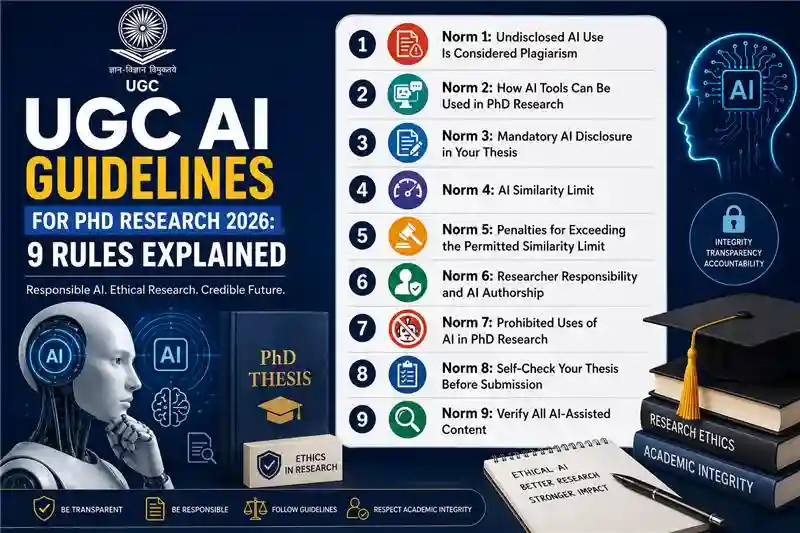
UGC AI Guidelines for PhD Research in 2026: Everything You Need to Know
Are you a PhD researcher in India using ChatGPT, Grammarly, or other AI tools during your research? Before you continue, read this first.
UGC has issued guidelines for the use of Artificial Intelligence in PhD research, and non-compliance with these guidelines may result in academic consequences. From cancellation of the PhD thesis to a one-year debarment, these consequences can significantly affect your academic progress.
This article explains the nine key UGC guidelines on AI use in PhD research.
Why Has UGC Issued AI Guidelines?
Tools such as ChatGPT, Gemini, Claude, etc., have revolutionized how students conduct their writing, analysis, and research. Although there is nothing wrong with this type of tool, it becomes a significant threat to academic integrity when used improperly.
Purpose of the UGC AI Guidelines 2026
- Promote originality in PhD research
- Prevent AI-generated content from replacing original research
- Ensure accountability for researchers and supervisors
- Maintain the credibility of Indian academic research internationally
Norm 1: Undisclosed AI Use Is Considered Plagiarism
This is a crucial guideline for maintaining ethical AI usage in research. If you use AI in your PhD thesis without disclosing it, it will be regarded as plagiarism by UGC.
The UGC won’t care what exactly you did using AI, be it writing a paragraph, a summary of an article, or generating some ideas. It may be treated as academic misconduct or plagiarism if not properly disclosed.
✅ Key point: Always disclose your use of AI. No exceptions.
Norm 2: How AI Tools Can Be Used in PhD Research
However, not all types of AI use are prohibited. The UGC permits using AI for:
- Correcting grammar and language
- Improving grammar
- Improving language (making your writing more understandable)
- Translating (converting the content from one language into another)
These uses are generally considered assistive rather than substitutive. This means AI assists your writing without replacing your original ideas.
✅ Key point: AI can support editing and translation tasks, provided its use is reported in accordance with institutional guidelines.
Norm 3: Mandatory AI Disclosure in Your Thesis
If you use AI tools in your research, even for grammar checking, you will be required to mention it in the thesis preface or acknowledgment section.
Required AI Disclosure Details
- Mention the AI tool used (e.g., ChatGPT, Grammarly).
- Specify the version of the AI tool you used (e.g., ChatGPT-4 or GPT-4o).
- Purpose of use
Example of AI Disclosure: “AI-assisted language editing and grammar review were used to improve the clarity of this thesis. All research, analysis, interpretations, and conclusions are the author’s original work.”
✅Key Point: Always be honest. Following proper disclosure practices can help prevent serious academic issues.
Norm 4: AI Similarity Limit
If your institution follows AI similarity guidelines, ensure your thesis complies with the prescribed similarity limits under the applicable plagiarism policy.
This means that the combined score from AI detection and plagiarism software, such as Turnitin’s AI writing indicator, should remain below 10%.
✅Key Point: Use a very small amount of AI-generated text and paraphrase it properly.
Norm 5: Penalties for Exceeding the Permitted Similarity Limit
The penalties vary depending on the percentage of AI-generated or plagiarized content identified in your thesis.
Level of AI Similarity | Penalty |
10%- 40% | Resubmit after revising within 6 months |
40%- 60% | Banned from doing a PhD for 1 year |
Above 60% | Registration of PhD cancelled |
✅Key Point: Be careful, do not take any risks! Always use AI tools responsibly and cross-check the similarity percentage.
Norm 6: Researcher Responsibility and AI Authorship
According to UGC guidelines, both the PhD scholar and supervisor share responsibility for ensuring the ethical use of AI in the thesis. The supervisor cannot claim unawareness , like not knowing anything about it, when the student uses a lot of AI-generated content in the thesis.
In addition to that, AI tools cannot be considered as the co-author or contributor in your research as well. AI can support the research process, but it cannot replace human expertise, academic judgment, or the researcher’s contribution.
✅Key Point: Ensure every section of your thesis reflects your own work and responsibility. Do not use any shortcuts in your PhD journey.
Norm 7: Prohibited Uses of AI in PhD Research
According to these guidelines, AI should not be used for the following core research activities:
- Generating the literature review
- Data Analysis
- Findings
- Conclusion
- Core Arguments
Why? AI can never substitute original academic writing and critical thinking. Your thesis should reflect your original intellectual work at every stage of the research process.
✅Key Point: Your research should reflect your own critical thinking, interpretation, and academic judgment.
Norm 8: Self-Check Your Thesis Before Submission
Prior to submitting your thesis, it is highly recommended by UGC to run your paper through AI/plagiarism detection tools. Those include:
- Turnitin – a well-known plagiarism and AI detector
- DrillBit – commonly used in Indian institutions for plagiarism checks
Many institutions may reject theses that exceed their permitted AI or plagiarism limits.
✅Key Point: Make sure to self-check your paper via Turnitin or DrillBit before your supervisor or institution does it.
Norm 9: Verify All AI-Assisted Content
Even when AI is used for permitted purposes such as editing, grammar improvement, or translation, you remain responsible for ensuring the accuracy of your thesis content.
AI Tools can:
- Generate inaccurate or fabricated information and references
- Create plausible-looking but erroneous information
- Fabricate details about authors, dates, or results of studies
Always verify AI-assisted content against reliable academic sources, particularly for factual claims.
✅Key Point: You are the researcher. AI is only a tool. The accuracy of your thesis is your responsibility.
Summary of UGC AI Guidelines
Norm | Rule |
1 | Undisclosed AI = Plagiarism |
2 | AI usage is only allowed for editing, grammar, and translation |
3 | Mention the AI tool’s name, version, and purpose in your thesis |
4 | Combined AI and plagiarism similarity below the permitted limit |
5 | Punishments vary from resubmission to termination |
6 | Both the scholar and his supervisor are accountable; AI is not a co-author |
7 | AI is forbidden for core research (literature review, analysis, conclusion) |
8 | Submit your thesis after checking it on Turnitin/DrillBit |
9 | Verify all AI-generated content for correctness |
Conclusion: AI Is a Tool, Not a Substitute for Research
The UGC’s 2026 rules reinforce an important principle. AI is a tool and not a replacement for research.
When used ethically and openly, AI can assist you in improving language and presentation. However, your analysis, critical thinking, and conclusions must always remain your own. PhD research is about making your contribution to the field of knowledge, and no AI can do that for you.
Use AI responsibly. Disclose AI usage transparently. Conduct research ethically.