

Web of Science ESCI Journals in May 2026
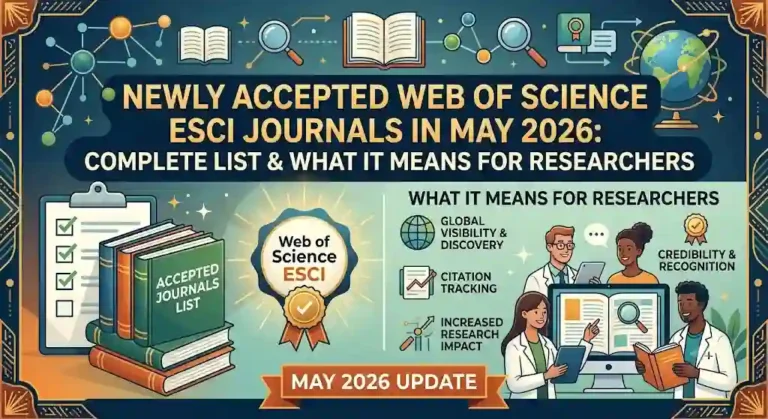
Understand what the Web of Science Master Journal List
Are you an academic researcher, journal editor, or publication strategist? Here comes another update for you to mark your calendar. In May 2026, Clarivate’s Web of Science will announce yet another list of 24 journals that have successfully earned their way into the Emerging Sources Citation Index (ESCI).
Why should you care? ESCI indexing is known worldwide as an important indicator of the quality, credibility, and internationality of a journal. If you are a researcher, this may provide you with new opportunities for publishing papers that will truly matter. If you are an editor or publisher, this will be proof of all your hard work on peer review and editorial practices.
In today’s post, we go over the entire list of newly included journals, highlight the different fields and publishers, and tell you what ESCI inclusion will mean for your academic career.
What Is the Emerging Sources Citation Index (ESCI)?
Before we look at the entire list, let us get acquainted with the concept of ESCI and learn about its importance in academic publishing.
The Emerging Sources Citation Index is one of the indexes of the Web of Science Core Collection launched by Clarivate Analytics in 2015. This index has been created to index journals that have shown high editorial quality and regional or worldwide importance, even though they have not achieved the citation impact necessary for the SCIE or SSCI databases.
Why ESCI Indexing Matters for Researchers and Publishers
- Worldwide Availability: Articles in ESCI indexed journals can be easily found through Web of Science search engines, thus making them very visible to readers worldwide.
- Official Approval: In many countries, universities and research institutions approve of ESCI index as a legitimate measure of scholarly output.
- Steps Towards Greater Indexing: The high editorial standards of ESCI indexed journals lead to their regular assessment for SCIE/SSCI indexing – the highest indexes available on Web of Science.
- Author Credibility: Publication in an ESCI-indexed journal can go a long way in improving the author’s scholarly reputation and can even be used for grants, tenure, and promotion.
Complete List: All 24 Newly Accepted Web of Science ESCI Journals – May 2026
Below is the complete list of journals indexed in the ESCI of Web of Science with their publishers, print ISSN, and E-ISSN as officially recorded this month.
| Sr | Journal | Publisher | ISSN | E-ISSN |
|---|---|---|---|---|
| 1 | Journal of Rural Mental Health | Amer Psychological Assoc | 1935-942X | 2163-8969 |
| 2 | Nexus | Elsevier | – | 2950-1601 |
| 3 | Archaeologia Polona | Polish Acad Sciences, Inst Archaeology & Ethnology | 0066-5924 | 2719-6542 |
| 4 | Journal of Structural Engineering & Applied Mechanics | Golden Light Publ | – | 2630-5763 |
| 5 | ACM Transactions on Evolutionary Learning and Optimization | Assoc Computing Machinery | – | 2688-3007 |
| 6 | Nordic Journal of Nursing Research | Sage Publications Inc | 2057-1585 | 2057-1593 |
| 7 | Mediastinum | AME Publishing Company | – | 2522-6711 |
| 8 | Journal of Liver Cancer | Korean Liver Cancer Assoc | 2288-8128 | 2383-5001 |
| 9 | Endocrine Oncology | Bioscientifica Ltd | – | 2634-4793 |
| 10 | Journal of Dynamics, Monitoring and Diagnostics | Intelligence Science and Technology Press – ISTP Press | 2833-650X | 2831-5308 |
| 11 | Probability and Mathematical Physics | Mathematical Sciences Publishers | 2690-0998 | 2690-1005 |
| 12 | Arte Nuevo | Univ Neuchatel | 2297-2692 | 2297-2692 |
| 13 | Estudios En Seguridad Y Defensa | Escuela Superior Guerra-Esdeg | 1900-8325 | 2744-8932 |
| 14 | Memory, Mind & Media | Cambridge Univ Press | – | 2635-0238 |
| 15 | Possibility Studies & Society | Sage Publications Inc | – | 2753-8699 |
| 16 | Taiwanese Journal of Psychiatry | Wolters Kluwer Medknow Publications | 1028-3684 | 2666-2078 |
| 17 | Virtual Worlds | MDPI | – | 2813-2084 |
| 18 | ACM Transactions on Recommender Systems | Assoc Computing Machinery | – | 2770-6699 |
| 19 | AI in Precision Oncology | Mary Ann Liebert, Inc | 2993-091X | 2993-0928 |
| 20 | Frontiers in Amphibian and Reptile Science | Frontiers Media Sa | – | 2813-6780 |
| 21 | Frontiers in Anesthesiology | Frontiers Media Sa | – | 2813-480X |
| 22 | Aquaculture Journal | MDPI | – | 2673-9496 |
| 23 | Intestinal Failure | Elsevier | – | 2950-4562 |
| 24 | Waste | MDPI | – | 2813-0391 |
Key Trends: Which Fields Are Growing in ESCI?
This month’s additions highlight very clear trends with regards to which academic disciplines are becoming more prevalent in institutions around the world.
Leading the Charge: Medical & Health Sciences
First and foremost is the strength shown by the medical and health sciences discipline. The following medical journals were indexed: Journal of Rural Mental Health, Taiwanese Journal of Psychiatry, Journal of Liver Cancer, Endocrine Oncology, AI in Precision Oncology, Mediastinum, Frontiers in Anesthesiology, and Intestinal Failure. This clearly demonstrates the rapid expansion of specialized biomedical literature and the ongoing efforts of Clarivate to index highly clinical journals that meet international standards.
Artificial Intelligence and Computing Are on the Rise
There are two journal titles published by the Association for Computing Machinery (ACM): ACM Transactions on Evolutionary Learning and Optimization and ACM Transactions on Recommender Systems, along with AI in Precision Oncology and Virtual Worlds. All four of these titles prove that artificial intelligence, machine learning, and computing are getting due importance in the most prestigious indexes. It is recommended that technologists in other fields keep a close eye on these titles.
Environmental and Sustainability Sciences Are Growing
Journals like Waste and Aquaculture, which are published by MDPI, indicate the increasing importance of environmental management, sustainability in food production, and ecology studies within the international indexing environment. In view of the increasing amount of funding being poured into climate research internationally, the ESCI listing of such journals is indeed an important step.
The Humanities and Social Sciences Get Their Share
The disciplines such as archeology (Archaeologia Polona), security and defense (Estudios En Seguridad Y Defensa), cognitive media (Memory, Mind & Media), futures studies (Possibility Studies & Society), and art studies (Arte Nuevo) are all included in this journal cycle. It is especially significant for scholars working in the humanities and social sciences, where indexing in Web of Science has traditionally been less frequent than in the natural sciences.
Engineering and Pure Sciences Remain Stable
The last three journals completing the list of technical sciences are Journal of Structural Engineering & Applied Mechanics, Journal of Dynamics, Monitoring and Diagnostics, and Probability and Mathematical Physics, indicating that engineering and pure science journals remain stable along with their rapidly developing counterparts.
Which Publishers Are Represented in the May 2026 ESCI Update?
The presence of publishers in this cycle is a mix of old guard academic giants and new emerging open-access publishers:
- MDPI, which has been growing at an exponential rate in open-access academic publishing in various fields, puts up three journals (Virtual Worlds, Aquaculture Journal, Waste).
- Frontiers Media Sa brings in two journals (Frontiers in Amphibian and Reptile Science, Frontiers in Anesthesiology), demonstrating its strong standing in open-access scientific publishing.
- Elsevier brings in two journals (Nexus and Intestinal Failure), showing its dominance across disciplinary boundaries.
- Association for Computing Machinery (ACM) puts up two journals, signifying the growing need for computer science journals worldwide.
- Sage Publications Inc adds two journals from nursing and social sciences (Nordic Journal of Nursing Research, Possibility Studies & Society). This demonstrates that established publishers of social science journals keep expanding their collections of indexed journals.
- Cambridge University Press, Wolters Kluwer Medknow, Mary Ann Liebert, Bioscientifica, Mathematical Sciences Publishers, AME Publishing Company, Korean Liver Cancer Assoc., Escuela Superior Guerra-Esdeg, and a number of other regional organizations complete the list.
How to Use This List for Your Research Publication Strategy
Are you an author looking to submit your next manuscript? Here’s how to leverage the latest additions to ESCI:
- Focus on newly added journals. Newly added journals will be actively publishing their indexed content. This may mean quicker editorial responses and a lower chance of rejection than established journals. Don’t wait for competition to heat up; submit your paper now.
- Find the journal that matches your field. Look at the list of disciplines above and see if any of the 24 journals fit your field. Matching topics increases your chances of getting published and cited.
- Make sure you understand the scope and submission guidelines of each journal. The scope of each journal varies – AI in Precision Oncology is interdisciplinary whereas Probability and Mathematical Physics is highly specialized. You should always make sure that your research falls within the aims and scope of the journal before submission.
- Cite using the E-ISSN. All 24 journals have valid E-ISSNs, which means that they are actively available digitally. Make sure you cite your publication using the E-ISSN.
Final Thoughts
The addition of 24 new journals to the list of journals indexed by Web of Science ESCI in May 2026 is a clear indicator of how the field of academic publishing is developing at a breakneck pace — becoming more specialized, more international, and more interdisciplinary than ever.
If you are a researcher trying to decide which journal to submit your work to, a librarian trying to update your library’s journal subscriptions, or a journal editor trying to gauge how your journal compares with others, this list is worth your time.
Bookmark this page, send it around to your fellow researchers in your department, and keep coming back to it as we continue to monitor developments on the Web of Science ESCI, SCIE, SSCI, and other key academic databases.