

Thesis of Dr BR Ambedkar
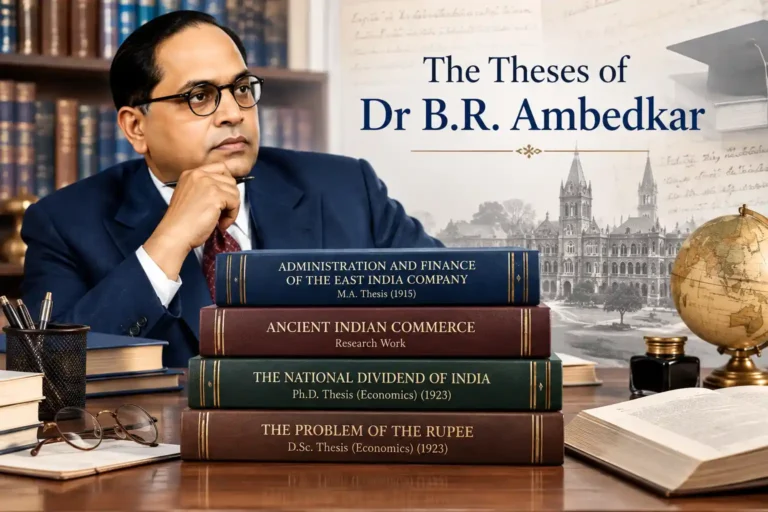
Table of Contents
Supporting Researchers at Every Stage
IdeaLaunch offers comprehensive academic and research assistance to help scholars succeed throughout their research journey. Whether you’re preparing a manuscript, publishing in a Scopus-indexed journal, or completing your PhD research, our experts provide end-to-end support.
Expertise That Supports Your Research
- PhD Research Assistance
- Research Paper Writing Help
- Thesis & Dissertation Writing
- Manuscript Writing & Editing
- Scopus Journal Publication Support
- Literature Review Writing
- Research Methodology Assistance
- Statistical Data Analysis (SPSS, AMOS, SmartPLS)
- Plagiarism Checking & Proofreading
- Journal Submission & Reviewer Response Support
Thesis of Dr BR Ambedkar: Major Academic Works and Contributions
Introduction
The thesis of Dr BR Ambedkar holds great significance for the students, researchers, and readers interested in the history, economy, and social changes in India. Although Dr. Bhimrao Ramji Ambedkar is known as the chief architect of the Indian Constitution, he also made significant contributions to the field of economics. His research revolved around colonial finance, monetary systems, state management, and fiscal systems that governed the country’s economy.
Thesis of Dr. BR Ambedkar is the title of various academic writings instead of one research paper. In his tenure as a student at Columbia University and the London School of Economics (LSE), Ambedkar focused on examining the financial and administrative system of colonial India.
His key works include “Administration and Finance of the East India Company,” “The Evolution of Provincial Finance in British India,” and “The Problem of the Rupee: Its Origin and Its Solution.” All three works addressed separate economic issues and showed how he could integrate history and criticism.
These studies provide an important learning experience for researchers of today. The purpose of this essay is to illustrate Ambedkar’s contributions in academia, compare his research topics, and examine how students can employ his research methods while conducting their studies.
What Was the Thesis of Dr BR Ambedkar?
Dr BR Ambedkar published various academic works during his higher studies. The following works are of great significance:
- The Administration and Finance of the East India Company: His MA thesis work, written and submitted in 1915 to Columbia University.
- The Evolution of Provincial Finance in British India: A significant work on colonial public finance, published in 1925, which was linked to his Columbia PhD in 1927.
- The Problem of the Rupee: Its Origin and Its Solution: LSE doctoral thesis work, accepted and published in 1923.
The topics of each study were varied. The first focused on colonial administration and finance. The second studied the distribution of financial responsibility among the central government and the provincial governments. The third considered India’s money supply and problems surrounding monetary stability.
Other research projects, which Ambedkar pursued earlier, are Ancient Indian Commerce and National Dividend of India: A Historic and Analytical Study. Both of them should not be confused with university dissertations of the scholar
Dr BR Ambedkar's Academic Journey
Ambedkar’s educational career saw him travel from the University of Bombay to Columbia University in the US and the London School of Economics in the UK.
Following his education at University of Bombay, he got financial aid from Maharaja of Baroda and joined Columbia University for higher studies. He earned his master’s degree in 1915 and proceeded with further research in the field of economics and allied subjects.
The lecture “Castes in India: Their Mechanism, Genesis and Development” was delivered by him in 1916 at an academic conference. This was a research paper as compared to a dissertation that showed his desire to know more about society and its inequalities.
Ambedkar proceeded to study further in London, where he did research on the topic of provincial finances and monetary policy.
Important Academic Milestones
| Year | Academic achievement |
|---|---|
| 1915 | Submitted Administration and Finance of the East India Company for his Columbia M.A. |
| 1916 | Presented his research paper Castes in India. |
| 1921 | Received his LSE master's degree following research on provincial financial decentralisation. |
| 1923 | His doctoral thesis on Indian currency was accepted and published as The Problem of the Rupee. |
| 1925 | Published The Evolution of Provincial Finance in British India. |
| 1927 | Columbia University formally awarded him the PhD associated with his provincial-finance research. |
Columbia University’s academic timeline confirms that Ambedkar received his PhD on June 8, 1927.
1. Administration and Finance of the East India Company
Administration and Finance of the East India Company was Ambedkar’s M.A. dissertation at Columbia University, submitted on May 15, 1915.
Before the year 1858, the East India Company was controlling huge territories in India. The administration of the East India Company was based on the principles of taxes, revenue, expenditures of the government, and loans.
Ambedkar studied how these financial arrangements worked in colonial administration. His study brought together economic resources with political power, demonstrating that financial management was an essential component of colonial administration.
The topics covered by the dissertation include the areas of revenue, expenditure, financial liabilities, and the connection between government administration and economic resources.
Why is this work important?
This dissertation shows Ambedkar’s early interest in public finance and accountability. This dissertation is an example that can illustrate how historical facts can serve in explaining the financial base of a political system.
History students and economic or public administration students can gain valuable knowledge about proper academic research from this approach. An effective academic research must begin with an accurate research question and analysis of relevant literature.
Researchers who require help with setting up research questions, objectives, or planning an academic study could consider IdeaLaunch’s research proposal writing services.
2. Ancient Indian Commerce: An Early Research Project
Ambedkar. The present manuscript reveals Ambedkar’s interest in studying the history of commercial activities and relations.
However, it was one of Ambedkar’s early research areas. In 1915, when completing his M.A., Ambedkar replaced it with Administration and Finance of the East India Company.
This is a critical issue since an early research area or unfinished manuscript cannot be
offered as a finished dissertation at a university.
It does, however, demonstrate the wide range of his academic interests. Trade is linked with economics, transport, politics, marketing, and history.
Modern researchers investigating economic history can use the same approach through formulating a research problem, analyzing other works, evaluating evidence, and stating how their discoveries add to what is already known.
The presence of a good literature review can help scholars analyze and understand existing research and form the basis for new research.
3. National Dividend of India: A Historic and Analytical Study
National Dividend of India: A Historical and Analytical Study represents another thesis title which is linked to the early academic endeavors of Ambedkar in Columbia University.
The theme deals with the economy of India and issues relating to the national dividend and economic development. This is different from the work he successfully completed for his Ph.D. degree awarded in 1927.
The word’ national dividend’ is generally associated with the economic performance of a nation. Research on this topic may focus on issues like productivity, government finances, economic development, and resource distribution.
The above mentioned title of the research reflects Ambedkar’s desire to analyze India’s economy.
It is equally important for today’s researchers to know that projects can change as a result of changing research questions and new information. In order to be successful, a thesis needs to have a good scope, right methods, reliable sources, and conclusions based on the information provided.
4. The Evolution of Provincial Finance in British India
The Evolution of Provincial Finances in British India: A Study in the Provincial Decentralization of Imperial Finance has been described as Ambedkar’s best-known work regarding public finance.
The topic of his study concerning provincial financial decentralisation was first the subject of his London master’s thesis. It became the topic of his subsequent doctoral thesis for which he received his doctorate from Columbia University. The publication of the book took place in 1925, and he received his doctorate in 1927.
Main research focus
Ambedkar examined the distribution of financial liabilities between the central government and provincial governments during the time of British rule.
The provincial governments had administrative duties, but their financial powers were subject to the system put in place by the imperial government. The issue here is one of revenue collection, spending, and the autonomy of the provincial governments.
The key issue was the interdependence of financial control and administrative duty. The government that is supposed to administer state affairs must have enough money.
Why does this work matter?
This book is useful in the study of colonial public finance and decentralization of administration.
Main topics covered in this book are:
- Revenue distribution among different levels of government.
- Distribution of expenditure responsibilities.
- Financial independence of provinces.
- Accountability in public finance management.
The above questions remain relevant in the debate on government finances despite the difference between the constitutional arrangements in present-day India and colonial India.
For the students, Ambedkar’s study shows how history helps in understanding the evolution of institutions and answering larger questions on governance.
Students working on projects of a similar nature will find PhD research assistance useful while planning and organizing their research or evaluating their methodology.
5. The Problem of the Rupee: Its Origin and Its Solution
The Problem of the Rupee: The above questions remain relevant in the debate on government finances despite the difference between the constitutional arrangements in present-day India and colonial India.
For the students, Ambedkar’s study shows how history helps in understanding the evolution of institutions and answering larger questions on governance.
Students working on projects of a similar nature will find PhD research assistance useful while planning and organizing their research or evaluating their methodology.
The problem of silver and gold
In the nineteenth century, the problems of exchange rate instability between silver and gold caused trouble for the monetary system of India.
The rupee was fixed against the silver standard, but the financial ties of the world were dominated by the gold standard. The variations in the exchange rates between the two precious metals caused trouble for the monetary system of India.
Ambedkar analyzed these trends and reviewed the policy measures taken by the colonial government.
Ambedkar’s monetary argument
Ambedkar attacked the gold-exchange standard on the ground that a stable exchange rate does not automatically result in stability in the purchasing power of the currency.
Ambedkar advocated the use of an inconvertible rupee with a fixed limit of issue. Ambedkar also recommended closure of the mints to the general public and the government.
It was more complicated in that he considered the effect of currency creation and monetary regulation on monetary stability.
This was influenced by the monetary debates in the 1920s and should not be taken to offer recommendations to the contemporary monetary structure in India.
One can read his arguments in the original book entitled “The Problem of the Rupee”.
The book was a significant contribution to deliberations over the Indian monetary system. The setting up of the Reserve Bank of India included debates on policies, institutional decisions, and legislation. It is not accurate to say that the RBI was set up based on Ambedkar’s thesis alone.
Comparison of Dr BR Ambedkar's Major Academic Works
| Academic work | Academic status or date | Main subject |
|---|---|---|
| Administration and Finance of the East India Company | M.A. dissertation, 1915 | Colonial administration and finance |
| Ancient Indian Commerce | Early research project | Historical trade and commercial relationships |
| National Dividend of India | Early research title | India's economic condition and national income |
| The Evolution of Provincial Finance in British India | Published in 1925; Columbia PhD awarded in 1927 | Provincial finance and decentralisation |
| The Problem of the Rupee | LSE doctoral thesis, 1923 | Currency history and monetary policy |
| Castes in India | Research paper presented in 1916 | Caste and social organisation |
The above comparison shows the differences that exist between research themes, dissertations, articles, and published books. This is very important to note when analyzing the academic life of Ambedkar.
What Can Modern Researchers Learn from Ambedkar?
The research done by Ambedkar teaches some important lessons to students who are preparing their thesis or dissertation.
Start with a clear research question. A well-formulated question enables researchers to find appropriate evidence and conduct their research efficiently.
Review existing scholarship. The review of the previous research aids in identifying any gaps, comparing various theories, and contributing to the new study.
Use reliable sources. Primary documents and reliable academic sources allow researchers to avoid unsubstantiated assertions.
Explain the evidence. The thesis should not be a list of quotes or data to support the research argument, but should interpret information.
Connect findings with objectives. Conclusions need to relate to the research questions posed in the study.
Researchers working with quantitative or qualitative evidence may also require methodological guidance.IdeaLaunch’s data analysis services help scholars who need help in deciding on appropriate analytical methods, interpreting results, and preparing research-focused reports.
Need Help with Your Thesis or Dissertation?
Inspiration may be gained from looking at Ambedkar’s scholarly writings, but the generation of a unique idea involves proper planning and reading, along with using the right methodologies and writing.
IdeaLaunch assists PhD scholars and postgraduate students at various levels of research.
As per your requirements, you may explore:
- Research planning and proposals: Come up with research questions and develop an effective research plan through research proposal writing services.
- Literature reviews: Organize past research, analyze research outcomes, and identify research gaps through literature review writing services.
- Thesis and Dissertation Support: Dissertation writing services to improve chapter structure, academic presentation, and research organization.
- Editing & proofreading services : to improve grammar, clarity, consistency, and formatting, academic editing services.
- Publication preparation: Get help to prepare your manuscript for journal publication services and submit it to a journal.
Your needs will be different depending on the level you are at with respect to your dissertation research. Students working on their proposals will require proposal help, while researchers with complete chapters will need editing or formatting help.
Planning your next research study? Please go to IdeaLaunch’s contact page to talk about your topic, university policies, and research requirements.
Academic help should enhance your knowledge and allow you to conduct your own research. Researchers should stay engaged in their projects and comply with the academic integrity policies of their institutions.
Conclusion: The Academic Legacy of Dr BR Ambedkar
Dr BR Ambedkar’s thesis is an interesting addition to the field of economics, colonial governance, and Indian intellectual history. The academic writings of Dr BR Ambedkar covered the finance of the East India Company, the allocation of financial duties in provinces, and the management of currency in India during British rule.
The importance of good research questions, historical facts, critical analysis, and logical conclusions is illustrated through his research. These are still relevant to students who are working on their academic projects in fields such as economics, history, and political science among others.
For the modern researcher, Ambedkar’s writings provide not only historical insight but also a model for scholarly inquiry. Through the study of primary sources, research into previous studies, and careful interpretation of evidence, students will be able to construct better academic arguments.
The services offered by IdeaLaunch help researchers to get the required help during various phases of this procedure, which includes research proposal writing, conducting literature review, data analysis, dissertation, editing, and publication. By choosing the right kind of help, the scholars may be able to organize their work better.
The intellectual legacy of Ambedkar thus goes well beyond his academic credentials. It shows how research can cast light on difficult public issues and help us better understand Indian economic and institutional history.