

How to Judge the Depth of Any Research
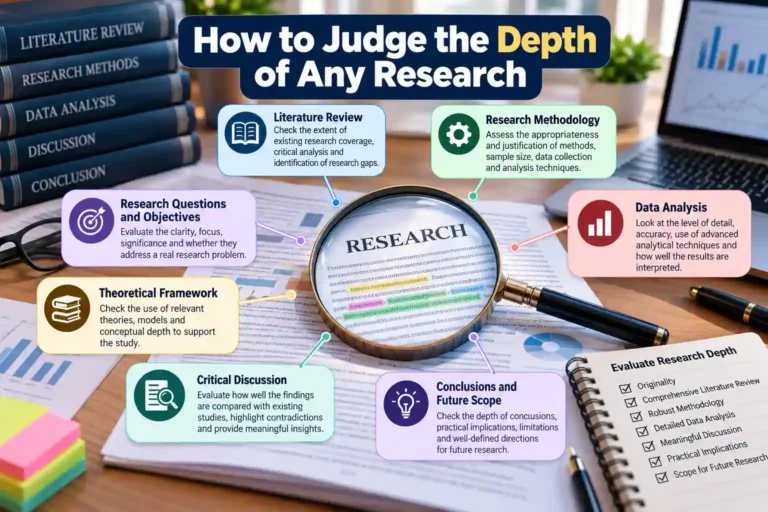
Table of Contents
How to Judge the Depth of Any Research: A Practical Guide
The usual answer for the common research-methodology multiple-choice question on “how to judge the depth of research?” is through research objectives. The research objective is the intended purpose of any research. In the case of assessing an already completed research paper, dissertation, or PhD thesis, apart from the objectives, the actual depth of the research also needs to be judged via the literature review, methodology, evidence, analysis, interpretation, originality, and conclusions of the research.
This is important for PhD students, masters’ level researchers, and young researchers. The objectives define the direction, and the research process and results indicate whether the researcher pursued the direction systematically. This guideline outlines the criteria to consider and offers an evaluation checklist.
What Does Research Depth Mean ?
Research depth can be described as the degree to which research on a specific problem has been carried out and how well the research has examined the problem critically using relevant methods, analyzing the evidence available and developing conclusions based on the findings. Depth does not necessarily mean length.
For instance, a paper that highlights AI technologies used in educational settings may be an overview. Research on how AI-enhanced feedback influences postgraduate learners’ revision process, explaining its rationale, analyzing evidence, examining other options, and recognizing limitations can show deeper insights. It will remain good quality based on its execution.
Both breadth and depth can be complementary to each other. The scoping review is likely to provide a wider scope of knowledge about a particular subject, whereas the experiment or qualitative case study will provide insights into a narrow issue.
How Do You Judge the Depth of Any Research?
If you are answering the multiple-choice question given in the current search results on education, go for research objectives. This is because the other choices, like title, period, number of pages, or cost, will not directly indicate the scope of the research.
Objectives of research explain what the research intends to achieve and help readers understand the aim of the research.
For a comprehensive academic evaluation, do not simply look at the objectives. Examine whether the study conducted is of an appropriate design, critically examines relevant literature, conducts an analysis of evidence, answers its research questions, and draws its conclusions. Objectives indicate what a study aims to achieve; the study indicates how well it achieves that aim.
8 Key Indicators of Research Depth
1. Clear and Meaningful Research Objectives
Objectives should be specific, researchable, feasible, and consistent with the problem. Are they factored into the design and analysis? “Studying technology in education” is too general, while “examining how postgraduate students utilize artificial intelligence in revising academic writing” is more specific. Being specific does not ensure depth, but being unclear makes accomplishment hard to evaluate.
2. A Critical Literature Review
A good literature review does not just summarize individual sources; it analyzes them. A good literature review compares findings, assesses previous approaches, identifies inconsistencies, and clarifies uncertainties. Take into account the relevance of the sources, their thematic arrangement, contradictions, and the reason for identifying the problem . The gap has to come from the literature review, not just because there are no similar titles or settings in the literature.
For an additional perspective, consult IdeaLaunch’s literature review on the significance of literature review in doctoral research. The ideas in that article could assist you in thinking about how prior research is being synthesized into a research problem.
3. Appropriate and justified Research Methodology
The methodology should match the research question. Consider design, sampling, data collection, measures, analysis, ethics in research , transparency. Validity and reliability may be important for quantitative research; credibility, reflexivity and interpretive transparency may be important for qualitative research. Cross-sectional surveys may indicate association, but not necessarily causality.A good study explains why it used the methods it used and what it shows.
For further elaboration on aligning questions, methods, and evidence, refer to the IdeaLaunch guide for research methodology.
4. Careful Data Analysis
Objective analysis and data. Quantitative research can include data analysis Qualitative research may include coding, thematic analysis, or systematic comparison. More complicated is not always better. Describe the methods, make reasonable assumptions, clearly state the results, and justify the interpretations.
5. Critical Interpretation of Findings
A good discussion talks about what the findings mean. How do they relate to previous research? What are other possible explanations? It’s more than just repeating the findings. Be explicit about correlation vs. causation, statistical vs. practical significance, facts vs. speculation. This finding differs from previous studies and may be due to methodological differences.
6. Originality and justified research gap
Research can provide new knowledge, test a role of theory in a new context, improve an existing method, resolve contradictory results, or synthesize information. What does this study add? Is the addition justified by the literature and the results? A different setting or sample does not guarantee originality. Don’t make claims like “the first ever” without proof.
7. Transparent Limitations
There are always some limits in any research design, such as sampling, measurement, data access, potential biases, context, or generalizability. Good research will identify important limitations and will discuss their impact on the findings. The results obtained from one organization cannot be assumed to apply to all organizations.
8. A Contribution Supported by Evidence
Decide if the research responds to its research questions and provides a theoretical, methodological, empirical, or practical contribution. The recommendations should follow the results. A good conclusion articulates what is known, what is not known, and what needs to be further explored from the research.
How to Evaluate Research Depth Step by Step
- Start with the question and the aims. Understand the problem and what you want to achieve.
- Read the literature review. synthesis, critical evaluation, and a justified research gap.
- Design and methodology assessment. Check the alignment of question, sample, data collection and analysis.
- Examine the evidence. Check that findings are reported transparently and support the claims.
- Read the debate carefully. Look for links to previous studies, alternative hypotheses, and cautious interpretation.
- Compute the contribution. What is previously known on this subject? What does this study add
- Cognize constraints and conclusions. Claims are consistent with the evidence and study design.
If you are not sure which strategy fits your topic, IdeaLaunch also includes a reference on sorts of study in research methodology. Pick a design because it matches the research challenge – not because it sounds fancier.
Research Depth Assessment Checklist
| Criterion | Questions to Ask | Evidence of Adequate Depth |
|---|---|---|
| Objectives | Are the objectives focused and answerable? | They set the limits and direction of the study. |
| Literature review | Are studies synthesized and critically compared? | The gap is logically derived from the relevant literature. |
| Methodology | Is the design justified and transparent? | Methods are suitable for the data and question. |
| Analysis | Does the analysis answer the objectives? | Reported findings support the interpretations. |
| Discussion | Are findings placed in context? | Review of previous research and alternative explanations. |
| Originality | What does the study add? | The contribution is specific and evidence-based. |
| Limitations | Are the boundaries acknowledged? | Claims are suitably qualified. |
| Implications | Do recommendations follow from results? | Implications are realistic and linked to findings. |
Rate each criterion as “Adequate,” “Needs improvement,” or “Not applicable.” This is a useful guide rather than a scored evaluation. For a formal assessment of the design, use a discipline-specific checklist. The CASP (Critical Appraisal Skills Program) provides guidelines that can be used for a study-specific evaluation within health and clinical research studies.
Signs That Research May Lack Depth
| Warning Sign | Why It Matters | Possible Improvement |
|---|---|---|
| Objectives are vague | The study’s direction is unclear. | Make objectives focused and researchable. |
| Literature review is only descriptive | Connections and contradictions are missed. | Synthesize findings by theme, method, or theory. |
| Methods are poorly justified | Readers cannot judge suitability. | Explain and support design choices. |
| Analysis does not match objectives | Results may not answer the research questions. | Map each analysis to an objective. |
| Conclusions exceed evidence | Claims may be misleading. | Qualify claims and acknowledge uncertainty. |
| Contribution is unclear | The value of the study is difficult to assess. | Explain the specific gap addressed. |
| Limitations are omitted | Readers cannot judge the boundaries. | State important limitations and their effects. |
How PhD Scholars and Master’s Students Can Improve Research Depth
- Refine the research question. Narrow the problem to a question that can be investigated with available time, data, and resources.
- Build a critical literature review. Group sources by theme, method, theory, or finding; compare them and explain the unresolved issue.
- Justify methodological choices. Explain why the design, sample, instruments, and analysis fit the objectives.
- Interpret rather than merely report. Discuss the implications of the results, their relation to previous research, and possible alternative explanations.
- Claims must be relevant. Do not claim causation, generalizability, and novelty without evidence.
- Get feedback that is informed. Get a supervisor or experienced researcher to determine if the problem, objectives, methods, results, and conclusions are aligned.
Conclusion
For the common research-methodology question, the expected answer is “by research objectives,” because objectives establish the intended purpose and scope of the investigation. For a real academic paper or thesis, however, objectives are only the starting point. Research depth is demonstrated through a critical literature review, suitable methods, careful analysis, justified interpretation, originality, transparent limitations, and evidence-based conclusions.
Use the checklist in this guide to assess whether a study has achieved its stated aims. A focused, well-supported paper is better than a long paper that is descriptive or makes unsupported claims.
Frequently Asked Questions
In the general multiple-choice question, the expected answer is research objectives. A full evaluation also includes literature, methods, evidence, analysis, originality, and conclusion.
They establish the study’s purpose and dictate its design, analysis, and evaluation.
Nope. What matters is not the quantity of sources, but the relevance, credibility, critical synthesis, and connection to the research question.
Review objectives, literature, methods, analysis, discussion, contribution, limitations, and conclusions. Check that the evidence backs it up.
Preliminary objectives, descriptive literature, weak methods, disconnected analysis, unsupported conclusions, unclear contribution
Redefine the question, synthesize literature critically, justify methods, interpret results, acknowledge limitations, explain contribution.
Neither is always more important. Breadth maps a field; depth investigates a question thoroughly. Balance is about purpose and design.
The originality, methodology, data accuracy, references, findings, plagiarism, and credibility of the journal can be checked by analyzing the quality of the research paper.
Need Research Guidance? Explore IdeaLaunch
If you are developing a literature review, justifying a research design, interpreting evidence, or organizing a dissertation, academic guidance may help clarify gaps and options. IdeaLaunch offers support across research stages. Choose assistance that fits your needs, preserve your authorship, and follow your institution’s academic-integrity policies.
You can consider using literature review writing services to help you with literature-review development, PhD research methodology services to help you with research-design decisions, or even broader PhD research assistance and dissertation writing services to get relevant guidance, review, and development support.
Visit IdeaLaunch.in to explore the services or request a consultation. Academic assistance is not intended to guarantee acceptance, publication, or any specific result of your thesis. It is only meant to improve your understanding and communication. You are responsible for the accuracy, originality, attribution, ethics, and final submission of your research.