

20 Types of Research Explained: Concept, Justification and Examples
IdeaLaunch - Blog - Research Methodology - 20 Types of Research Explained: Concept, Justification and Examples
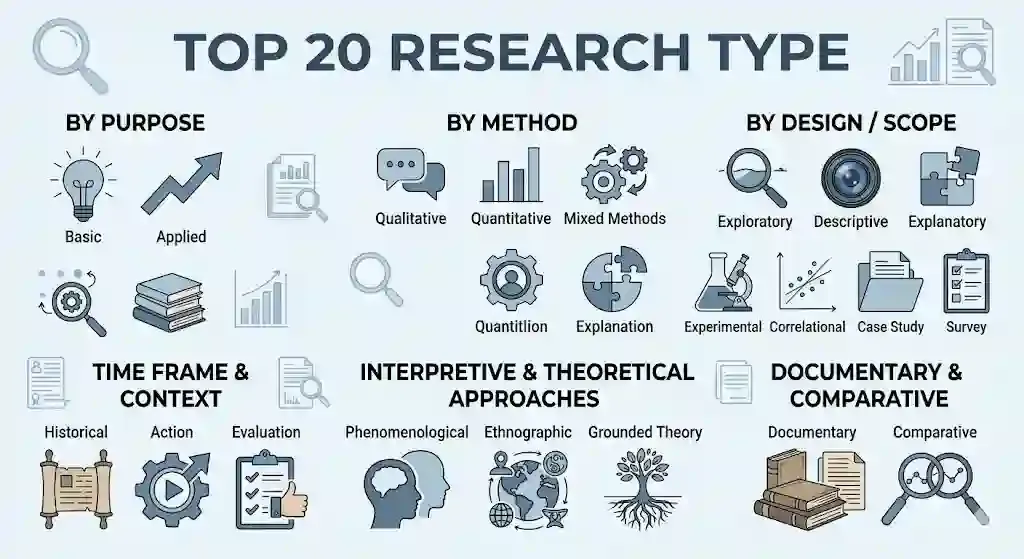
How to Select the Right Research Type for Your Study
Not sure which kind of research to do? You aren’t the only one. Choosing the wrong kind of research is one of the biggest mistakes made in academic circles, and it can make the whole process of conducting the research impossible. Learn more about the various types of research here. This guide helps understand and categorize all 20 types for selecting the correct one before you begin your investigation.
Types of research are better perceived as instruments than categories. Research is classified based on five criteria: purpose (why), method (how), scope of research design (what kind), data collection techniques (with what), and temporal aspect (when). More often than not, a particular type of research could fall under several categories at once.
Complete Table of All 20 Types of Research
| No. | Type of Research | Concept | Justification | Example |
|---|---|---|---|---|
| GROUP 1 – BY PURPOSE | ||||
| 1 | Basic Research | Increases theoretical knowledge | Forms the basis for further research | Studying theories of political participation |
| 2 | Applied Research | Resolves practical issues | Presents solutions to actual problems | Evaluation of an e-governance framework |
| GROUP 2 – BY METHOD | ||||
| 3 | Qualitative Research | Studies experiences and meanings | Provides deep insight | Interviewing teachers about online education |
| 4 | Quantitative Research | Uses numerical data | Produces measurable results | Survey on voter turnout rates |
| 5 | Mixed Methods Research | Combines qualitative and quantitative methods | Provides comprehensive insights | Survey and interviews on public service delivery |
| GROUP 3 – BY DESIGN / SCOPE | ||||
| 6 | Exploratory Research | Studies emerging problems | Identifies future research directions | AI in local government management |
| 7 | Descriptive Research | Describes a phenomenon | Provides detailed information | Characteristics of social media users |
| 8 | Explanatory Research | Explains causes and effects | Identifies relationships | Education and political awareness |
| GROUP 4 – BY DATA COLLECTION STRATEGY | ||||
| 9 | Experimental Research | Tests cause-and-effect relationships | Demonstrates causation | Testing new teaching methods |
| 10 | Correlational Research | Examines variable relationships | Predicts trends | Study hours vs GPA |
| 11 | Case Study Research | Detailed examination of a case | Provides in-depth understanding | Case study of an Ombudsman office |
| 12 | Survey Research | Collects data using questionnaires | Reaches large populations | Public opinion survey |
| GROUP 5 – TIME FRAME & CONTEXT | ||||
| 13 | Historical Research | Studies past events | Analyzes historical trends | Development of a constitution |
| 14 | Action Research | Solves problems through action | Improves processes | Improving classroom participation |
| 15 | Evaluation Research | Assesses programs or policies | Measures effectiveness | Evaluation of a welfare program |
| GROUP 6 – INTERPRETIVE & THEORETICAL APPROACHES | ||||
| 16 | Phenomenological Research | Studies lived experiences | Understands personal perspectives | Experiences of first-generation students |
| 17 | Ethnographic Research | Studies cultures and communities | Explains social behavior | Research on tribal traditions |
| 18 | Grounded Theory Research | Develops theories from data | Creates new theoretical frameworks | Online learning theory development |
| GROUP 7 – DOCUMENTARY & COMPARATIVE | ||||
| 19 | Documentary Research | Analyzes existing documents | Uses readily available sources | Government policy document analysis |
| 20 | Comparative Research | Compares multiple cases | Identifies similarities and differences | Comparing e-governance systems |
A Quick Look at the 5 Most Misunderstood Research Types
| Pair / Group | Key Distinction | When to Use Which |
|---|---|---|
| Basic vs Applied Research | Basic Research develops theories and expands knowledge, while Applied Research uses that knowledge to solve practical problems. | Choose Basic Research when the underlying cause or theory is unknown. Choose Applied Research when a real-world problem needs a solution. |
| Exploratory vs Descriptive Research | Exploratory Research investigates unfamiliar topics, while Descriptive Research measures and documents known phenomena. | Use Exploratory Research when the topic is new or poorly understood. Use Descriptive Research when you already know what needs to be measured. |
| Explanatory vs Experimental Research | Explanatory Research identifies relationships between variables, whereas Experimental Research manipulates variables to establish cause and effect. | Use Experimental Research when you can control and manipulate conditions. Use Explanatory Research when working with existing data or real-world situations. |
| Phenomenological vs Ethnographic Research | Phenomenology focuses on individual lived experiences, while Ethnography studies cultures, groups, and social practices through immersion. | Use Phenomenological Research to understand a specific experience. Use Ethnographic Research to study a community or culture over an extended period. |
| Case Study vs Survey Research | Case Studies prioritize depth and detailed understanding, whereas Surveys prioritize breadth and larger sample sizes. | Use a Case Study when investigating a specific individual, organization, or event. Use a Survey when collecting data from many respondents to identify trends or patterns. |
3 Overlooked Research Challenges in 2026
Challenge 1: Ethics of AI in Peer Review
- It is now required for journals that you disclose the use of any AI tools.
- The methodology should explain which tools were used at which point and how the results were validated by human judgment.
Challenge 2: Data Protection Internationally
- International cross-national studies will have to be compliant with India’s DPDP Act (2023), the EU AI Act, and similar laws.
Challenge 3: Impact-Based Research Funding
- The funding agencies now want your research to show some immediate social impact. Exploratory studies need a translation story, too, now.
Frequently Asked Questions
Qualitative tells us how and why through stories and interviews. Quantitative answers “how many” and “to what degree”, using numbers and stats. Your research question determines the appropriate approach.
Yes. Research may be applied (purpose), qualitative (method), and phenomenological (approach) altogether. They are different dimensions rather than competing categories. You only need to justify them in your methodology section.
There is no answer to this question since it varies depending on your interests. However, descriptive, case study, and survey would be the easiest to do after you complete your postgraduate degree.
Ready to Transform Your Research Type into a High-Quality Academic Output?
The IdeaLaunch experts will assist you throughout the entire process, from methodological proof to preparing your dissertations, proposals, and academic papers for publication.