

Challenges Faced by Researchers 2026
Why the Challenges Faced by Researchers in 2026 Are More Complex Than Ever
Conducting research has always been a challenging and demanding process. But the challenges have become even higher and more difficult than before in 2026. Researchers nowadays don’t simply struggle with funding problems or publication backlogs. They face confusion about AI policies, data privacy restrictions, and a mental health issue that academics are just beginning to recognize.
The following is a straightforward discussion of the challenges that today’s researchers actually face, one by one.
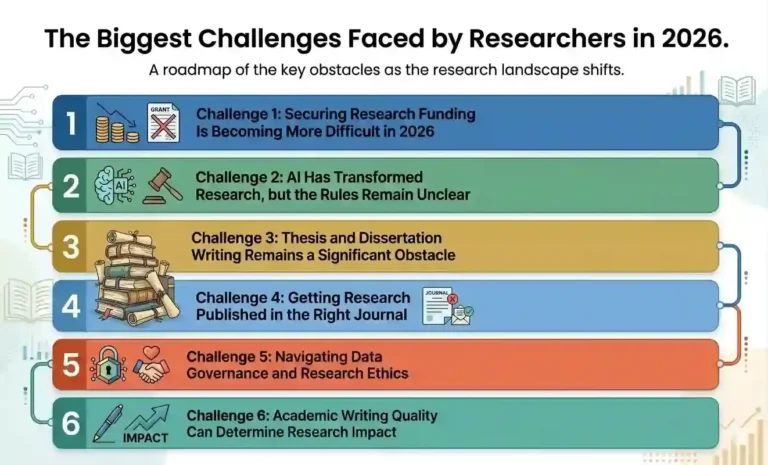
Challenge 1: Securing Research Funding Is Becoming More Difficult in 2026
What Is Driving the Growing Competition for Research Grants?
In 2026, government agencies around the world shifted their budget allocations towards national concerns such as energy, defence, and domestic manufacturing. This leaves arts and sciences in general and humanities and social sciences in particular competing for ever-diminishing amounts of money, with reduced application periods and more rigorous guidelines.
Many scholars devote as much as 40% of their time to writing grants rather than doing research.
Solution
- Communicate the impact of your research using the vocabulary that funders understand — results, societal benefit, ROI
- Seek out funding programs that support multidisciplinary projects.
- Use a specialist to organize your proposal properly.
A compelling PhD research proposal can greatly improve the prospects of research approval and overall success. Good proposals are not only about ideas but also about how they are presented.
Challenge 2: AI Has Transformed Research, but the Rules Remain Unclear
How Can Researchers Use AI While Maintaining Academic Integrity?
This is the question of 2026. AI technology is actually useful for literature reviews and improving grammar. However, there are no clear guidelines on how AI should be used, and most universities and academic publications lack appropriate policies.
There are dangers associated with this. The undetected use of AI is prone to triggering plagiarism detection, moreover, an AI trained on flawed databases may corrupt an analysis summary unnoticed. The validity of the peer-review process is called into question when peer reviewers rely on AI software to assess papers.
Solution
- Limit AI usage to purely structural elements – formatting, grammar, bibliography. Maintain academic integrity by ensuring that analyses and conclusions are developed through independent critical thinking.
- State the use of AI software in the methodology section and check all AI-assisted text for plagiarism and errors.
Challenge 3: Thesis and Dissertation Writing Remains a Significant Obstacle
Why Does Thesis Writing Continue to Challenge PhD Scholars?
Despite years of collecting data and conducting literature reviews, many students eventually reach a point where they are unable to write. This is typically due to improper chapter structuring, improper referencing formats, differences in the questions asked and the findings made, and language-related problems that lead to rewrites.
In 2026, examiners are becoming even more aware of potential AI-written phrases in students’ work — something you should avoid!
Solution
- Think out your thesis structure before the writing starts, not after
- Treat each thesis chapter like an argument to be built into the big picture of your work.
- Seek expert help for both structure and language editing.
Expert help in PhD thesis chapterization and writing synopsis will save you valuable time at the university submission stage.
Challenge 4: Getting Research Published in the Right Journal
Why Do Many Researchers Struggle with Journal Publication in 2026?
Open access policies have led to the development of a parallel market for predatory journals that imitate genuine journals and charge processing fees with very little peer review. Meanwhile, well-known journals take anywhere from 18 months to 2 years to review, which adversely affects careers and discourages researchers from publishing in them if they lack publishing connections.
Common Mistakes: publishing in the wrong journal, poor research paper formatting, and submitting work to non-Scopus and Web of Science-indexed journals.
Solution
- Check the scope, indexing status, and acceptance rate of the targeted journal before submission.
- Format your research paper to meet the publication standards.
- Take assistance from the journal publication services.
Challenge 5: Navigating Data Governance and Research Ethics
Why Are Data Ethics and Compliance Becoming Major Concerns in 2026?
The increasing globalization and digitization of academic processes may make data management an unexpected compliance issue for scholars who fail to address it from the very start. Following post-2023 regulations in Europe, Asia, and the Americas, crossing borders for data collection can prove legally problematic without adequate preparation.
Problems may arise from inconsistent consent management, unclear guidelines for data repurposing, and tighter criteria for institutional ethics boards. A single breach of ethics can delay the progress of a research project or lead to an eventual post-publication retraction.
Solution
- Design your data governance structure into your research process from the outset.
- Seek approval from your ethics board in advance of data collection.
- Include proper mention of consent and data management in your academic paper.
Challenge 6: Academic Writing Quality Can Determine Research Impact
How Does Strong Academic Writing Influence Research Success?
The standard of writing in an academic paper is often the decisive factor in whether the article gets accepted, even though it may contain very novel information. As reviewers handle an increasing volume of submissions, the quality of the abstract and introduction often plays a decisive role in whether a paper progresses through the review process.”
Native English speakers are less affected by this problem, but it applies to all authors writing interdisciplinary or international papers.
Solution
- Always make sure your grammar is checked, and your paper is professionally proofread.
- Create a reputation through writing popular blogs based on your research findings.
Overcoming Research Challenges with the Right Support
There is something all the researchers who navigate 2026 well have in common: they never hesitate to ask for help. They understand that grant writing, thesis construction, and publication skills can be mastered, and thus turn to specialists to conserve their brain capacity.
Are you a researcher based in India looking for assistance at all stages of the research process, from topic selection and writing the research proposal to writing up your thesis and getting it published? IdeaLaunch has helped many researchers achieve success in their fields.
Research is difficult but not impossible, especially if you have help along the way. Discover how IdeaLaunch can support you at every stage of your academic journey.