

Web of Science Master Journal list
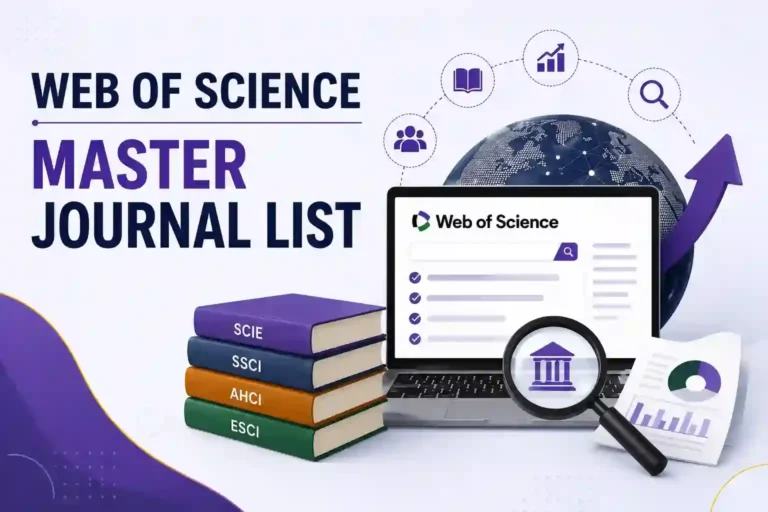
Table of Contents
- Understand what the Web of Science Master Journal List
- Importance of Visibility in Research
- Explore the structure of Master journal Collections
- Learn how to search journals
- Cost-Effective Publishing Opportunities for Scholars
- Complete Research Publication Process Explained
- Reasons for Failure to Publish Papers on WoS
- Conclusion
Web of Science Master Journal List 2026 – SCIE, SSCI, AHCI & ESCI Journals
- Every scientist needs to ask: “Is it listed in the Web of Science?“
- The response will determine if your work gets worldwide recognition – or remains unknown.
- The Web of Science Master Journal List is the definitive list of all Web of Science-listed journals.
- Maintained by Clarivate, in operation since 1964
- Not just a list, but a quality standard for journal editing and publishing
- Follows citations, impact factors, and research trends in thousands of fields
- Beneficial for: PhD students, young scientists, and professors applying for advancement.
- Inclusion is a globally acknowledged marker of academic excellence.
Importance of Visibility in Research
A publication in a Web of Science Master Journal List journal makes an immediate difference in your academic career. The reasons include:
- Citation frequency – papers indexed in WoS will be searched for by millions of researchers around the world, resulting in higher citations.
- Grant application – many research funding agencies require a publication record in WoS before granting funding for research.
- Promotion and Tenure – universities in Asia, Europe and America consider WoS publications while considering promotion for their staff.
- University Ranking – both QS and Times Higher Education Rankings depend on the WoS database citations when ranking universities.
- Visibility globally – papers indexed in WoS will be available to researchers in more than 100 countries, but the best research will go unnoticed.
- Recognition among peers – reviewers and fellow researchers will take your research seriously if it is indexed in WoS.
Exploring the Structure of Master of Journal Collections
| Collection | Focus Area | Journals Covered |
|---|---|---|
| SCIE – Science Citation Index Expanded | Natural & Applied Sciences | 9,200+ |
| SSCI – Social Sciences Citation Index | Social Sciences | 3,500+ |
| AHCI – Arts & Humanities Citation Index | Arts & Humanities | 1,800+ |
| ESCI – Emerging Sources Citation Index | Multidisciplinary (entry-level) | Growing |
| BkCI – Book Citation Index | Academic Books & Chapters | Selected |
| CPCI – Conference Proceedings Citation Index | Key Conference Papers | Selected |
Notes: SCIE and SSCI are the two indexes that hold the highest value. ESCI is an authentic pathway for journals considered for inclusion.
Learn how to search journals
Step 1 – Visit the website.
- Visit the official website webofscience
- No login or subscription needed
Step 2 – Search by journal title or ISSN
- Enter the journal name or ISSN number
- Immediately know its index, collection, and since year
Step 3 – Filter by category
- Filter the publications according to your discipline in order to find appropriate journals
- Sort based on impact factor or quartile classification
Step 4 – Assess the journal details
- Evaluate: indexing, collection, impact factor, quartile (Q1-Q4), publisher, and scope.
Step 5 – select your journal list
- Select 5-10 journals depending on your research theme and professional goals.
Cost-Effective Publishing Opportunities for Scholars
- Use Filter Open Access – many OA journals indexed by WoS have zero APCs.(Article Processing Charge).
- Search for ESCI-indexed journals – usually have lower APCs than SCIE but provide credible indexing.
- Review journal APC waiver policy – most journals give complete waivers for authors from low & middle-income countries
- Check before submitting – make sure the journal is indexed on the MJL website; do not fall victim to misleading journals.
- Consider society journals – academic societies often have journals that are indexed and have low or zero author costs
Complete Research Publication Process Explained
Step 1 – Select the appropriate journal
- Choose a journal depending on your topic that has recently published similar research papers in the past three years.
- Check the impact factor, quartile ranking, and decision time after submission of your manuscript.
- Choose Q1/Q2 journals for career advancement, whereas Q3/Q4 journals can be selected by young researchers
Step 2 — Read author guidelines carefully
- Follow the word limit, citation format, and section format exactly.
- Formatting mistakes result in desk rejection prior to peer review.
Step 3 – Get the Manuscript Ready for Publication
- Identify a research gap clearly in your introduction
- Provide sufficient methodological details for reproduction
- Make sure that the statistics have correct formatting and labeling
- Write a discussion that relates findings without overstating them
Step 4 – Write the Cover Letter
- Below 300 words
- Explain why the reader is interested in your paper based on their field
- Confirm there are no other submissions at other journals
Step 5 – Respond to reviewer comments professionally
- Answer all the comments, even if you do not agree with them.
- Prepare a separate response file matching each comment to your changes.
- Apply evidence rather than opinions while arguing against reviewer recommendations.
Step 6 – Monitor indexing status after publication
- Check whether your paper is indexed by WoS 4-8 weeks after online publication.
- In case of no indexation in 8 weeks, contact the journal’s editorial board directly.
Step 7 – Distribute and promote your published paper
- Distribute the DOI of your published paper on ResearchGate, Academia.edu, and LinkedIn.
- Include it in your Google Scholar profile.
- Notify your institution’s research department for internal use.
- This will boost citation numbers.
Reasons for Failure to Publish Papers on Web of Science
No matter how good the paper is, it can get rejected. The top reasons are as follows:
- Wrong scope – sending an article to the journal that doesn’t fit the scope of research
- Research method flaws – reviewers can spot the issues with methodology that the writer didn’t see
- Language issues – difficulties with writing in English for those who aren’t native speakers
- Weak literature review – omitting important sources that will stand out immediately to reviewers
- Non-compliance with the formatting guidelines – using a different format than the one specified in the journal
- Lacking a cover letter – no justification provided in the cover letter as to why this paper should be published in this specific journal
Conclusion
Publication of research papers in a Web of Science-indexed journal calls for the appropriate strategy, selection of journals, and preparation of the manuscript.
The Master Journal List can be considered an excellent resource for those looking for top publications.
IdeaLaunch offers professional services to help researchers publish their papers.