

Stephen Hawking’s PhD Thesis
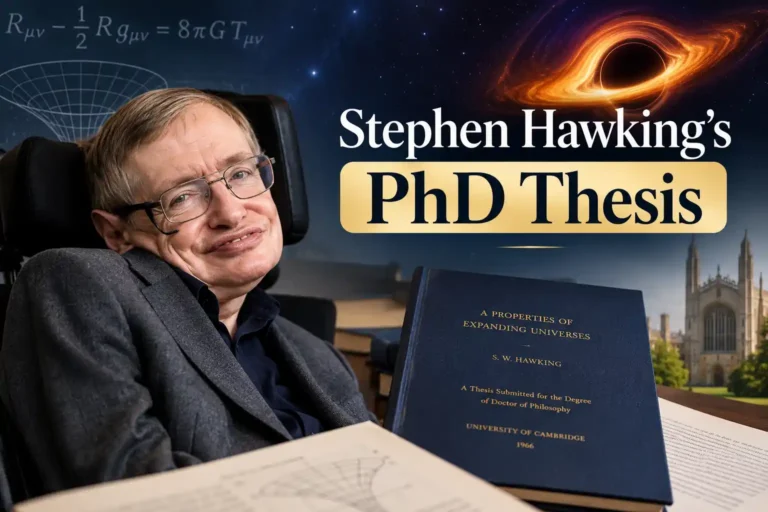
Table of Contents
Supporting Researchers at Every Stage
IdeaLaunch offers comprehensive academic and research assistance to help scholars succeed throughout their research journey. Whether you’re preparing a manuscript, publishing in a Scopus-indexed journal, or completing your PhD research, our experts provide end-to-end support.
Expertise That Supports Your Research
- PhD Research Assistance
- Research Paper Writing Help
- Thesis & Dissertation Writing
- Manuscript Writing & Editing
- Scopus Journal Publication Support
- Literature Review Writing
- Research Methodology Assistance
- Statistical Data Analysis (SPSS, AMOS, SmartPLS)
- Plagiarism Checking & Proofreading
- Journal Submission & Reviewer Response Support
Stephen Hawking's PhD Thesis: Research, Discoveries, and Where to Read It
Cambridge University placed an online copy of the PhD thesis from 1966 on their website in October 2017, which caused so much interest that the site became slow. The PhD thesis was written by Stephen Hawking. Here is why it still matters, especially if you are writing a thesis yourself.
Short answer: Stephen Hawking PhD thesis “Properties of Expanding Universes” considers what will happen when the universe expands. The four chapters of the PhD thesis prove the alternative theory of gravity, consider galaxy formation, investigate gravitational waves, and suggest that the universe originated from a single point – a singularity.
What Was Stephen Hawking's PhD Thesis About?
The topic of the thesis is that of cosmology, which involves the study of the origin, structure, and evolution of the universe. By the 1960s, it had been discovered that the universe was expanding since the galaxies were moving away from each other.
Think of a film of an expanding balloon played in reverse. The balloon collapses. Reverse the universe, and the same question arises – would everything end up in a single point?
It was done using mathematics, not telescopes, thanks to Einstein’s theory of gravity.
Where Did Stephen Hawking Complete His PhD?
Hawking attended the University of Cambridge, where he was educated at Trinity Hall since 1962, being taught by the cosmologist Dennis Sciama.
At an early stage of the PhD programme, Stephen Hawking was stricken by motor neurone disease. According to Hawking’s associates, this is when he became a hard-working researcher.
What Did Stephen Hawking Study in His Thesis?
Chapter 1: He proved that a new theory of gravity formulated by Fred Hoyle and Jayant Narlikar fails in an expanding universe.
Chapter 2: He found that small and early ripples in matter could not evolve to form galaxies through this mechanism alone.
Chapter 3: He studied how gravitational waves evolve in an expanding universe, which was the most computationally intensive part.
Chapter 4: Using Roger Penrose’s 1965 work on collapsing stars, he concluded that an expanding universe should start from a singularity under quite general assumptions.
Some of his best-known theories, including Hawking radiation (1974), followed afterward. This thesis is his beginning, but not his entire journey.
Why Was Stephen Hawking's PhD Research Important?
Prior to this study, many physicists believed that the beginning of the Big Bang was simply an artifact of oversimplified models. As it was implied in chapter 4, it was a genuine part of Einstein’s theory.
Hawking has developed this idea further, and by 1970 together with Penrose they presented a more solid singularity theorem.
Can You Read Stephen Hawking's Original PhD Thesis?
Yes, it is freely available online. With permission from Hawking, the Cambridge University Library made it available on 23 October 2017. Use the official websites instead of reproductions available elsewhere on the Internet:
- Apollo repository (PDF): doi.org/10.17863/CAM.11283
- Cambridge Digital Library (scans): cudl.lib.cam.ac.uk/view/MS-PHD-05437
You can find both typeset pages as well as handwritten equations with errors that have been scratched out. There are slight discrepancies between different sources as far as dates are concerned.
What Can PhD Scholars Learn From Stephen Hawking's Thesis?
- Ask a focused question. Every chapter addresses one distinct issue, the first step towards choosing a PhD research topic.
- Know the latest research. Hawking questioned a theory that was only a few months old. That is why an extreme literature review matters.
- State your foundation. The outcomes are based on a Clear theory and assumptions. (the role of theory).
- Organise in steps. Four linked chapters made a huge topic manageable.
- Explain simply. His abstract sums up each chapter in a sentence or two.
- Think independently.The student asked tough questions of a leading scientist with his own computations to back him up.
- Value depth over length. The thesis consists of about 120 pages. Its value is in what it answers.
Having trouble narrowing down a broad topic into a focused research question? The PhD assistance offered by IdeaLaunch will enable you to formulate a research problem and organize your chapters.
How Is a Scientific PhD Thesis Structured?
In most cases, a scientific thesis includes an introduction, literature review, research questions, research design, results, discussion and conclusion, and references. The structure will depend on the topic and requirements of your institution.
Hawking’s thesis has a simple structure with an introduction and four research chapters. Remember that structure should follow your research questions, not vice versa. Here are some mistakes to avoid when writing a PhD thesis.
Properties of Expanding Universes, awarded by the University of Cambridge in 1966.
The effects of an expanding universe, from gravity theories and galaxy formation to gravitational waves and the universe's beginning.
At the University of Cambridge, supervised by Dennis Sciama.
Yes. It is free on Cambridge's Apollo repository and the Cambridge Digital Library.
It argued that the universe's starting point is a general result of Einstein's theory, opening the way to the 1970 Hawking–Penrose theorem.
Keep each chapter focused on one question, build on current research, and judge your work by what it answers.
Conclusion
Stephen Hawking’s PhD Thesis is an example of how a student can break down a single big question into four that can be answered. This document is brief, flawed at times, but still highly useful.
Take a look at the Cambridge version and see how each chapter poses a problem before answering it. Do the same thing for your research based on a complete PhD outline.
Are you looking for assistance in forming a research question and planning a chapter? IdeaLaunch can give you PhD research advice. (IdeaLaunch is an independent company, not related to Hawking or Cambridge.)