

October 8, 2026
Complete PhD Roadmap 2026
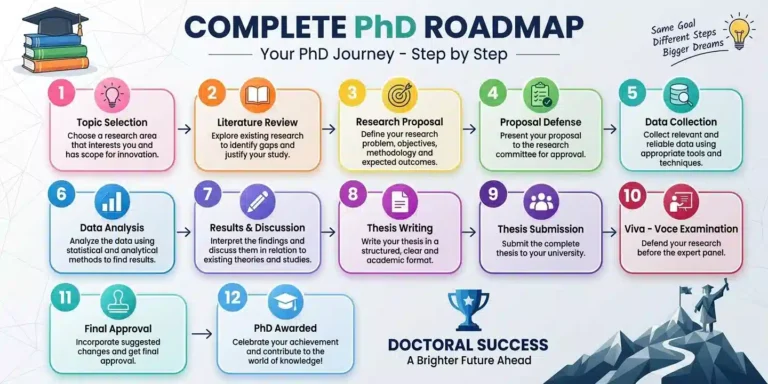
Table of Contents
The Complete PhD Roadmap for 2026: 12 Steps to Get Your PhD From Choosing a Topic
Completing a PhD is more than writing a thesis. It is an organized research process that begins with selecting a topic and proceeds through steps such as literature review, research proposal, data collection, data analysis, thesis writing, evaluation, and final approval.
The Complete PhD Roadmap 2026 outlines a 12-step sequence that research scholars can use to understand what needs to be done at every stage of their PhD completion process. The most critical approach is consistency, in which the selected topic should lead to the identification of research gaps, the gaps to research questions, and, in turn, to research methodology, data collection, analysis, and contribution.
IdeaLaunch provides end-to-end PhD research assistance across the following areas: topic selection, research proposal writing, literature review, methodology, data analysis, thesis writing, editing, formatting, and viva preparation.
Road Map: Quick Overview
- Topic Selection
- →
- Literature Review
- →
- Research Proposal
- →
- Proposal Defense
- →
- Data Collection
- →
- Data Analysis
- →
- Results & Discussion
- →
- Thesis Writing
- →
- Thesis Submission
- →
- Viva-Voce Examination
- →
- Final Approval
- →
- PhD Awarded
1. Research Topic Selection
Select a Research Topic with a Research Gap
The first step in the PhD roadmap is to select a topic that is researchable, relevant, and feasible, and that allows for an original contribution.
A good PhD topic would have considerations such as:
- Research a problem that is clearly defined
- Research gap in recent literature
- Availability of data
- Research methodology
- Time and other resource constraints
- Requirements of the supervisor and institution
- Contribution to academia or practice
According to IdeaLaunch, the researcher is advised to review the literature, identify gaps, and ensure the research can be completed within the available time.
For more information, read IdeaLaunch PhD Topic Selection.
2. Literature Review
Transition from Literature Collecting to Critical Research Gap Identifying
A PhD literature review is not just a compilation of summaries. It should involve an analysis of the prior literature and illustrate how your study sits within the extant literature.
A good literature review involves:
Prior research → limitations → research gap → research problem → proposed research
Researchers should be organized by literature themes or methodology, not by one paper after another. IdeaLaunch defines a doctoral literature review as “critical synthesis of the existing literature to establish the need for the suggested research.”
For further information, visit IdeaLaunch Literature Review Writing Services.
3. Research Proposal
Transforming the Research Idea into a Valid Research
After identifying the research topic and research gap, the next step is to formulate the PhD research proposal.
The proposal typically includes:
- Research background
- Problem statement
- Research gap
- Research questions
- Objectives
- Literature review
- Methodology
- Contribution
- Timeline
- References
The methodology should be directly related to the research questions. For example, depending on the research type, the methodology may include qualitative, quantitative, or mixed methods, as well as sampling, data collection, and analysis methods.
IdeaLaunch highlights aspects such as novelty, well-defined research objectives, feasibility, recent advances, and the compatibility of objectives with the proposed research structure.
Discover more about IdeaLaunch Research Proposal Writing Services.
4. Defense of Research Proposal
State and Defend Your Research Design
The proposal defense is when the researcher presents the proposed research to the relevant academic committee or supervisor.
You should be ready to explain:
- Relevance of the research problem
- What gap does the research fill?
- Suitability of the chosen methodology
- How the data will be collected
- What contributions will the research make?
- Practicality of the research
This will not only give you an opportunity to spot any flaws in your proposal design but also to make revisions without having to make fundamental changes to the methodology during the research.
For more details, visit the peer review process for your PhD proposal.
5. Data Collection
Data Collection According to the Approved Methodology
Following approval of the research design, the next step will be data collection. The methodology may vary according to the research and include:
- Surveys and questionnaires
- Interviews
- Experiments
- Observations
- Secondary data
- Archival data
- Case studies
- Computer-based data
Data collection should adhere to the guidelines outlined in the research design, sampling method, and ethical considerations.
IdeaLaunch provides guidelines on research design that link the research problem or questions to population, sampling, data collection, research instruments, and analysis.
For more details , visit PhD Research Methodology.
6. Data Analysis
Select Analysis Methods That Match the Research Questions
Data analysis is the process where raw data is turned into information to answer the research questions.
According to the field of study and methodology used, one can employ any of the following software for data analysis:
- SPSS
- R
- Python
- AMOS
- SmartPLS
- Excel
- NVivo
- Statistical or thematic analysis methods
The software is not the determinant of the research methodology; rather, it is the research questions and data used among others.
IdeaLaunch offers services for data analysis that include SPSS, R, Excel and others.
7. Results & Discussion
Explain What the Findings Imply
Results discuss the findings, and the discussion interprets the analysis’s results.
A good discussion should be linked to:
- Research questions
- Research objectives
- Previous literature
- Theoretical framework
- Existing findings
- Practical implications
- Limitations
- Future research
You do not have to just restate tables or statistics. You should show how the findings contribute to answering the research question and relate them to existing studies.
A good literature review is especially useful at this stage, as it provides a basis for comparison.
8. Thesis Writing
Convert the Entire Research into a Thesis
A thesis is the conclusion of your entire research process in an academic format. An example of a PhD Thesis format is:
- Introduction
- Literature Review
- Methodology
- Findings
- Discussion
- Conclusion
- References
- Appendices, wherever required
This may differ according to the university, subject, and research method.
IdeaLaunch’s thesis support resources focus on chapter-based development, research methodology, data analysis, writing, and formatting according to academic needs.
Click here for complete help at IdeaLaunch Thesis Writing Services.
9. Thesis Submission
Complete the Final Academic and Formatting Checks
Before submitting the thesis, perform a thorough check.
Check:
- University formatting requirements
- Chapter structure
- Research objectives and conclusions
- Citations and references
- Tables and figures
- Grammar and academic language
- Originality requirements
- Required declarations
- Supervisor corrections
- Submission forms and supporting documents
Formatting is more than just about aesthetics. The thesis may have good research, but it still needs changes if it does not meet submission guidelines.
IdeaLaunch provides editing and formatting services, proofreading, for theses as part of their research process.
10. Viva-Voce Examination
Defend Your Research to the Examination Panel
The viva-voce examination allows you to prove that you are aware of the research you have done.
Be ready to explain:
- Why did you choose this topic
- What is the research problem/gap
- Research goals
- Methodology
- Data and results
- Main conclusions
- Your research contribution
- Limitations of research
- Areas for future research
Do not just prepare a presentation. Understand why all major decisions were made during your research.
IdeaLaunch covers Viva preparation as part of its PhD research assistance services.
11. Final Approval
Make Corrections and Get Final Approval
The viva can result in corrections, revisions, or further clarification from the examiner. The student should ensure that all the requirements of the examiner/university have been met throughout the process.
Here, the following actions are taken:
- Examiner’s comments reviewed
- Corrections made
- References and format checked
- Supervisor’s approval obtained if necessary
- Corrected copy submitted
- Final university procedures completed
This is the last check stage before the award of the PhD.
PhD. Scholars who want end-to-end support through this stage can refer to IdeaLaunch PhD consultancy services.
12. PhD Awarded
Completing the Doctoral Journey and Move Forward
When the university accepts your thesis and goes through all the necessary formalities, you get your PhD.
But the research process may continue even after the degree is completed. For example, the research process you conduct during your PhD can turn into:
- Journal articles
- Conference papers
- Collaborative research
- Datasets
- Patents
- Policymaking contributions
- Postdoctoral research
- Industrial research projects
That means that you have to treat your PhD as a research foundation, rather than a qualification. Thesis chapters are often reworked into papers with manuscript writing support and submitted through journal publication services, and scholars targeting high-impact outlets can review what it takes to publish in Q1 Scopus and SCI journals.
What Makes the 2026 PhD Roadmap Different?
Today’s PhD experimenters require researchers to go beyond the conventional research process.
There are three things that require special attention:
Responsible AI
AI can speed up literature review, coding, transcription, language editing, and data analysis. However, researchers have to validate results, ensure data confidentiality, and adhere to policies of institutions and journals.
Privacy of Research Data
Cloud computing, collaborations on online platforms, and distributed research raise additional questions about data ownership, access, storage, and participants’ privacy.
Research Funding and Strategy
Funding priorities may affect the projects that are feasible. Researchers should look out for relevant calls, interdisciplinary funding, industrial collaborations, sustainable priorities, and emerging technology themes, but should not design their projects without considering funding opportunities.
The best approach entails research significance, feasibility, methodology, resources, and the contribution to be made.
Need Help at All Stages of Your PhD Process?
From choosing a researchable topic to writing the final thesis, IdeaLaunch provides research-specific help with topic choice, literature review, writing a proposal, methodology, data analysis, thesis writing, editing, formatting, and viva preparation.
In case you do not know what the next step to take is, you may check out IdeaLaunch PhD Research Assistance and figure out which kind of help suits your current research process best.
Categories
- Dissertation (2)
- Journal Publication (18)
- Ph.D. Guidance (13)
- PhD Research Proposal (12)
- PhD Research Topics (16)
- Phd Thesis (5)
- Research Methodology (12)
- Research Paper Writing (14)
Recent News

September 26, 2026
Web of Science New Journals September 2026

September 24, 2026
Scopus New Journals September 2026
September 21, 2026
Thesis Topics in Pediatrics 2026
Tags
academic integrity
academic publishing
academic research
academic writing
AI in PhD research
citations
journal selection
journal updates
journal verification
literature review
paper writing
PhD Proposal
PhD Research
PhD researchers
PhD research plan
PhD research proposal
PhD research topics
PhD Thesis
PhD topics
proposal structure
proposal writing
research career
research design
research ideas
research journals
research methodology
research methods
research paper
research paper publication
Research Paper Writing
Research Paper Writing Services
research planning
Research Proposal
research proposal format
research topic selection
research writing
Scopus
Scopus indexed journals
Scopus journals
synopsis writing
thesis planning
thesis writing
types of research
Web of Science
WoS journals