

How to Identify Predatory and Clone Journals
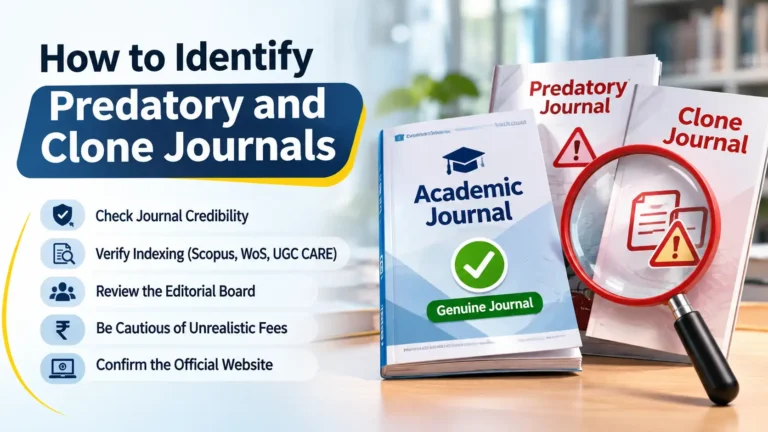
Table of Contents
How to Identify Predatory and Clone Journals? 7 Warning Signs Every Researcher Should Know
Preparing your research paper for submission to an esteemed academic journal? Choosing the publishing journal research is important to maintain academic integrity and respect in research. But several journals, despite being claimed as prestigious and indexed, do not meet scholarly publication standards.
Predatory and clone journals can mislead researchers through false indexation claims, publishing guarantees, impact factor ratings, and even cloned journal sites. Publishing in predatory and clone journals may lead to financial losses, questionable publications, and risks to academic reputation.
Identifying predatory and cloned journals before submitting a manuscript is a key responsibility of the research community, including PhD researchers, research students, professors, and academicians. Professional guidance on journal publication will help researchers prepare their manuscripts.
What Are Predatory and Clone Journals?
Predatory journals are unethical journals that prioritize profit over the integrity of scholarly publishing. They may charge authors APCs without conducting proper peer reviews or exercising appropriate editorial control.
Clone journals are websites that fraudulently imitate authentic journals by duplicating their names, ISSN numbers, logos, publishers, and website designs. They do this to trick scholars into submitting manuscripts through unapproved channels.
Both are risks to researchers, but they use different strategies to trick them. Identifying these differences helps an author verify a journal before submitting a research paper.
What Is the Difference Between Predatory and Clone Journals?
Although both journals use deception in the publication process, they differ in how they do so.
| Comparison | Predatory Journals | Clone Journals |
|---|---|---|
| Identity | Operate as questionable publishing outlets | Impersonate established journals |
| Website | May use their own branding | Copy legitimate journal websites |
| ISSN | May display misleading or questionable details | May misuse an existing journal's ISSN |
| Publishing process | Often lacks proper peer-review standards | May divert submissions and payments |
| Main objective | Generate revenue through questionable publishing practices | Exploit the reputation of legitimate journals |
For Example, a predatory journal may offer publication within three days without any credible peer review. Similarly, a clone journal may imitate the website of a reputable journal indexed in Scopus and offer authors a way to submit manuscripts by paying fees.
In conclusion, scholars should evaluate both the journal’s publishing standards and its authenticity before submitting papers.
7 Warning Signs to Watch Out For
Journals suspected of being predatory need careful examination of their websites, indexing, editing, and communication practices. The seven criteria below can help researchers make well-informed publication choices.
1. Fake Indexing Claims
Some suspicious journals use icons such as Scopus, Web of Science, PubMed, or other indexing services to attract researchers. However, an icon does not guarantee that a journal is indexed.
How to recognize:
- Check the journal name and ISSN in the Scopus Sources database.
- Cross-check coverage in Web of Science using the Master Journal List.
- Confirm that the journal’s indexing status is currently active.
- Check the coverage years rather than relying on the journal’s website.
Researchers can confirm journal indexing independently using the Scopus Sources list and Web of Science’s Master Journal List.
2. Unrealistic Publication Promises
Legitimate academic publications involve editorial screening, peer review, revision, and acceptance. Academic journals that guarantee acceptance or promise rapid publication (within a few days) may not have a proper evaluation process.
The warning signs are:
- Automatic acceptance without a review process.
- Fast publication within 24–72 hours.
- No review comments or revisions needed.
- Instant acceptance upon payment.
Academics need to be aware that each journal has a different publication timeframe.A quick response alone does not indicate misconduct, but guaranteed acceptance requires closer scrutiny.
3. Fake Impact Factors
The impact factor is commonly used to communicate a journal’s impact. But some suspicious publishers may provide unverified scores or metrics to create an appearance of academic legitimacy.
How to identify:
- Verify information about Journal Impact Factors from Clarivate’s Journal Citation Reports.
- Find out whether the claimed index has been formally accepted.
- Do not trust unfamiliar indices if they claim to be equivalent to accepted citation measures.
- Never base the quality assessment of the journal on just one number.
Any legitimate journal measure must necessarily have an identifiable origin.
4. Suspicious Website and Email Addresses
Cloned journals can mimic reputable academic publishing sites by using slightly altered website URLs, copied information, and fake email addresses.
Check for:
- Journal or publisher names misspelled.
- Unusual website domain variations.
- Personal email addresses rather than official institutional/publisher email addresses.
- Inconsistencies in contact information.
- Unofficial submission portals for manuscripts.
Always ensure that the journal you want to access is available from a legitimate publisher’s website. Do not send your manuscript or make payment through emails that you receive unexpectedly.
5. Unclear Editorial Board
A good journal should clearly list the editor-in-chief, editorial board members, institutional affiliations, and academic qualifications.
Some predatory journals may include fake editor profiles, outdated affiliations, or names of researchers who haven’t been asked to be on the board.
Identification criteria:
- Verify editorial board membership using university websites.
- Verify researchers’ publications and profiles.
- Verify the affiliations of institutions.
- Look for discrepancies in the professional information provided.
- Be cautious if editorial board members are not independently verifiable.
A genuine editorial board is an important element of accountability in the journal’s evaluation process.
6. Aggressive Publication Invitations
Unsolicited emails promising rapid publication may also indicate questionable practices in scholarly publishing.
These journals have been known to contact researchers repeatedly regardless of their areas of specialization.
The following are some of the warning signs:
- Repeated emails asking for manuscript submissions.
- Guaranteed publication with discounted prices.
- Invitations not related to the researcher’s field.
- Deadline pressure for submission of the manuscript.
- Immediate payment of APCs required.
Researchers should evaluate the journal independently, without relying on any information in the invitation itself.
7. Clone Journal Websites
Clone journal websites are hard to detect because they often copy the design, title, ISSN, publisher, and articles of legitimate journals.
Fraudsters use these similarities to divert researchers to the wrong submission sites and payment options.
How to detect?
- Check the website domain against the journal’s listed page on the publisher’s website.
- Look up the journal’s ISSNs using the ISSN Portal.
- Check the publisher’s information.
- Ensure that the manuscript submission link is provided on the official website of the journal.
- Check the official publisher if anything seems wrong.
Do not take it for granted just because the name/logo or ISSNs match those of another journal.
BEFORE YOU SUBMIT, ALWAYS VERIFY!
Before sending your paper to any scholarly journal, ensure that you verify these necessary procedures to decrease chances of publishing fraud.
- Go to the journal website: Make sure the journal is on the publisher’s official website.
- Check journal indexing independently: See whether the journal is indexed in Scopus and Web of Science, rather than relying on the indexing logo on the journal’s website.
- Cross-check ISSN and publisher information: Verify the journal’s title, ISSN, and publisher.
- Check peer-review policies and charges: Find out about APCs, review processes, copyright policies, and publication ethics before you submit.
- Don’t believe what the journal says: Verify its editorial board, indexing, publication history, and authenticity independently.
This will help you to avoid any suspicious publishing platform and make the right choice of journals.
How Can Researchers Protect Their Research Publication?
Choosing a journal that is credible goes beyond determining whether the journal is indexed. Researchers are supposed to look at the academic significance of the journal among other factors before submitting manuscripts.
The following are some of the approaches:
- Scope of Journal: Select a journal that publishes research similar to yours, employing a similar methodology.
- Review of Published Articles: Review recent publications to evaluate the quality and relevance of research to the academy.
- Secure research information: Confidential information or unpublished manuscripts should not be shared outside the official submission process.
- Review institutional policies: Make sure the journal you choose will meet your university, research supervisor, or funding agency’s publication requirements.
- Track your publications: Save copies of your submission acknowledgments, editorial correspondence, payment receipts, and acceptance letters.
- Review publication ethics policies: including plagiarism, authorship criteria, and procedures for corrections and retractions.
With the rise of AI content generation and automated publication platforms, it is important that researchers also verify the identity of reviewers and editorial communication processes.
Academic researchers who require help in refining their scholarly papers may use Manuscript Writing Services and Proofreading and Editing Services for language improvement, manuscript structuring, and submission to journals.
Professional Journal Publication Support
It can be difficult for researchers to find an appropriate journal and write a research paper for publication, especially for PhD students and new researchers.
IdeaLaunch helps academic researchers prepare to publish their research papers in the right journals by helping them understand journal policies.
The related services include:
- Journal Publication Services: Help choosing a suitable journal and meeting manuscript submission requirements.
- Manuscript Writing Services: Manuscript writing for academic purposes in relation to research objectives and results.
- Manuscript Formatting Services: Formatting of research manuscripts according to the guidelines of individual journals.
- Proofreading and Editing Services: Making academic papers readable, understandable, and properly formatted.
- PhD Guidance: Research help, manuscript writing, and ethical journal publication services.
Whether you are writing your first research paper or submitting your next manuscript to a journal, understanding publication guidelines is essential.
Conclusion – Choose the Right Journal Before Submitting Your Research
Spotting predatory and cloning journals is a vital duty of any scientist. False indexing claims, unreasonable publication guarantees, suspicious websites, obscure editorial boards, and deceptive ISSNs can indicate problems with such publishers.
Check the following details of the journal before submission: Official website; Indexing; ISSN; Publisher information; and the type of peer review. A reliable publishing process starts with checking facts rather than believing advertisements.
Need help publishing your research? Then IdeaLaunch can offer you guidance on how to publish your research.