

Scopus Journal Search
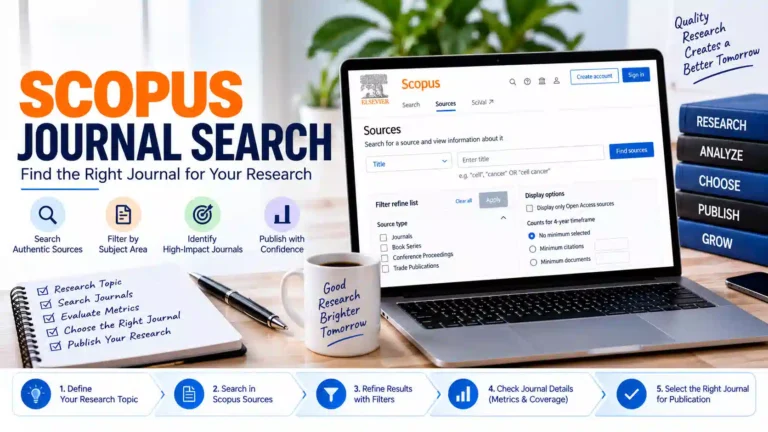
Table of Contents
Searching for Journals in Scopus: Find The Best Journal for Your Research
A Scopus journal search assists researchers in finding journals that are relevant to their research topics, academic needs, and publishing objectives. Nevertheless, choosing a journal cannot be limited to Q1 or Q2 classification only.
Such aspects as the scope of the journal, the Scopus coverage, recent publications, peer review, publishing ethics, and expenses should be taken into account.
The main objective of a Scopus journal search is to select a suitable journal.
What is a Scopus Journal Search?
A Scopus journal search is a process that involves the identification, evaluation, comparison, and verification of journals that are either indexed or covered by Scopus for a specific research manuscript.
The factors that can be compared include:
- Research scope and subject area
- Current Scopus coverage
- ISSN and publisher
- CiteScore and quartile
- Recent publications
- Peer review and publication ethics
- Open-access options and publication charges
Thus, a good Scopus journal search involves several steps:
Research field → Journal Identification → Scope assessment → Indexing verification → Quality assessment → Selecting and submitting to journals
Why is Scopus Journal Search Important for Researchers?
A Scopus journal search assists researchers in finding suitable journals, avoiding inappropriate submissions, and comparing journal options based on scope, indexing, metrics, recent studies, and publication costs.
A Scopus journal search may assist in:
- Finding suitable journals
- Validating Scopus indexing
- Comparing Q1 to Q4 journals
- Analyzing journal metrics
- Examining recent publications
- Avoiding indexing scams
- Checking publication costs
Scopus indexing alone is not sufficient; journal relevance, editing, and research compatibility need to be taken into account.If you are still deciding where your paper belongs, this guide on choosing the right journal for your research explains how fit is judged before metrics are considered.
How does Scopus Journal Search work?
Research Topic → Journal Search → Evaluation of Scope and Metrics → Verification of Indexing → Comparing → Selecting
Researchers are able to conduct a journal search using a journal name, subject, publisher, or ISSN. A similar approach applies when you run a Scopus author search to review where researchers in your field are publishing.
How to Conduct a Scopus Journal Search
1. Start Your Scopus Journal Search with Your Research Topic
Start a Scopus journal search with your research topic rather than
journal rankings. Define:
- Research problem and discipline
- Core keywords
- Methodology and population
- Geographic context
- Theoretical framework
- Expected contribution
In the case of AI ethics in peer review, there is a relation between AI, research ethics, information systems, or scholarly communication. Understanding these relations will help you identify more relevant journals. Much of this clarity comes from the identification of the research problem at the start of your study.
2. Use Relevant Keywords for Your Scopus Journal Search
Make a keyword cluster using your manuscript. The keyword cluster for AI peer review might be:
- Generative AI in academic publishing
- AI-assisted editorial decision-making
- Research integrity and AI
- Automated peer review
- AI governance
Usage of keywords will help you determine journals where similar papers are usually published. You can also test these keywords in the free journal finder tools for research scholars to widen your initial list of options.
3. Filter Out Irrelevant Journals during Your Scopus Journal Search
Apply relevant filters to get rid of irrelevant journals, including:
- Subject area
- Source type
- Open-access status
- CiteScore and percentile
- Quartile
- Publisher
- Journal title
- ISSN
Select only the filters necessary for your publication. Researchers publishing from India often add a regional filter as well and review the current list of Scopus indexed Indian journals in their subject area.
4. Shortlist Journals From Your Scopus Journal Search
Create a shortlist of three to five journals and compare them based on:
| Factor | Check |
|---|---|
| Scope | Strong Research fit |
| Recent Papers | Topic Relevance |
| Quartile | Q1 - Q4 |
| CiteScore | Compare Metrics |
| Indexing | Verify Current Status |
| APC | Check Publication Charges |
| Peer Review | Review Transparancy |
This comparison helps you make a more evidence-based journal selection.
What Should You Check During a Scopus Journal Search?
| Check | What to Evaluate | Evaluation Criteria |
|---|---|---|
| Journal Scope | Aims, scope, and research fit | Research problem, methodology, theoretical framework, population, and geographic context |
| Scopus Indexing Status | Current indexing information | Exact title, ISSN/eISSN, publisher, source details, coverage, and subject category |
| CiteScore and Quartile | Journal-level metrics | CiteScore, percentile, rank, and quartile within the relevant subject category |
| Recent Published Articles | Current research published by the journal | Similar research questions, methodologies, datasets, theories, contexts, and emerging themes |
| Peer-Review & Publication policies | Editorial and ethical standards | Peer-review process, author guidelines, research integrity, retraction, conflicts of interest, and publication ethics |
If your target is a top-quartile title, the requirements for a Q1 journal publication are stricter on all of these points, particularly scope fit and methodological depth.
How to Verify Results From a Scopus Journal Search?
| Verification Check | What to Verify |
|---|---|
| Journal Title & ISSN | Exact title, ISSN/eISSN, publisher, and official website |
| Current Scopus Coverage | Current source information, coverage details, and indexing status |
| Publisher & Editorial Information | Editors, editorial board, affiliations, author guidelines, peer-review process, ethics policies, and contact details |
| Publication Practices | Clear submission procedures and realistic publication claims |
Always check updated information from Scopus rather than following outdated journal lists and websites. A step-by-step walkthrough is available in this guide on how to check Scopus indexed journals. Beware of journals that offer guaranteed acceptance or quick publishing.
How Do You Select the Right Journal from a Scopus Journal Search?
Match the Journal to Your Research Topic
Select journals whose topics, methodologies, target audience, and contributions fit your research. For interdisciplinary research, choose journals that publish interdisciplinary studies. Where the fit is close but the framing is not, manuscript writing support can help you align the paper with the journal’s expectations.
Check Out Your Research Against Recent Journal Articles
Study recent journal articles and make comparisons on:
- Topic and methodology
- Research design and data
- Theoretical base
- Study sample
- Research contribution
Find out whether the journal regularly publishes research articles like yours.
Assess the Journal’s Quality and Relevance
Scope + Recent Articles + Indexing + Metrics + Peer Review + Ethics + Price + Audience
This is a more comprehensive way of selecting a journal than just by the journal’s quartile. These same factors decide how a research paper stands out in high-impact journals once it reaches the editor’s desk.
What Should You Avoid During a Scopus Journal Search?
1. Relying on an Outdated List of Scopus Journals
Coverage in Scopus changes over time. It is important to check the up-to-date information about the source.
2. Believing in Unverified Scopus Claims
One should be careful about such phrases as “Scopus indexed,” “Guaranteed Scopus publication,” and “100% acceptance.”
3. Picking a Journal Based Only on Its Quartile
Do not choose a journal based only on its Q1, Q2, or Q3. The choice should also be
based on scope, relevance, audience, etc.
4. Disregarding the Publication Ethics and Peer-Review Process
It is important to learn more about a journal’s peer-review process, editorial board, ethics, corrections and retractions policies, etc.
Scopus Journal Search Checklist
- Research domain: Does the journal publish research related to your topic?
- Journal’s suitability: Is the manuscript suitable for that journal?
- Current indexing: Have you ensured the journal’s current Scopus indexing?
- ISSN: Do you have an accurate ISSN?
- CiteScore: Is the metric relevant to your comparative analysis?
- Quartile: Does the journal meet your institutional requirement?
- Recent Publications: Are similar studies being published in the journal?
- Peer-Review process: Has the review process been explained clearly?
- Publication Ethics: Do you have information on publication ethics?
- APC: Can you pay the publication charges?
- Open-access requirements: Does the publishing model meet your needs?
- Publisher credibility: Is the information publicly available?
Why Choose IdeaLaunch for Scopus Journal Search?
Choosing the right journal is not only about selecting a Scopus-indexed journal. IdeaLaunch assists researchers in analyzing journals according to their research, publication needs, and submission intentions.
Research-Based Scopus Journal Search
We find appropriate journals taking into consideration the research topic, discipline, methodology, and scope of the manuscript, including support for Scopus indexed journal publication.
Finding Q1/Q2 Journals
If you require a Q1 or Q2 journal, we analyze appropriate subject categories, current statistics, journal scope, and the suitability of the manuscript. We also help researchers who need SCI indexed journals or Web of Science journals for their submission.
PhD Publication Requirements
Our Scopus journal search will take into consideration criteria like indexing, quartile, research field, publication policy, and other institutional guidelines, including university requirements such as UGC CARE list journals.
Manuscript–Journal Suitability Evaluation
Prior to submitting your manuscript, we assist in assessing the compatibility of scope, recently published papers, indexing, journal statistics, publication models, and submission criteria.
Responsible Publishing Practices
We concentrate on accurate data about journals and responsible publication practices rather than on unreal promises of guaranteed acceptance and publication.
For researchers who need support in journal selection or publication planning, IdeaLaunch academic journal publication services could be the practical next step.
Frequently Asked Questions
Scopus journal search refers to the activity of finding, assessing, comparing, and validating relevant journals for a research manuscript.
First of all, determine the research topic and keywords. Search relevant databases, assess the filters in line with the subject and requirements, evaluate the scope and recent papers, validate Scopus status, and make comparisons to develop a list before submission.
You should check the title and ISSN of the journal against current information in Scopus about sources. Look into the publisher, coverage, subject category, and source information. Avoid basing yourself solely on lists published by third parties or claims published on the website of the journal itself.
Compare the potential journal against the research topic, methods, contribution, readership, recent publications, indexing, metrics, peer review policy, ethics, and pricing.
Yes. Scopus assesses the indexed sources and may stop indexing if the journal fails to meet certain criteria. Hence, researchers are advised to check for the indexing status of sources before making any submission.
A reasonable number is between three to five journals. The exact number will depend on several factors including your field of research, publication needs, and the state of your manuscript.
Find the Right Scopus Journal for Your Research
Are you confused about selecting the appropriate journal for your manuscript? Receive journal selection help from experts in your research field, with guidance on your specific topic, indexing, and journal metrics.
Identify suitable journals and take your publication journey forward.