

AI Citations Are Getting Researchers Investigated, Is Your Paper Next?
The Controversy That Changed the Conversation in Indian Academia
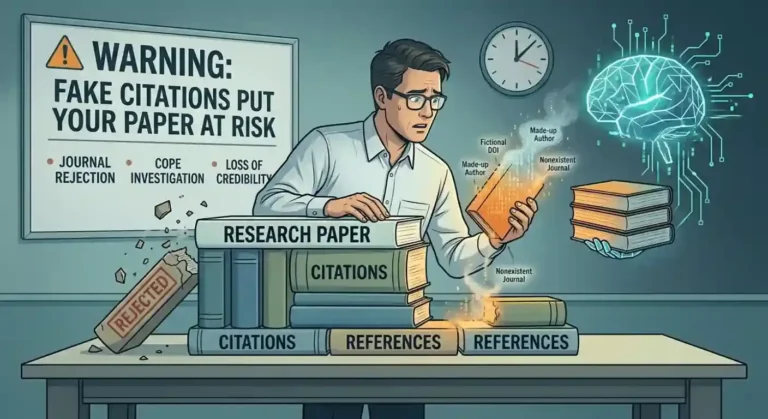
In November 2025, the Springer Nature journal China Population and Development Studies issued an unexpected announcement. They’d started an investigation into one of their papers, in accordance with COPE(Committee on Publication Ethics) guidelines. Researchers from the University of Hong Kong were exposed for including 24 entirely fabricated references that likely didn’t exist and were likely created by AI.
It wasn’t just a small mistake; these weren’t actual papers. Once the news got around, it set off alarm bells in academic communities worldwide. It also got folks in India thinking – could they make the same mistake?
Believe it or not, they already have. Indian PhD students and faculty are just as susceptible to similar issues.
Understanding the Real Scale of the Issue
According to a 2026 study in The Lancet by researchers at Columbia University, after combing through more than 2 million papers and 97 million citations, things look pretty influential.
- In 2023, one in 2,828 papers had made-up references.
- By 2025, it had gotten a whole lot worse, jumping to 1 in 458 papers.
- In the first seven weeks of 2026, it shot up again to one in 277.
That’s a sixfold increase in just three years.
To make matters even more concerning, another study by researchers at Cornell University, UCLA, and UC Berkeley found that about 150,000 fake AI-generated references appeared in research in 2025.
Here’s the kicker: Even top-tier spots like NeurIPS 2025 aren’t spared. Despite its rigorous review standards, GPTZero identified more than 100 phantom citations across 51 of the 4,841 papers accepted by the conference.
So if such references can sneak by at the hands of expert reviewers in elite venues, there’s a good chance they could slip by you, too.
Why This Has Become a Major Concern for India's Research Community.
For researchers in India, what’s at stake goes beyond career advancement; it hits much closer to home. Having a paper published in Scopus-indexed or Web of Science journals isn’t just beneficial—it’s often necessary.
- IITs, central universities, and NAAC-accredited institutions won’t let you complete your PhD viva without at least one Scopus-indexed publication.
- DST fellowships and research grants use Scopus citation counts as a qualifying rule.
- NIRF rankings, looking at more than 674 Indian institutions, also factor in Scopus publications and citations.
- The UGC allows Scopus papers to be considered for faculty promotions and API score calculations.
It’s not just about having your work retracted or being investigated. One mistake can hold up your degree, remove a fellowship, or put a stop to a promotion. When combined with the intense pressure to publish quickly and the widespread use of AI writing tools, it becomes clear how these factors create serious challenges for researchers. They’re trapped in a perfect storm of demands and difficulties.
The Growing Problem of AI-Generated Fake References.
An AI-generated fake citation is basically nonsense info made up by AI tools, like ChatGPT or Gemini, that think they’re helping with your lit review or reference list. These systems can dream up fake citations that sound legit but aren’t.
Academic writers might encounter these bogus entries:
- Fictional journal articles — credible-sounding titles that are pure fantasy.
- Made-up author names — phony scholars attached to nonexistent work.
- DoIS and URLs that go nowhere — either dead ends or pointing at different research entirely.
- Incorrect pub data — actual journals with fake dates, volumes, or pages tacked on.
- Mishandled quotes too — baseless claims tied to sources that lack the claimed info. So, be super careful because these glitches can mess up your work big time.
That’s the scary part – these references seem totally real. They follow the correct formats, include credible journal titles, and even list believable author surnames. A writer pressed for time, or a reviewer dealing with lots of papers, could easily overlook them.Studies show that AI tools produce citations 17% to 33% of the time. This depends on the tool and what you ask it.
How Publishers Are Strengthening Citation Verification
Publishers have moved quickly. Springer Nature, Elsevier, and Wiley are now using automated reference verification tools. These tools check citations against verified databases such as CrossRef, Semantic Scholar, PubMed, and Scopus. They catch dodgy entries during peer review and even after.
What Every Research Author Needs to Know
- Journals review already published papers and sometimes find issues.
- Editors are issuing public corrections and retractions due to unverifiable references.
- The COPE is looking into papers when just a few references are fishy.
- Retractions are becoming more common across top Scopus-indexed journals.
When your paper receives a retraction or an investigation notice, it stays up for everyone to see. Future reviewers, hiring folks, and potential collaborators will spot it. Restoring your reputation after such an incident can be extremely challenging.
The Top 5 Reasons AI-Generated Citations Appear in Research Papers
You might not even notice that AI has slipped a fake citation into your work. Here’s how it typically happens when we audit manuscripts at IdeaLaunch.
- Using AI to write or add to a literature review. These tools confidently produce paragraphs with citations that seem legit, but often aren’t.
- Asking AI to find supporting references for an argument. When you tell it, “Give me three references for this,” it’ll create references that look genuine and properly formatted, but could be totally made up.
- Accepting AI-suggested citations without checking the DOI. Researchers can end up putting non-existent papers straight into their reference managers just by trusting the tool.
- Using AI to update an old reference list is risky too. In one case, an author had ChatGPT update and format their references, which resulted in fake citations being added.
- Using AI to reformat reference lists, even something simple like switching from APA to Vancouver style, can introduce errors, wrong years, or totally fake entries.
The 4-Step Citation Verification Framework
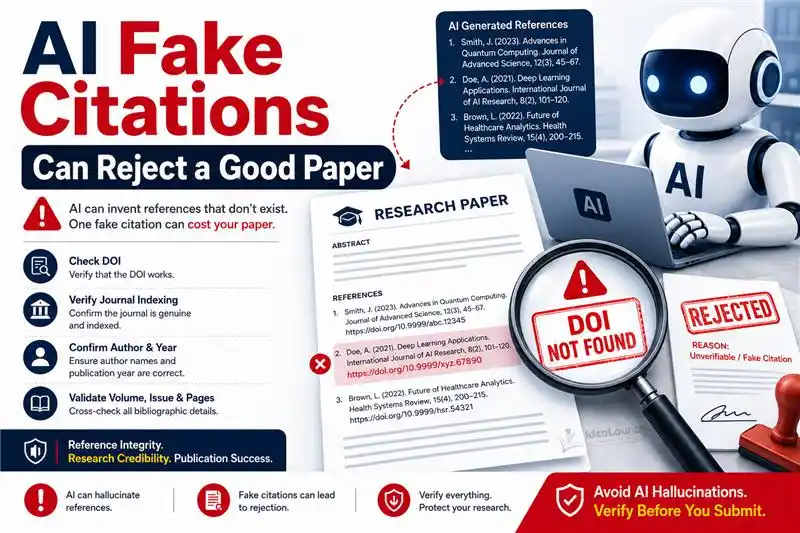
It will be hard to recognize a spoofed citation; it uses an actual author’s name, an appropriate date, an acceptable journal title, and a correctly constructed DOI. There are four basic things to examine before considering a source a spoof.
1.Test the DOI
The first place to go to test a DOI is doi.org. This doesn’t necessarily mean that the citation is a hoax; even the smallest mistake in entering a DOI would render a citation useless, just like it does for the automated systems at CrossRef.
2.Check Journal Citing Services
Check for the journal title through Scopus or Web of Science instead of depending upon its sound. The AI technology is capable of joining valid subject terms to make fake titles of journals.
3.Confirm the Author and the Year
Perform a search on Google Scholar to check if this author ever wrote a research paper in that particular year. It is an old pattern by which the AI combines authors’ names and fake papers.
4.Verify Volume, Issue, and Page Range
Check the real table of contents to find out that this paper is really located on the mentioned page number. This is one of the most obvious indications that an entry has been invented.
Performing these four steps leaves no room for doubt: your references move from being credible enough to a fake citation
Why Self-Checking Is No Longer Enough in the AI Era
You might think, “I’ll check my references myself before submitting.” That’s smart, but it’s tougher than you’d think and easy to do incorrectly, too.
Here Are Some Common Pitfalls to Watch Out For:
- When you search Google instead of a database like Google Scholar, it can show similar-sounding papers that look like the correct citations.
- People often check just the title and don’t verify the author, journal, year, and DOI.
- There’s also the issue of missing paywalled sources; some fake citations look like legit hard-to-access papers.
- We assume journal names must be real, but AI can make up convincing names that seem genuine.
- Time pressure thoroughly auditing 40-60 references takes 3-5 hours of cautious, detailed work.
This isn’t something that gets easier or faster by rushing it. Even one fake citation slipping through could lead to a formal investigation.
The 2026 Pre-Submission Checklist Every Researcher Needs
- Verify each DOI on CrossRef.org.
- Make sure every journal is active and legit.
- Double-check author names against the real publication record.
- Don’t use AI-generated reference lists without manually reviewing them.
- Ensure all in-text citations match their references.
- Format references in the style the journal requires.
- Get a professional citation audit for papers assisted by AI.
The Final Review Before Submission
Academic publishing in 2026 is difficult. Just one fake AI-generated citation can land you in a COPE investigation, stall your PhD, or even cost you years of hard work on a Scopus publication.
That’s why at IdeaLaunch, we check every single DOI, author, and journal in your references against CrossRef, Scopus, and PubMed. Your manuscript is ready to submit, guaranteed within 48–72 hours.
The research is yours, so the credit should be too.
Related Article: https://idealaunch.in/what-is-citation-in-a-research-paper/